
The best first time China itinerary for 10 days is the classic Beijing–Xi’an–Shanghai loop: three nights in Beijing, two in Xi’an, and three in Shanghai, linked by high-speed trains. It gives you the Great Wall, the Terracotta Army, and a world-class skyline without a single rushed day.
Here is the part most guides skip. "10 days visa-free" is not one rule. If you hold a US, Canadian, UK, or Australian passport, your 10 days almost always means the 240-hour visa-free transit window, which requires an onward ticket to a third country and starts its clock at midnight the day after you land. Nationals of many other countries get 30-day visa-free entry with no such catch.
That difference changes how you book your flights. Get it wrong and you can be turned away at the airport. This guide builds a real 10-day plan that fits the visa-free clock, then hands you the exact trains, prices, and passport rules to pull it off.
Key Takeaways
- The 240-hour (10-day) visa-free transit needs a confirmed onward ticket to a third country or region (Seoul, Tokyo, and Hong Kong all count) — a round trip home does not qualify.
- Book Beijing → Xi’an (about 4.5–6 hours) and Xi’an → Shanghai (about 6–7 hours) as second-class G-train seats; expect roughly ¥515 and ¥670 respectively.
- The Forbidden City (¥60 peak), Terracotta Army (¥120), and most big sites need a real-name passport reservation up to 7 days ahead and are closed to walk-ins.
- Set up Alipay or WeChat Pay with a foreign Visa/Mastercard before you fly — cash is now rare and many counters no longer take it smoothly.
- Spring (April–May) and autumn (September–October) bring mild weather across all three cities and thinner crowds than summer.
How the 10-day visa-free clock actually works
Two separate policies let you spend 10 days in China without a visa. Knowing which one applies to you is step one of the whole trip.
The 240-hour visa-free transit covers 55 nationalities, including the United States, Canada, the UK, Australia, and most of Europe. You must be passing through China to a third country. So your route has to look like Home → China → Somewhere Else, not Home → China → Home.
The 30-day unilateral visa-free policy covers a wide list of countries whose citizens can simply fly in, tour, and fly home. If your passport is on that list, you can ignore the transit rules entirely and stay up to 30 days.
Here is the comparison that trips up first-timers:
| Feature | 240-hour transit | 30-day visa-free entry |
|---|---|---|
| Who it’s for | US, Canada, UK, Australia + 51 more | Many EU, Asian & other nationals |
| Max stay | 240 hours (10 full days) | 30 days |
| Onward third-country ticket | Required | Not required |
| Round trip home allowed | No | Yes |
| Regions | 24 provinces/cities (not Tibet, Xinjiang) | Nationwide |
Beijing, Xi’an, and Shanghai all sit inside the 240-hour zone, so this itinerary works under either policy.
Take Jake, a first-timer from Chicago. He booked Chicago → Beijing, then Shanghai → Seoul → Chicago. That Shanghai-to-Seoul leg is his "onward third-country ticket," which satisfies the transit rule and lets him fly home the cheap way through Korea.
The 240-hour clock starts at 00:00 Beijing time on the day after you arrive. Land at 2pm on a Monday and you have until midnight ten days later. If you are unsure which policy fits your passport, our visa and entry guide breaks down every scenario, and the official 240-hour transit explainer walks through the paperwork.
Your day-by-day china itinerary for 10 days

This is a comfortable pace, not a forced march. You get full days in each city plus travel days that still leave time to explore.
Days 1–3: Beijing. Arrive and settle. Day two is the Great Wall — Mutianyu is the smart first-timer pick, with a cable car up and a toboggan down. Day three covers Tiananmen Square, the Forbidden City, and a walk through the Jingshan Park hilltop for the classic rooftop view. Add a Temple of Heaven morning or a hutong lunch if you have energy.
Days 4–5: Xi’an. Take a mid-morning bullet train south. Spend the afternoon on the Ancient City Wall (rent a bike and ride the full loop) and eat your way through the Muslim Quarter at night. Day five is the Terracotta Army, an easy half-day trip east of the city.
Days 6–8: Shanghai. Ride the train east to Shanghai. Walk the Bund at dusk when the Pudong skyline lights up. Spend a full day between Yu Garden, the old town, and the leafy French Concession. Use day eight for Zhujiajiao water town or a fast day trip to Suzhou.
Days 9–10: Buffer and fly out. Keep day nine loose for anything you missed — a museum, a food street, last shopping. Fly out on day ten (to your third country if you’re on the transit policy).
Meet Priya and Tom from Manchester. They swapped the day-eight Suzhou trip for a lazy morning at Tianzifang and a Huangpu River cruise, and said the unscheduled afternoon was the highlight of the whole trip. Build in slack — you’ll want it. For more route options and timing help, browse our itineraries and timing hub.
Getting between cities: high-speed trains, not flights
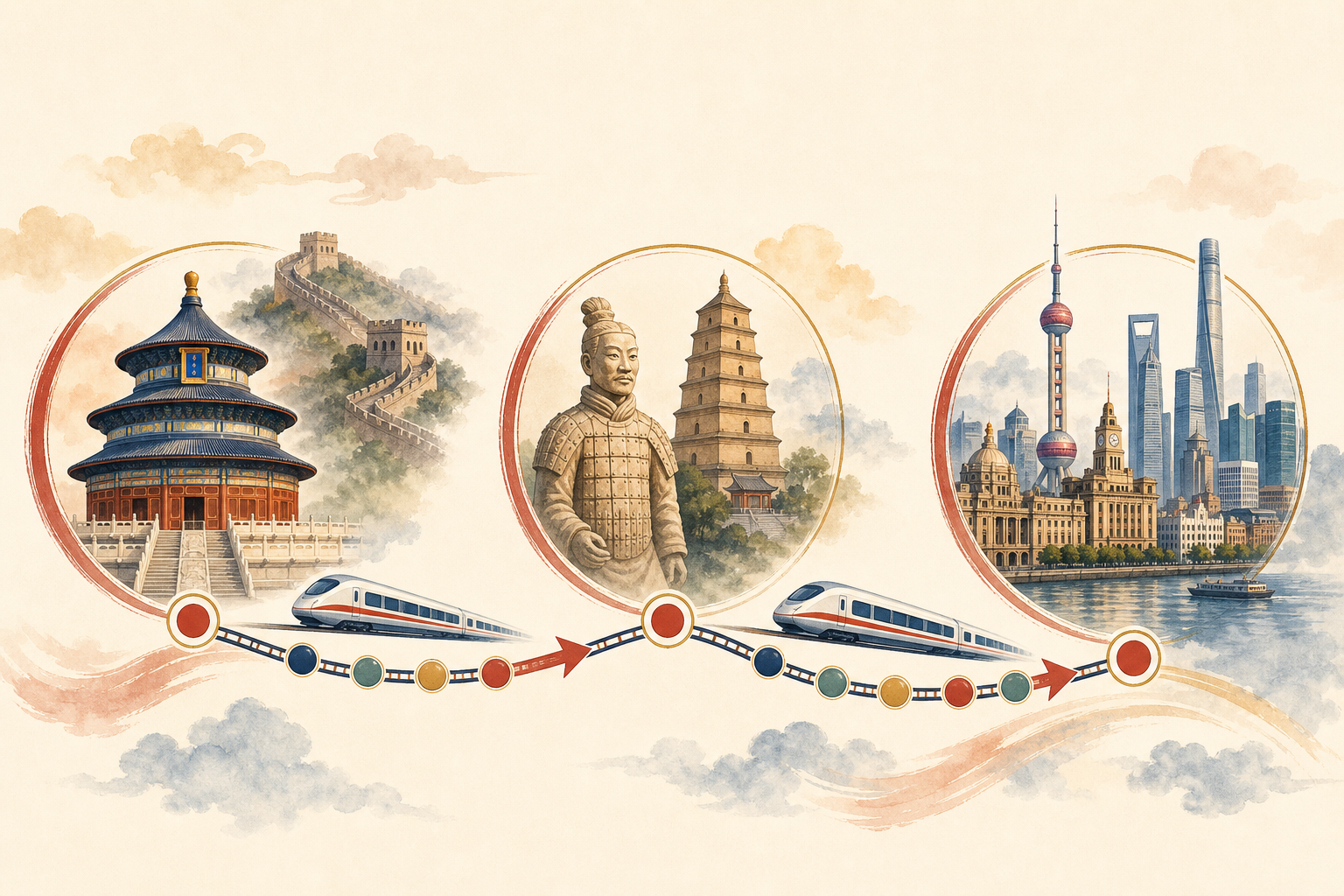
China’s bullet trains beat domestic flights for these three cities. Stations sit closer to the center, there’s no long security wait, and you watch the countryside roll by at 300 km/h.
Here are the routes you’ll book, with current 2026 second-class fares:
| Route | Fastest time | Second-class fare | Trains/day |
|---|---|---|---|
| Beijing → Xi’an | ~4.5 hrs | ¥470–577 | 20+ |
| Xi’an → Shanghai | ~6 hrs | ~¥670 | 20+ |
| Beijing → Shanghai (direct) | ~4.5 hrs | ¥553–673 | 40+ |
Note one 2026 change: some Beijing–Shanghai high-speed fares rose about 20% from late May 2026, so check the live price when you book rather than trusting old figures.
Book seats a few days out, especially around the October holiday. Second class is clean, comfortable, and fine for these distances — first class rarely earns its premium. You’ll need your passport to buy tickets and to pass the station gate, and your name on the ticket must match your passport exactly.
Don’t want to fight a Chinese-language booking app? We handle the whole thing for you. Get a free quote and English-language support at our train ticket booking service, or learn the DIY route in our step-by-step guide on how to book China high-speed train tickets.
Booking attractions: passport reservations you must do early
This is the single biggest mistake first-timers make. China’s top sites do not sell walk-up tickets. You reserve online, tied to your passport number, days in advance — and popular slots sell out.
Here’s what the flagship sites cost and how far ahead to book in 2026:
| Attraction | City | Ticket | Book ahead | Closed |
|---|---|---|---|---|
| Forbidden City | Beijing | ¥60 peak / ¥40 low | Up to 7 days | Mondays |
| Terracotta Army | Xi’an | ¥120 | Up to 7 days | Open daily |
| Mutianyu Great Wall | Beijing | ~¥40 + cable car | 1–2 days | Open daily |
| Yu Garden | Shanghai | ~¥40 | Same week | Open daily |
The Forbidden City caps entry at 40,000 people a day, sells no same-day tickets, and closes Mondays — so a Monday Beijing day should go to the Great Wall, not the palace. The Terracotta Army opens 8:30am and needs your original passport at the gate.
For each reservation you’ll enter your passport details exactly as printed. Screenshot every confirmation. See the official Palace Museum ticketing site for the Forbidden City and the Terracotta Army museum’s official ticket page for the warriors. To go deeper on what to prioritize, our attractions guide ranks the must-sees by city.
Money, internet, and the small stuff that stresses first-timers
China runs on QR-code payments. Cash and foreign cards are awkward almost everywhere, so the fix is simple: install Alipay or WeChat Pay before you fly and link a foreign Visa or Mastercard.
As of 2026, you don’t need a Chinese bank account or phone number. Verify with a passport photo — it’s mostly automated and takes about ten minutes. The single-transaction limit for verified foreign users now runs up to about ¥35,000, which is plenty for any trip. Set up both apps if you can; Alipay tends to be smoother for travelers. Our Alipay setup guide for foreigners walks through every screen.
For internet, buy a travel eSIM before departure or plan to use a VPN, since Google, WhatsApp, and Instagram are blocked on local networks. Details live in our connectivity guide.
A few more first-timer wins: carry your passport everywhere (hotels and sites check it), download offline maps, and save your hotel address in Chinese to show taxi drivers. If you want help locking in well-located rooms near the train stations, see our hotels page, and keep the medical care guide bookmarked just in case.
Frequently asked questions
Can I really see China in 10 days as a first-timer?
Yes. Ten days is the sweet spot for Beijing, Xi’an, and Shanghai at a relaxed pace. You get the Great Wall, the Terracotta Army, and Shanghai’s skyline with buffer time built in. Trying to add a fourth far-flung city is where trips start to feel rushed.
Does the 240-hour visa-free transit let me fly home directly?
No. Transit means you must continue to a third country or region, not back to your origin. A common fix is flying home via Seoul, Tokyo, Bangkok, or Hong Kong. That onward ticket is what makes you eligible, so book it before you arrive.
Should I take trains or flights between the three cities?
Take the high-speed trains. Stations are central, there’s no long airport security line, and second-class seats cost ¥470–673 with frequent departures. Flights only make sense for much longer distances than Beijing, Xi’an, and Shanghai.
How far ahead do I need to book the Forbidden City and Terracotta Army?
Reserve both up to 7 days ahead using your passport number. Neither sells same-day tickets, and the Forbidden City caps daily entry at 40,000 and closes Mondays. Popular slots sell out in peak season, so book the moment your dates are set.
What’s the best time of year for this trip?
Spring (April–May) and autumn (September–October) bring mild weather across all three cities and thinner crowds than summer. Avoid the first week of October, China’s National Day holiday, when domestic travel and ticket demand spike sharply.
Do I need cash in China in 2026?
Barely. Alipay and WeChat Pay with a linked foreign card cover almost everything, from street food to train tickets. Carry a little cash as a backup for tiny rural vendors, but you’ll rarely reach for it in Beijing, Xi’an, or Shanghai.
Before you go: your action checklist
Do these in order and you’ll land relaxed:
- Confirm your visa-free path — check whether you’re on the 240-hour transit list or the 30-day list, and book an onward third-country ticket if you need one.
- Book your two trains — Beijing → Xi’an and Xi’an → Shanghai, second-class, once your dates are firm.
- Reserve big sites — Forbidden City and Terracotta Army by passport, up to 7 days ahead; screenshot every confirmation.
- Set up payments — install Alipay or WeChat Pay and link a foreign card before you fly.
- Sort connectivity — buy a travel eSIM or set up a VPN so your apps still work.
Ready to lock in the trains that hold this whole itinerary together? Skip the Chinese-only apps and let our English-speaking team book every seat for you. Get your free train ticket quote here and start your 10 days in China the easy way.
Featured image: “Xian, Terracotta Army (6170329474).jpg” by Arian Zwegers from Brussels, Belgium, via Wikimedia Commons, CC BY 2.0.