
Before a domestic flight in mainland China, check the power bank itself: a clear CCC/3C mark, readable capacity information, and a model and batch that are not recalled. Then read the operating airline’s current limits. A familiar brand, a small size or approval on your flight into China does not settle the rules for the next flight.
Source-based guide checked on 27 October 2026. No security screening or product testing is claimed. Airline instructions and airport security decisions apply to the device you actually carry.
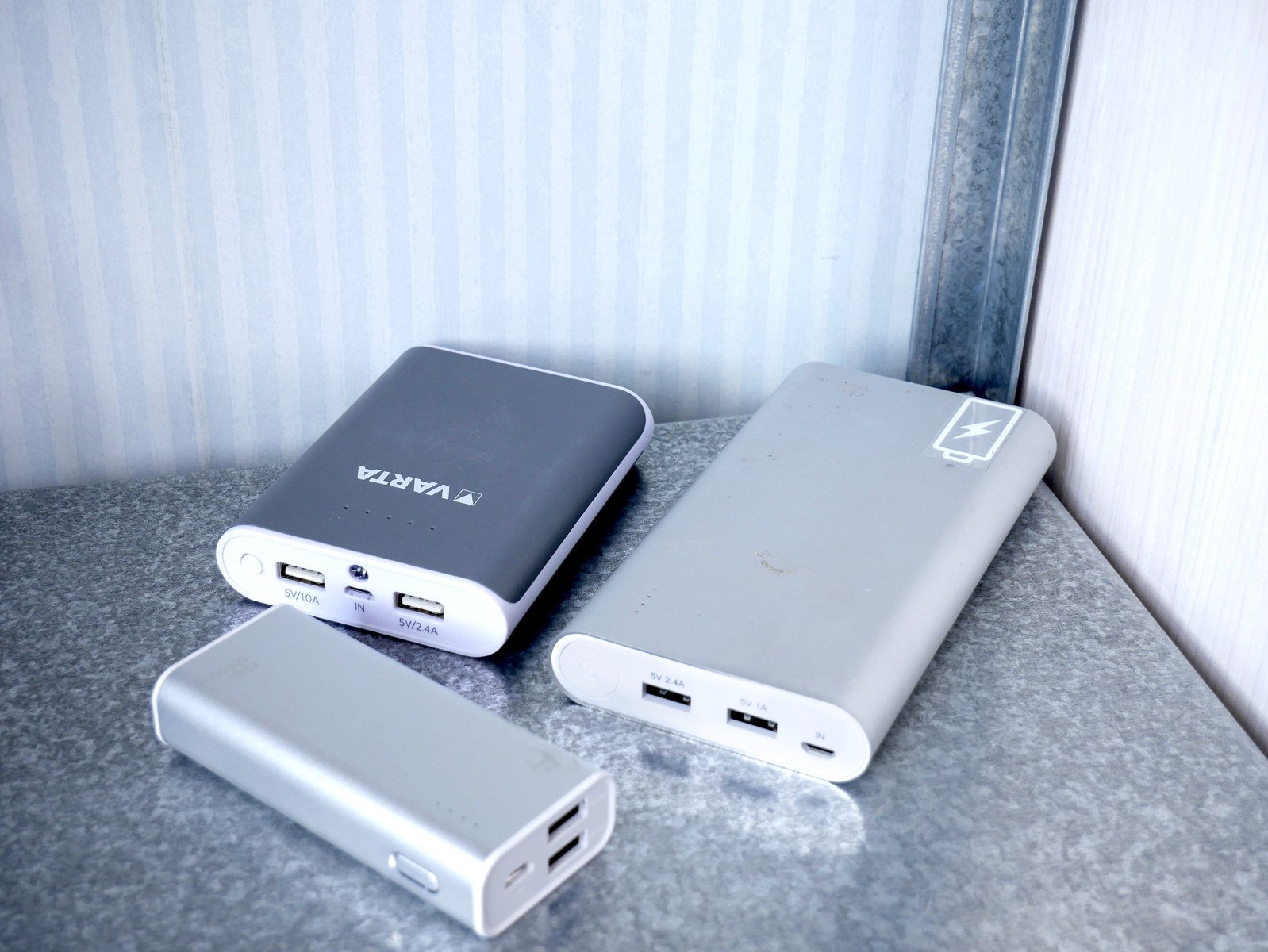
Portable power banks, photographed on 10 April 2018. Archival equipment photo; the pictured products are not recommendations or evidence of current flight compliance. Photo: Santeri Viinamäki. Source · CC BY-SA 4.0. Resized and JPEG encoded; no crop.
Start with the domestic flight on your itinerary
The domestic-flight rule described in China Eastern’s lithium-battery guidance excludes power banks with no 3C mark, an unclear mark, or a recalled model or batch, effective 28 June 2025. Treat certification, capacity and recall status as separate checks: passing one does not replace the others.
Look through every flight segment before packing. If an international itinerary includes a mainland domestic flight, prepare for that domestic segment as well. For other routes, ask the operating carrier which conditions apply; do not extend a rule labelled domestic into a guarantee about all international flights.
Our China packing list covers the rest of your departure preparation. This guide focuses on the battery decision.
Read the label before comparing capacity
Put the device on a table in good light. Find the manufacturer, exact model, rated energy in watt-hours, and certification marking. Check whether a protective case or sticker hides the original label. If the information is worn away or cannot be established, contact the manufacturer and carrier before taking it to the airport.
A product advertised as “20,000 mAh” still needs a readable energy specification. Do not use a rough conversion to rescue an unidentifiable battery, and do not confuse charging output in watts with stored energy in watt-hours. A “100 W” fast-charging claim is not a “100 Wh” capacity label.
For example, Air China’s notice dated 4 August 2026 permits no more than two power banks per passenger. It sets 100 Wh as the threshold below which its approval is unnecessary; above 100 Wh and up to 160 Wh requires its approval. More than 160 Wh is outside its permitted power-bank limit. These are Air China’s stated conditions, not permission from every carrier.
If your device falls into an approval category, contact the operating airline before departure and retain its response. A seller’s “airline approved” badge is not approval for your booking.
Check the exact model and recall batch
Compare the manufacturer and model on the physical device with the manufacturer’s current recall notice. Where a recall identifies serial numbers, production dates or batches, match those details too. A similar-looking product photograph is not enough.
China Eastern directs passengers to the Consumer Product Recalls section of the SAMR Defective Product Recall Technical Center. If a notice and your label cannot be matched confidently, ask the manufacturer for clarification. Do not assume a different capacity or colour automatically puts your unit outside the affected batch.
Leave a swollen, cracked, deformed or otherwise suspect unit out of your travel bag. Air China’s notice expressly prohibits damaged and recalled units and devices whose required specifications cannot be confirmed. Seek the manufacturer’s safe handling instructions rather than trying to repair, relabel or discharge a damaged battery for travel.
Pack for the cabin and for the time onboard
China Eastern’s current instructions require power banks in carry-on baggage and prohibit both using them to power a device and recharging them from aircraft power. They must not go in overhead bins; the airline identifies under-seat baggage or another designated location such as a seat-back pocket. Keep an available power switch off and follow crew directions.
The practical packing implication is simple: make the power bank easy to find without emptying your bag. Keep it protected against accidental activation and short circuits. Avoid placing it loose with keys, coins or other metal objects.
If staff take a cabin bag for hold loading, tell them it contains a power bank and follow instructions about removing it. Do not leave it inside merely because the bag began the journey as carry-on luggage.
Air China’s August notice also prohibits onboard use, recharging and overhead-bin storage. Recheck your own carrier rather than relying on an old article that allows in-flight charging.
If the device does not pass your checks
Resolve this before leaving for the airport where possible. Your options may include leaving the device at home, obtaining a compliant replacement from a reputable source, or planning to use fixed charging facilities. Check any replacement just as carefully as the original; a new purchase is not automatic proof of acceptance.
Do not assume security will store a rejected item, arrange delivery or provide a replacement. Ask staff what options actually exist at that airport. Moving it into checked baggage does not solve the cabin-only restriction.
Prepare a phone-independent fallback: save your hotel address and essential confirmations offline, carry a printed arrival note if useful, and travel with the correct cable and mains charger. The China plug and voltage guide explains a different issue: connecting a charger to a socket, rather than permission to carry a battery.
Your final pre-flight check
- Every operating airline and domestic segment has been checked.
- The device’s model, energy rating and clear 3C mark can be read.
- The exact unit has been checked against relevant recalls.
- Any required airline approval has been obtained.
- The device is protected, accessible and packed for the cabin.
- You know your airline’s onboard use and storage restrictions.
If one answer remains uncertain, settle it with the carrier or manufacturer before packing. This checklist helps you ask the right questions; it does not certify a particular power bank.