
You need a China power plug adapter that fits the Type I socket, because that three-pin angled outlet is the one your Type A, Type C, or UK plug will not slide into on its own. Mainland China runs on 220 volts at 50 hertz, and its wall sockets accept Type A, Type C, and Type I plugs.
Here is the part most guides get wrong. Newer Chinese hotels install a single "universal" socket that already swallows flat American pins and round European pins. So a first-time visitor often plugs in a phone charger with no adapter at all and assumes everyone is fooling them.
That works until you meet an older socket, or you carry a British, Irish, or South African plug. Then you are stuck.
This guide covers the exact adapter to pack, whether your device survives 220V, and a 2026 rule change that catches thousands of travelers at the airport: China now confiscates power banks without a proper certification mark before you board a domestic flight.
Key Takeaways
- China uses 220V / 50Hz and sockets accept Type A, C, and I plugs.
- The only plug that never fits a bare Chinese socket is the Type I three-pin angled plug, so a universal adapter is the safe buy.
- Most phone, laptop, and camera chargers are dual-voltage (marked "100-240V") and need only a plug adapter, not a converter.
- A 1200W hair dryer from the US will burn out or trip the breaker on 220V unless it is switchable.
- Since 2025, power banks without a CCC / 3C mark are seized at Chinese airports, even under 100Wh.
China plug type: what the sockets actually look like
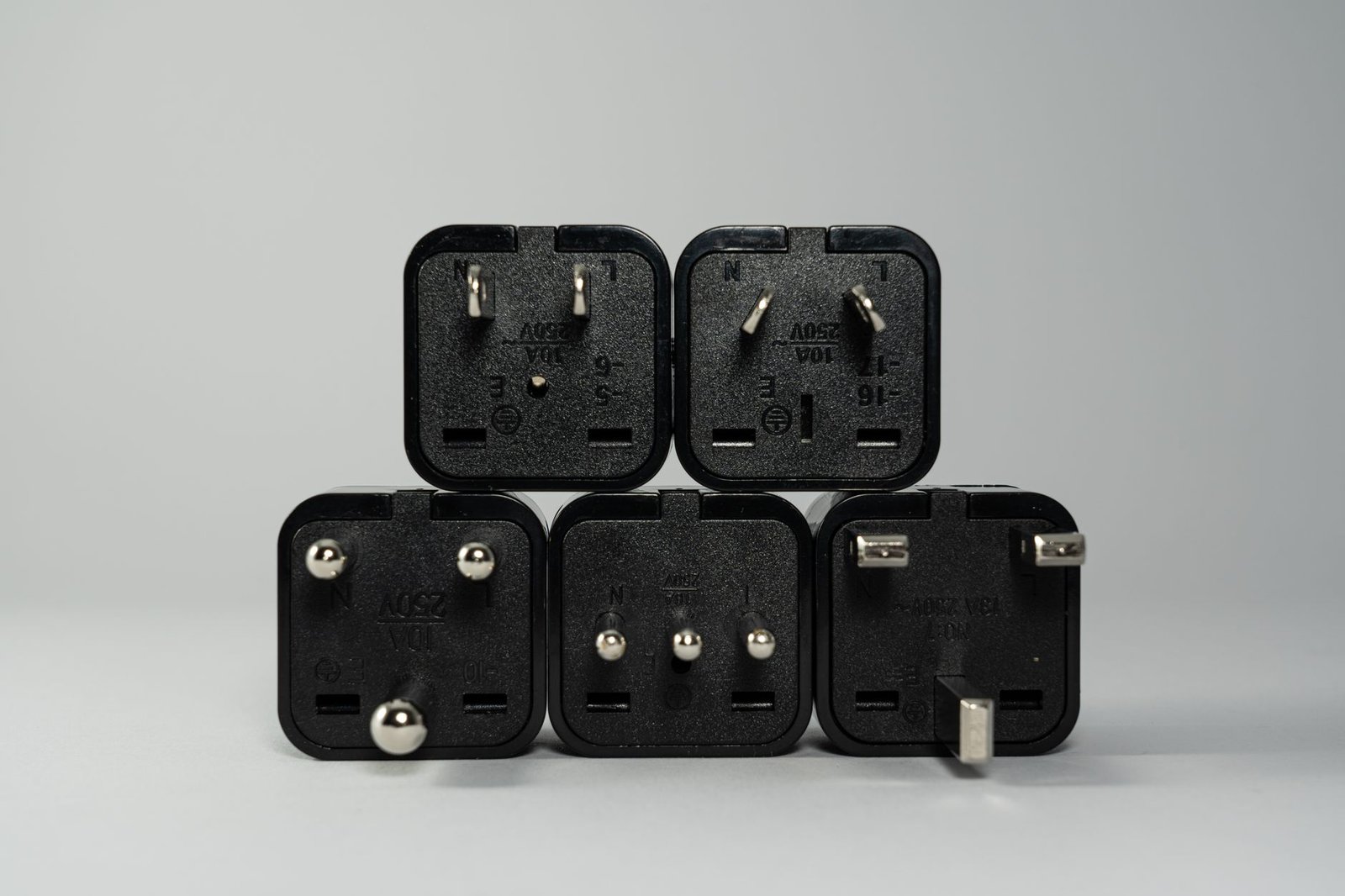
Walk into any Chinese hotel room and you will see one of two socket faces. Both are worth recognizing before you arrive.
The classic socket has a lower slot shaped like an upside-down V with a straight pin below it. That is the Type I outlet, the same three-pin shape Australia and New Zealand use. Above it sits a smaller slot for flat American-style (Type A) or round European (Type C) pins.
The newer "universal" power point China installs everywhere in hotels built after roughly 2015 combines everything into one opening. It accepts flat pins, round pins, and the angled Type I pins from a single face.
| Plug type | Pin shape | Fits bare Chinese socket? | Common on devices from |
|---|---|---|---|
| Type A | 2 flat parallel pins | Yes | USA, Canada, Japan |
| Type C | 2 round pins | Yes | Europe, most of Asia |
| Type I | 2 angled + 1 straight pin | Yes | Australia, New Zealand, China |
| Type G | 3 large rectangular pins | No | UK, Ireland, Hong Kong, Singapore |
| Type M | 3 large round pins | No | South Africa |
The takeaway is simple. If your plug is American, European, Japanese, or Australian, it may fit a Chinese socket directly. If it is British, Irish, South African, or from Hong Kong or Singapore, it will not, and you must bring an adapter.
Do you need a China power plug adapter, or not?
The honest answer is that you probably do, even if some of your gear fits without one.
James, a software engineer from Manchester, assumed his hotel had UK sockets because his colleague raved about how "modern" Shanghai felt. His three-pin British charger fit nothing. He spent his first night hunting a convenience store instead of sleeping off jet lag.
Buy one good universal travel adapter and the problem disappears. A universal adapter covers the Type I socket that trips up Australians using an old plug, and it covers British and South African travelers whose plugs never fit at all.
Skip the adapter only if every plug you own is Type A or Type C and you are staying in newer hotels with universal sockets. That is a lot of ifs for a nervous first trip.
One more tip. Chinese sockets often sit close together, and a bulky adapter can block the neighboring outlet. A slim model with its own USB ports lets you charge a phone, a watch, and a laptop from one wall socket.
Voltage in China: will your device survive 220V?
This is the question that actually damages equipment, so read it twice.
China supplies 220 volts at 50 hertz. The United States, Canada, and Japan run on 100 to 120 volts. Plug a single-voltage 120V device straight into a Chinese wall and you can fry it, smell burning plastic, or trip the breaker.
Before you pack anything, read the tiny print on the charger or the device itself. Look for the input rating.
- If it says "INPUT: 100-240V, 50/60Hz", the device is dual-voltage. It handles China fine with just a plug adapter.
- If it says only "120V" or "110V", it is single-voltage and needs a voltage converter, not just an adapter.
Almost every modern phone charger, laptop brick, tablet, camera charger, and electric shaver is dual-voltage. You can leave the converter at home for those.
The devices that get people are heating appliances: hair dryers, curling irons, straighteners, travel kettles, and some electric toothbrush chargers. These often draw 1000 to 1875 watts and are single-voltage. A US hair dryer on 220V is a genuine fire risk.
The clean fix is to buy a cheap dual-voltage travel hair dryer, or use the one already mounted in most mid-range and up Chinese hotel bathrooms. Do not try to run a full-size US dryer through a small travel converter. Those converters are rated for a few hundred watts and will overheat.
Adapter vs. converter: two different tools
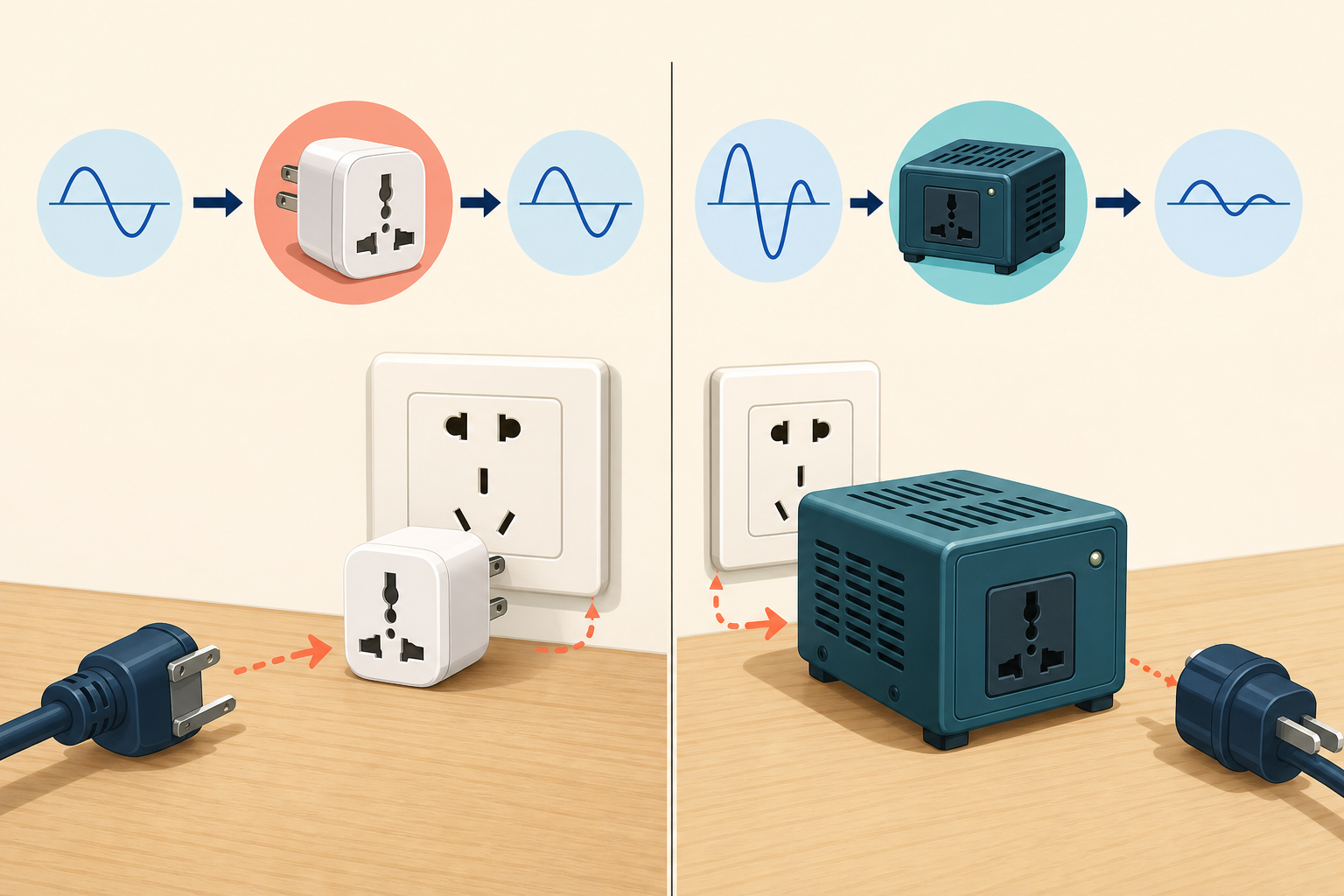
People blur these two words and buy the wrong thing, so here is the plain difference.
A plug adapter only changes the shape of the pins so your plug fits the wall. It does nothing to the electricity itself.
A voltage converter (also called a transformer) actually steps 220V down to 110V so a single-voltage device does not burn out.
| Your device | What it needs in China |
|---|---|
| Phone, laptop, tablet, camera (dual-voltage) | Plug adapter only |
| US hair dryer, curling iron (single-voltage, high wattage) | Converter, or buy a local dual-voltage one |
| Electric shaver, toothbrush (usually dual-voltage) | Plug adapter only, but check the print |
Priya, a photographer from Los Angeles, packed a heavy step-down converter "just in case" and never took it out of her suitcase. Every charger she owned already read 100-240V. She carried three extra pounds across the country for nothing.
Check your labels first. Most travelers need only a lightweight plug adapter.
USB charging: the easiest path
For phones, tablets, watches, and cameras, the simplest setup skips wall plugs almost entirely.
Bring one compact multi-port USB charger, ideally a GaN charger with two or three USB-C ports and one USB-A port. Fit a single Type I plug adapter to it, and you charge every small device from one socket.
USB ports are also common in the field. Newer hotels, high-speed trains, airport gate areas, coffee shops, and many long-distance buses now have USB-A or USB-C ports built into seats and desks. On a high-speed train, most seats have a standard socket, and many newer carriages add USB ports at seat level. For more on getting around, see our guide to trains and metro travel in China.
Do not rely on public USB ports for a full charge, though. They are handy top-ups, not a substitute for your own charger and a wall socket at night.
The 2026 power bank rule that catches travelers
This is the single fact most plug guides still miss, and it can strand you at a boarding gate.
Since mid-2025, the Civil Aviation Administration of China (CAAC) bans power banks that do not carry a valid CCC mark (China Compulsory Certification, also called the 3C mark) from domestic flights. Security will confiscate uncertified power banks at the checkpoint, and most units bought outside China do not have the mark.
The capacity rules still apply on top of that. Power banks up to 100Wh are allowed in carry-on with no approval. Between 100Wh and 160Wh, you need airline approval. Above 160Wh, they are banned. Power banks must always go in your carry-on, never checked luggage.
To find your Watt-hours, multiply the mAh rating by 3.7, then divide by 1000. A 20,000mAh bank is about 74Wh, which is under the limit.
High-speed trains are more relaxed. Power banks up to 100Wh are allowed, and per official Beijing government guidance, the CCC label is currently not checked at rail security the way it is at airports. Still, keep the rating visible on the label.
Lena, a student from Berlin, had her uncertified 26,000mAh power bank taken at Chengdu airport before a domestic hop to Xi’an. She bought a CCC-marked one for about 120 yuan in a departures shop and made the flight. Budget for that possibility if you plan to fly within China.
Frequently asked questions
What plug adapter do I need for China?
A universal travel adapter that covers the Type I (three angled pins) socket is the safest choice. If all your plugs are Type A or Type C, they often fit Chinese sockets directly, but a universal adapter also handles UK, Irish, and South African plugs that never fit.
Can I use my US charger in China?
Yes, if it is dual-voltage. Read the label. A charger marked "INPUT: 100-240V" works on China’s 220V with only a plug adapter. A single-voltage 120V device, like many US hair dryers, needs a voltage converter or you risk damaging it.
Is China 110V or 220V?
Mainland China is 220 volts at 50 hertz, not the 110 to 120V used in the US, Canada, and Japan. Confirm your device says "100-240V" before plugging in, or use a voltage converter for single-voltage electronics.
Do Chinese hotels provide adapters or hair dryers?
Many mid-range and higher hotels have wall-mounted hair dryers and can lend a plug adapter at the front desk, though supply runs out fast. Do not count on it. Bring your own adapter and check hotel amenities when you book your rooms.
Can I bring a power bank to China?
Yes, up to 100Wh in carry-on with no approval. For domestic flights, it must carry a CCC (3C) mark or airport security will confiscate it. Trains are more relaxed and do not currently check the mark. Never pack a power bank in checked luggage.
Does an Australian plug work in China?
Often yes, because both use the Type I shape. Pin dimensions vary slightly, so an old or worn Australian plug can fit loosely. Bring a proper adapter as a backup, and check whether your device is single or dual-voltage before plugging in.
Before you go: your power checklist
Sort your electronics a week before departure, not at the gate.
- Read every charger label for "100-240V." Dual-voltage means a plug adapter is all you need.
- Pack one universal travel adapter, ideally with built-in USB-C and USB-A ports.
- Leave single-voltage hair dryers and irons at home. Use the hotel’s or buy a cheap dual-voltage travel model.
- Check your power bank for a CCC / 3C mark and confirm it is under 100Wh before any domestic flight.
- Bring one GaN multi-port USB charger so all your small devices share a single socket.
Sort your power gear once and you never think about it again. What is worth planning early is your route, because train seats and berths sell out fast on popular lines.
Let us handle the hard part. Get a free quote and book your China train tickets so your seats are locked in before you land, and read up on staying connected with an eSIM and VPN and paying for everything with Alipay so your phone stays charged and useful from the moment you arrive.
Sources: Civil Aviation Administration of China (CAAC), Beijing Municipal Government official guidance on power banks on trains, and the International Electrotechnical Commission (IEC) World Plugs.
Featured image: “IEC Plug Type I.svg” by BlankMap-World6.svg : Canuckguy ( talk ) and many others (see File history) derivative work: Wiljahelmaz, via Wikimedia Commons, Public domain.