
The Qin bronze chariots sit in the same museum complex as the terracotta army in Xi’an, and one standard 120 RMB ticket gets you into both. Most visitors rush the warrior pits and skip the two half-size bronze carriages entirely. That is a mistake.
The chariots are the finest bronzework to survive from ancient China, cast around 210 BC and buried beside the First Emperor’s tomb. Each one has more than 3,400 separate parts. You can see the reins, the umbrella, the tiny bronze knots, and the painted patterns up close, behind glass, in a quiet hall away from the crowds.
This guide covers what to see, how to buy tickets in 2026, how to get there from central Xi’an, and the exact hours to arrive so you are not fighting a wall of tour groups. It is written for a first-time visitor who has never navigated a Chinese ticket app or a Lintong bus. By the end you will know exactly what to book, when to show up, and how to spend your two hours on site.
Key Takeaways
- One ticket (about 120 RMB) covers the terracotta army pits, the bronze chariots hall, and the Lishan Garden tomb mound.
- The two bronze chariots are half life-size, have roughly 3,462 parts each, and were unearthed in December 1980 west of the tomb mound.
- You must book online in advance with your real passport number; no paper tickets are sold at the gate.
- Arrive at 8:15 AM or after 3:30 PM to dodge the 10:30 AM–2:30 PM tour-bus crush.
- The fastest route from downtown is Metro Line 9 to Huaqing Pool, then a short local bus; a high-speed train to Lintong takes about 19 minutes.
What are the Qin bronze chariots and terracotta army?
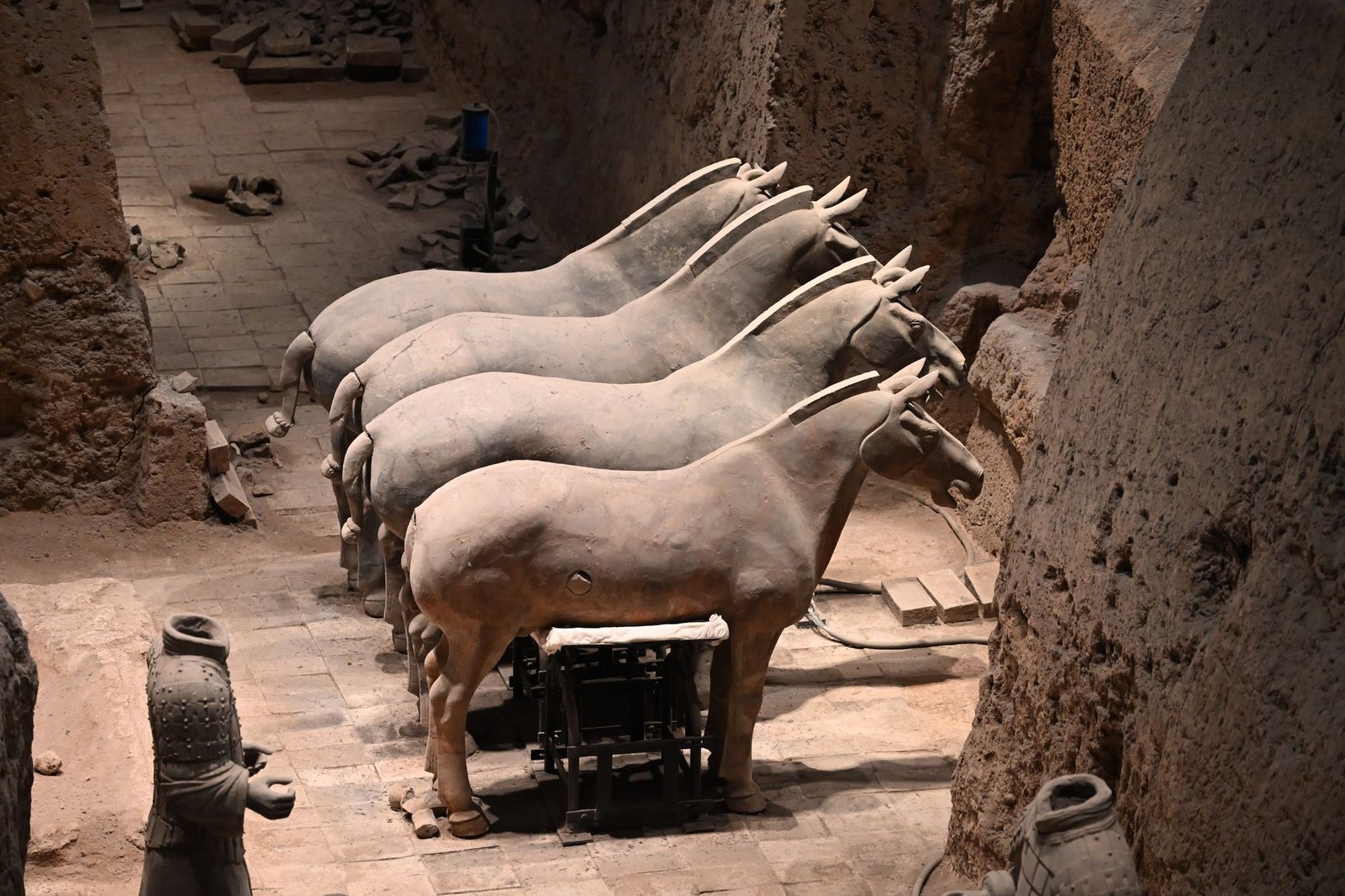
In 1974, farmers digging a well near Xi’an struck a life-size clay head. That accident revealed the terracotta army: thousands of soldiers, horses, and chariots buried to guard Qin Shi Huang, China’s First Emperor, in the afterlife.
The whole site is the Mausoleum of the First Qin Emperor, named a UNESCO World Heritage Site in 1987. Three main pits hold the clay warriors. Pit 1 is the giant one you see in photos, with columns of infantry marching in formation.
The bronze chariots are a separate treasure. In December 1980, archaeologists found two of them about 20 meters west of the tomb mound, packed in a wooden coffin that had rotted and collapsed. Each chariot was smashed into thousands of fragments and took years to rebuild.
They are half the size of the real thing. Chariot 1 is the "High Chariot" (立车), an open standing carriage that likely led the imperial procession. Chariot 2 is the "Comfortable Chariot" (安车), a closed cabin where a passenger could ride or even lie down.
Together the two carriages are the largest and best-preserved ancient bronzeware ever found. This is why serious travelers put the chariots hall on the same must-see level as Pit 1.
Why the bronze chariots beat the warrior pits for detail
The warrior pits impress by scale. You stand on a walkway above a football-field-sized trench and look down at an army. The bronze chariots impress by craft, and you can get within a meter of them.
Each chariot has roughly 3,462 separate cast parts. The full set, with four horses and a driver, weighs over 1,200 kilograms. The metalworkers used more than 1,700 pieces of gold and silver as fittings and trim.
Look for the umbrella on Chariot 1. Its bronze shaft locks into a swivel joint so the driver could tilt it against sun or rain. The reins are cast as chains of tiny linked rings, and the horses’ bridles carry gold and silver studs.
Sarah, a museum designer from Chicago, told us she spent forty minutes at the chariot glass and ten minutes in Pit 3. "The warriors are a spectacle," she said. "The chariots are a masterpiece you can actually study."
The hall is indoors, climate-controlled, and usually calmer than the main pits. It is the one place on site where you can slow down.
Terracotta army Xi’an tickets and opening hours in 2026
One ticket covers everything: the three warrior pits, the bronze chariots exhibition hall, and the Lishan Garden mound. You do not buy separate tickets for the chariots.
Booking is fully online and tied to your passport. Physical tickets are no longer sold at the entrance, so a walk-up without a reservation will be turned away. Book at least two to three days ahead in peak months.
| Detail | Information (verify before travel) |
|---|---|
| Standard ticket | ~120 RMB (~$17), covers pits + chariots + tomb mound |
| Peak season hours | Mar 16 – Nov 15: 8:30 AM – 5:00 PM (last entry 4:30 PM) |
| Off-season hours | Nov 16 – Mar 15: 8:30 AM – 4:30 PM (last entry 4:00 PM) |
| How to book | Official museum WeChat account, official website, or a trusted agent |
| ID required | Passport (real-name booking) |
| Free / half-price | Children, seniors 65+, students, and others with valid ID |
To book yourself, you scan your passport into the official museum system. If that feels risky before your trip, a reputable local agent can hold your reservation for a small fee. Whichever route you pick, bring the exact passport you booked with, because the gate scans it.
Pay for everything else on site with Alipay or WeChat Pay. Learn the basics first in our guide to using Alipay in China so you can buy water, snacks, and shuttle rides without cash.
Best time to visit and beat the crowds
Crowd timing matters more than any other tip here. Get it right and the difference is night and day.
The worst window is 10:30 AM to 2:30 PM. That is when the fleet of domestic tour buses arrives from the city, and Pit 1 becomes a wall of raised phones and selfie sticks. You will spend more time dodging elbows than looking at warriors.
Two smart windows work. Be at the gate by 8:15 AM for the 8:30 opening and walk straight to Pit 1 before the groups land. Or arrive around 3:30 PM, when the morning crowds leave for early dinners in Lintong and the light inside the hangar softens.
James, a retired teacher from Melbourne, tried the late-afternoon plan in spring. "I had a clear view of the front rank of Pit 1 for a full ten minutes," he said. "My friend went at noon the day before and saw the backs of strangers’ heads."
Weekdays beat weekends. Avoid the October National Day holiday and early May, when the whole country travels at once. For more on planning around Chinese holidays, see our itineraries and timing guide.
How to get to the terracotta warriors from Xi’an
The site is in Lintong District, about 40 kilometers east of central Xi’an. You have three good options, none of them expensive.
Metro plus bus. Take Xi’an Metro Line 9 to Huaqing Pool Station, then transfer to a local Lintong bus (602 or the 613 tourist bus) for the last stretch. This is the cheapest, most scam-resistant route and hard to get wrong.
High-speed train. A bullet train from Xi’an North to Lintong Station takes about 19 minutes. From Lintong Station you grab the 613 tourist bus or a taxi. Total door-to-door time is roughly an hour, and fares run 15–50 RMB. Book the train segment through our train ticket service so your passport is pre-loaded.
Tourist bus or taxi. Tourist Bus No. 5 (route 306) leaves from the east square of Xi’an Railway Station, costs around 7 RMB, and drops you near the entrance in 60–75 minutes. A private car or taxi is faster but pricier.
| Route | Time | Cost | Best for |
|---|---|---|---|
| Metro Line 9 + local bus | ~75–90 min | ~10 RMB | Budget, first-timers |
| High-speed train to Lintong | ~60 min total | 15–50 RMB | Speed, comfort |
| Tourist Bus 5 (306) | 60–75 min | ~7 RMB | Direct, cheap |
| Private car / taxi | 45–70 min | 150+ RMB | Groups, no hassle |
Skip the unofficial "tour" touts who approach you at the train station. They often reroute you through jade shops. Stick to the numbered public buses or a booked service.
A smart two-hour route on site
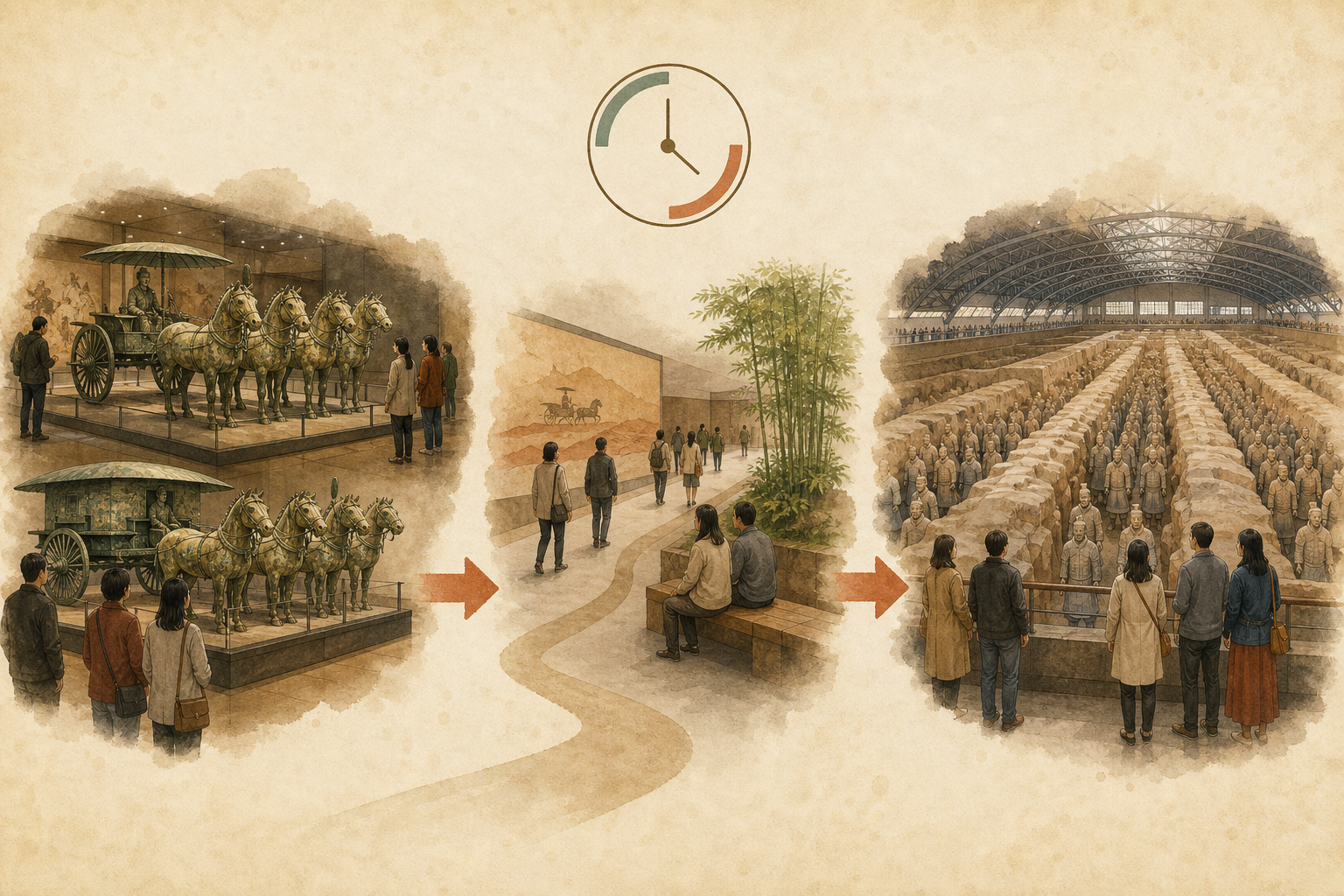
Plan two to three hours. Once inside, the layout runs Pit 1, then Pit 3, then Pit 2, with the bronze chariots hall near Pit 2.
Do the pits in reverse crowd order. Head to Pit 1 first thing to see the star attraction before the groups arrive. Then work through Pit 3 (the command post) and Pit 2 (cavalry and chariot units).
Save the bronze chariots hall for when you want quiet. It is indoors and shaded, a good midpoint on a hot day. Give it at least 30 minutes, and read the panels; the restoration story is remarkable.
A free shuttle links the museum area to the Lishan Garden tomb mound, which your ticket also covers. The mound itself is a grassy hill, not an open tomb, but it completes the picture of the emperor’s underground city.
Frequently asked questions
Are the bronze chariots the real originals or replicas?
The two chariots on display are the genuine restored originals, rebuilt from thousands of excavated fragments. They are half life-size because they were made that way in antiquity, as burial models, not because they are modern copies. Full-size souvenir replicas are sold in the gift shops.
Do I need a separate ticket for the bronze chariots?
No. The standard museum ticket, around 120 RMB, covers the three warrior pits, the bronze chariots exhibition hall, and the Lishan Garden tomb mound. There is no extra charge for the chariots, so do not let anyone sell you a "special" add-on ticket.
Can I buy tickets at the gate?
No. The museum uses a real-name online reservation system tied to your passport, and paper tickets are not sold at the entrance. Book two to three days ahead through the official channel or a trusted agent, and bring the exact passport you booked with.
How long should I spend at the terracotta army?
Plan two to three hours. That gives you time for all three pits, at least 30 minutes at the bronze chariots, and the shuttle to the tomb mound. Rushing it in under 90 minutes means you will miss the chariot detail that makes the trip worthwhile.
What is the best time of day to visit?
Arrive at 8:15 AM for the opening, or after 3:30 PM. The heavy tour-bus crowds fill the pits between 10:30 AM and 2:30 PM, when viewing is loudest and slowest. Weekdays are far calmer than weekends and public holidays.
Is a guide or audio guide worth it?
Yes, for the history. The pits have limited English signage, and a good guide brings the ranks and weapons to life. If you prefer to go solo, rent the official audio guide at the entrance and focus it on Pit 1 and the chariots hall.
Before you go: your action list
Lock in these steps before you travel, and the day itself will feel easy.
- Book your museum reservation two to three days ahead with your passport.
- Set up Alipay or WeChat Pay before arrival for buses, water, and snacks.
- Choose your route: Metro Line 9 or a high-speed train to Lintong.
- Aim for the 8:15 AM or 3:30 PM arrival window.
- Book a Xi’an hotel near the Bell Tower or the North railway station for easy access. Compare options through our hotel booking page.
Getting to Xi’an is the first move, and the smoothest way in is the high-speed rail network. Tell us your dates and cities, and we will handle the passport details and seat selection for you.
Get a free train ticket quote and lock in your Xi’an trip today.
For deeper reading, the UNESCO World Heritage listing for the Mausoleum of the First Qin Emperor covers the site’s history, and the official Emperor Qinshihuang’s Mausoleum Site Museum ticketing page has the current booking rules straight from the source.
Featured image: “2014 Qin Shihuang Bronze Chariot Horses.jpg” by Gary Todd, via Wikimedia Commons, CC0.