
Two minutes to seven on a Thursday evening in July, and most of the crowd on the raised promenade is facing the wrong way — heads down, thumbs moving. Then somebody two metres to your left says oh, and the Pudong skyline switches on across the water, tower by tower, in about four seconds. The sound that goes up is somewhere between a stadium and a sigh. Six hundred phones come up at once.
That moment is the actual product here. Everything else about the Bund Shanghai — the 52 stone banks and trading houses behind you, the flood wall you’re standing on, the ferries grinding upriver — is scenery for those four seconds and the ninety minutes either side of them. Get the timing right and it is one of the great free evenings in Asia. Get it wrong and you have paid nothing to stand in a line of strangers looking at a dark river.
The short version: free, open 24 hours, no ticket, no booking. Turn up 30 minutes before the lights (roughly 19:00 in summer, 18:00 in winter), come in from the northern end rather than East Nanjing Road, and allow 90 minutes.
Getting in from the side nobody uses
Almost every guide sends you to East Nanjing Road station on Metro Lines 2 and 10, out of Exit 2, and down the pedestrian street. It works. It is also the single most congested funnel in central Shanghai after about 18:00, and on weekend evenings the queue simply to get out of that exit can run several minutes.
There is a better move. Ride Line 10 or 14 to Yuyuan Garden and walk north along the water, or take Line 10 or 12 to Tiantong Road and come down over Waibaidu Bridge — the 1907 steel truss span where Suzhou Creek joins the Huangpu. From the bridge you get the whole curve of the promenade unrolling in front of you, thinning crowds behind you, and no need to fight the shopping street at all. It adds maybe eight minutes of walking and removes most of the misery.
One thing to plan around: during the big domestic holidays — the first week of May and the National Day week from 1 October — Shanghai Metro runs hard crowd control here. On the heaviest evenings the exits at East Nanjing Road are closed for hours at a stretch, and trains can be sent through the station without stopping. Check the official Shanghai Metro site for live station notices on the day, and keep Tiantong Road or Yuyuan Garden in your back pocket as a fallback. If you are staying near People’s Square, walking the 1.5 km is often faster than the train anyway.
Taxis and ride-hailing will not save you either. Zhongshan East First Road, the road that runs behind the promenade, is frequently barricaded to vehicles on busy nights. Expect to be dropped two blocks back regardless of what the map says.
What the walk is actually like
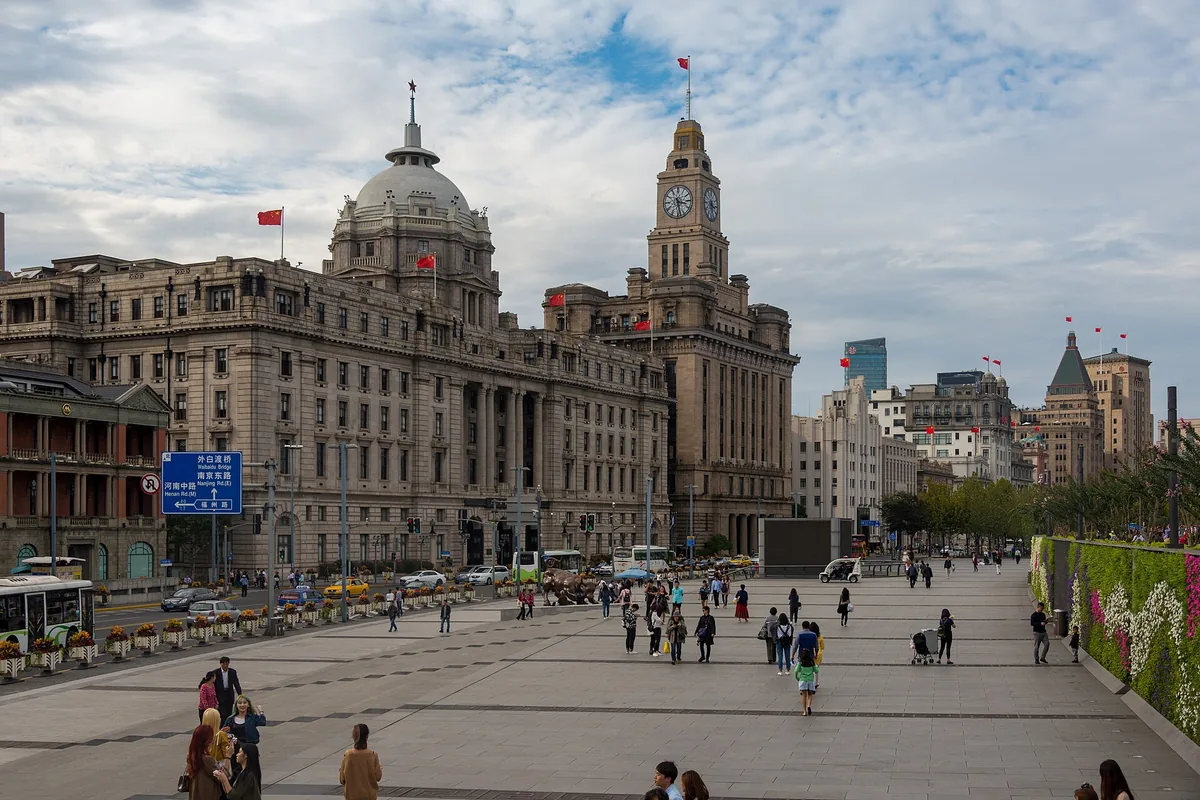
The Bund — Waitan, if you are reading a Chinese map — is a stretch of raised riverside walkway roughly a mile long, running from Waibaidu Bridge in the north to Yan’an Road in the south. You are standing on top of a flood barrier, which is why the whole thing sits a storey above the traffic, and why the view works.
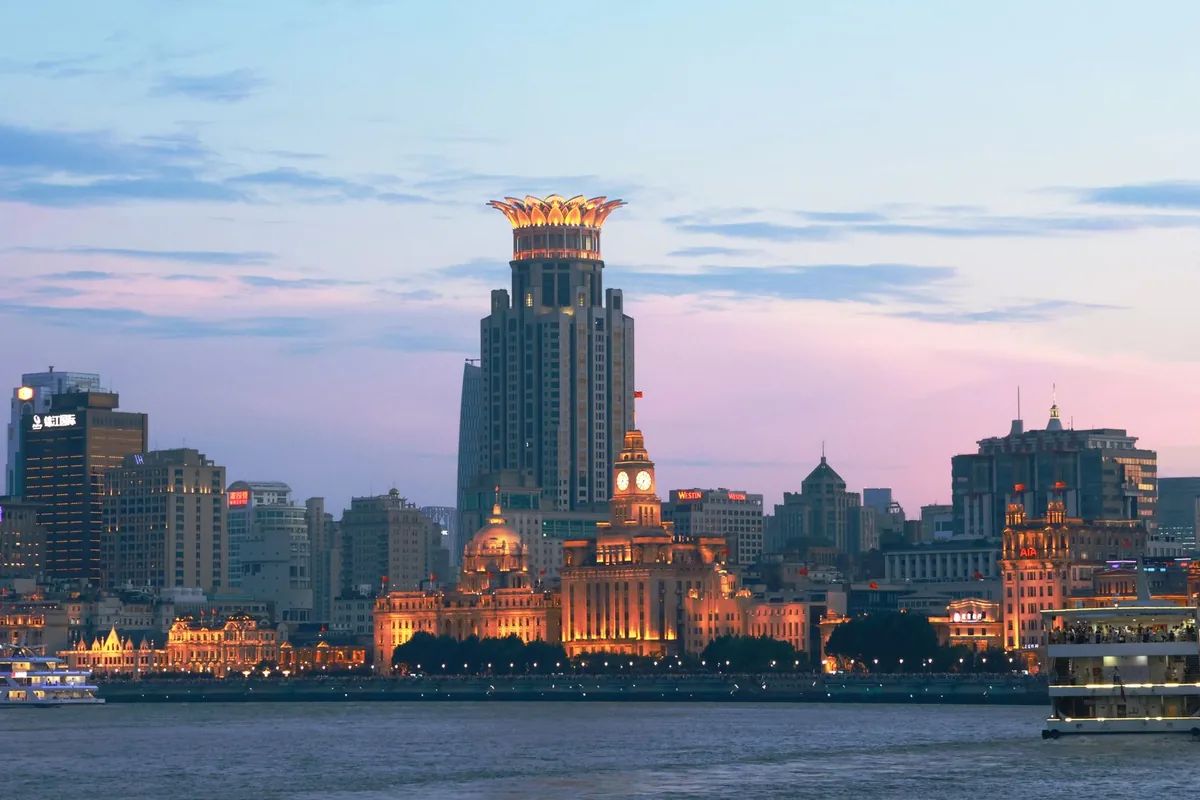
Walking south from the bridge, the buildings on your right arrive in a very deliberate order: the former consulate compounds, then the banks, then the trading houses. Fifty-two of them, in about six architectural styles. The two that stop people are the old Hongkong and Shanghai Bank building with its dome, and the Customs House next door with the clock tower that still chimes. Further along, the green pyramid roof belongs to the Peace Hotel. The city tourism board has put QR plaques on 115 heritage buildings in the district — scan one and you get the building’s history in English, which is more interesting than the plaque itself suggests.
Then you turn your head left and the whole thing flips a century forward: Lujiazui, the Oriental Pearl Tower’s concrete lollipops, the bottle-opener, the Shanghai Tower’s twist. Two skylines, ninety years apart, one river apart. Photographs do not convey how odd that feels in person.
At the southern end you will find the bronze bull, by the sculptor who made the Wall Street one. It has a permanent scrum around it. Skip it unless you enjoy queuing to photograph an animal’s backside.
Give the whole walk 60 to 90 minutes at a normal pace. Two hours if you stop, and half a day if you fold in Yuyuan Garden and the old city to the south.
The forty minutes that decide your evening
Most guides will tell you the Bund is "best at night". That is not quite right. It is best during one specific window, and the window moves with the season.
Shanghai schedules its landscape lighting centrally, and the municipal greenery and city appearance bureau publishes the timetable. Through the summer season — roughly early May to the end of September — the core zone that covers the Bund, the North Bund and Lujiazui runs 19:00 to 23:00, every night. Outside that season the lights come on nearer sunset and go off earlier; treat 18:00 to 22:00 as a working assumption for a winter visit, and check the current notice before you commit to a dinner reservation.
Monday to Thursday you get the standard lighting. Friday to Sunday and on public holidays the city switches to "festival mode", which is brighter and busier across more buildings — and during the big national holidays it goes further again, into a full event mode that starts around 18:00.
Whatever the season, be in position about half an hour before the switch-on. The twenty minutes of blue dusk after the lights come up — sky still holding colour, towers already lit — is the good bit. Once the sky goes fully black you lose the architectural detail on the Bund side and you are just looking at neon.
So: arrive 18:30 in summer, 17:30 in winter. Walk the strip while it is still light, park yourself somewhere around the Customs House, and wait.
Crowd-wise, the worst combination is Saturday between 19:00 and 21:00. During the May and October national holidays the promenade runs under formal crowd control all evening and the experience changes character completely — you shuffle, you do not stroll. A Tuesday in late March or early November is the opposite: mild, clear, and you can lean on the railing without negotiating for space.
Early morning is the sleeper option. At 06:30 the promenade belongs to people doing tai chi and stretching against the railings, the light comes over Pudong straight into your lens, and you can count the number of other tourists on one hand. No lights, but no crowds either, and it is the only time the Bund feels like it belongs to Shanghai rather than to visitors.
The bit that is genuinely overrated
The Bund Sightseeing Tunnel.
It is a 647-metre tram tunnel under the Huangpu connecting the Bund to the Oriental Pearl Tower side, dressed up with flashing lights and inflatable figures. At the booth it is ¥50 one way and ¥70 return; booking platforms routinely discount the single trip to around ¥25–30, which tells you something about demand. The ride lasts three to five minutes. It is a 1990s ghost train with none of the ghosts, and people come out of it looking mildly betrayed.
If you need to cross to Pudong: the Metro does it for a few yuan, and the public ferry from near Jinling East Road does it for ¥2 with an actual view. Both are better value and neither involves a strobe light.
While we are being honest — the other thing to walk past is any friendly stranger on East Nanjing Road who wants to practise English, mentions being an art student, or suggests a traditional tea ceremony nearby. It ends in a side-street tea house with a bill running into the thousands of yuan and a door you cannot easily leave through. The scam has been working this stretch of pavement for two decades and it still lands every day. Locals do not recruit foreigners on the street for tea.
Getting on the water, or above it
There are three ways to get onto the river and one to get above it. Only one of them needs planning.
| Option | Rough 2026 price | Time | Verdict |
|---|---|---|---|
| Huangpu River cruise, after dark | about ¥145 | 45–60 min | Worth it once — both banks lit, seen from the middle |
| Huangpu River cruise, daylight | from about ¥107 | 45–60 min | Cheaper, and much less impressive |
| Public ferry to Pudong | ¥2 | ~5 min | Best value view in Shanghai |
| Bund Sightseeing Tunnel | ¥50 single, ¥70 return | 3–5 min | Skip |
Prices vary by operator and pier, and the after-dark sailings from Shiliupu — the main departure point, running from about 18:30 — carry the premium. Buy on the day at the pier unless you are travelling in a holiday week, when the boats sell out.
For height, the rooftop bars along the Bund’s western side put you level with the Peace Hotel’s roof and looking straight across at Lujiazui. Drinks run ¥100 upwards and most want you booked at weekends. The free equivalent: the promenade’s northern end near Yuanmingyuan Road, where far fewer people bother to walk.
Small things that save the evening
Payment. Cash is still legal tender and vendors are meant to take it, but everything here — ferry turnstiles, cruise piers, the tea stall on the corner — defaults to a QR code, and staff will look at a ¥100 note as though you have handed them a coupon. Set up mobile payment before you land; our walkthrough on using Alipay in China as a foreigner covers linking a foreign card.
Toilets. Public facilities exist at both ends of the promenade and are usually clean, but the queues at 19:30 are real. Use the ones inside the shopping complexes on Zhongshan East First Road instead.
Weather. The riverfront is exposed and the wind coming off the Huangpu in January is significantly colder than the forecast implies. In July and August the reverse problem: 33°C with heavy humidity well after sunset. Carry water in summer; carry a proper layer in winter.
Sleeping nearby. A room on the Bund or in Lujiazui costs a serious premium for a view you can have for free from the railing. Staying one metro stop back — People’s Square, or around Nanjing West Road — costs meaningfully less and puts you ten minutes away. Our hotel booking help can sort the paperwork if a property is refusing foreign guests.
Entry. Most readers now arrive without a visa at all. China’s unilateral visa exemption gives ordinary passport holders from a long list of countries 30 days, and it currently runs to the end of December 2026. If your nationality is not on that list, the 240-hour transit rule may still cover you: it is good for ten days and, since the 2024 rewrite, lets you cross provincial borders freely within a large block of eligible provinces rather than confining you to Shanghai and its neighbours. Confirm your own status on the National Immigration Administration site and read our breakdown of the 240-hour visa-free transit before you fly.
Three things people actually ask
Is there a ticket for the Bund?
No. The promenade is free, unticketed and open around the clock. You only pay for extras — cruises, tunnels, towers, drinks.
Bund side or Pudong side for photos?
Bund side for the classic skyline shot, because the subject is Pudong. Pudong side is better if you want the stone banks lit up with the river in front, and it is far less crowded. Do both if you have two evenings; the ferry makes it cheap.
How does the Bund fit into a short Shanghai stop?
Give it one evening, ideally your first, because it orients you. Pair it with Yuyuan Garden in the afternoon and the French Concession the next day. If Shanghai is one stop on a longer trip, the high-speed rail links to Hangzhou, Suzhou and Beijing leave from stations 20–45 minutes away by metro.
Shanghai is also the easiest place in China to start a rail trip — Suzhou is 25 minutes away, Hangzhou under an hour, Beijing four and a half. If working out seat classes and station names in Chinese is not how you want to spend your evening, tell us your route and get a free quote. We book the tickets, you keep the evening on the railing.
Photo by Leon Wang on Pexels. Source; Pexels License.