
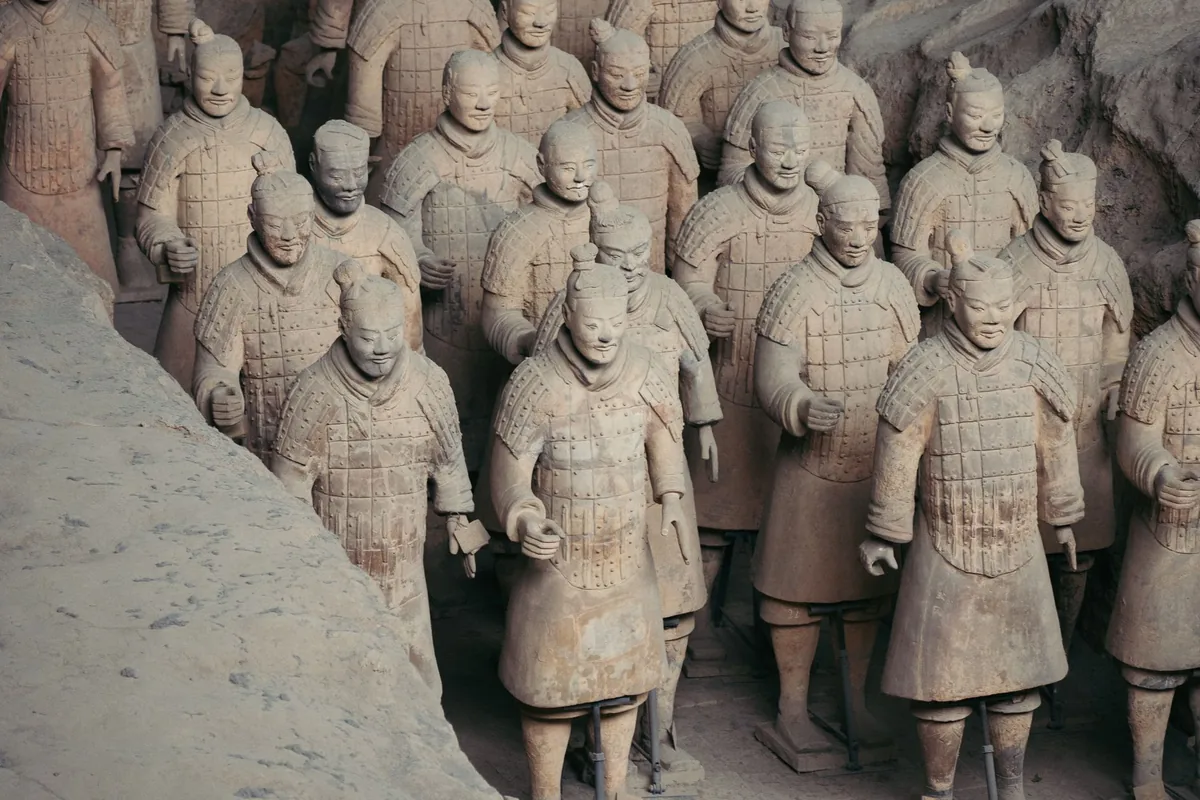
The first thing that hits you inside Pit 1 is the noise. Not the warriors — you can’t see them yet, because the entrance drops you at the back of a hall roughly two football pitches long and there’s a wall of shoulders between you and the railing. It’s the sound: dozens of guides on dozens of headset channels, all talking at once, ricocheting off a corrugated roof. Then the crowd shifts, you get a gap at the barrier, you look down into the trench — and none of that matters any more. Eleven columns of men in dirt-brown ranks, marching away further than your phone can usefully photograph, every single face different. The Terracotta Army earns the trip out.
The short version: book online against your passport number a few days ahead, ride Metro Line 1 to Fangzhicheng and Line 9 on to Huaqingchi, then a local bus for the last stretch. Tickets are 120 CNY year-round and cover both sites. Doors open at 08:30 — be there for it. Give yourself three hours inside.
The ride out east, and why the metro wins
The warriors are not in Xi’an. They’re in Lintong District, about 40 km east of the old city walls, near the foot of Mount Li — which is exactly where Qin Shi Huang wanted them, guarding the approach to his tomb.
Three sane ways to get there:
Metro plus a local bus. This is the route worth learning. From the centre, take Line 1 east to Fangzhicheng, change to Line 9, and ride to Huaqingchi station. Follow the signs out to the bus stand — a few minutes on foot — and take Lintong bus 613 or 602 the rest of the way to the museum’s tourist service centre. The bus is a few yuan and about fifteen minutes. Door to door from the Bell Tower, budget roughly 90 minutes and around 15 CNY. Coming from Xi’an North Railway Station you’ll change twice: Line 2 south into the centre, Line 1 east, then Line 9.
Public bus 306 (the old 游5). Around 5 CNY and an hour or so, and the buses themselves are exactly what they claim to be — green, public, parked in marked bays with a fare box. The catch is the departure point, which has shifted with station building works over the years; confirm the current bay on the day rather than trusting a two-year-old blog. The forecourt around those bays is also the most heavily worked patch of ground for tourist scams in Shaanxi. More on that below.
Didi or a taxi runs roughly 120–150 CNY each way and takes about forty minutes with clear roads, which the afternoon rarely gives you. Worth it for three or four people, or with kids.
Most visitors reach Xi’an by high-speed rail — roughly four and a half hours from Beijing on the quickest services, six or so from Shanghai. Seats on the popular morning departures vanish early, especially around holidays; our walkthrough of how to book China high-speed train tickets covers the passport-linked booking system and the ID-scan gates at the platform.
Getting a ticket: your passport is the ticket
There is no window where you hand over cash and walk in. Entry to the Emperor Qinshihuang’s Mausoleum Site Museum is real-name and pre-booked: you register your name, passport number and a contact phone before you arrive, and the turnstile scans the passport itself. Bring the physical booklet. A photo on your phone will not open the gate.
Book through the museum’s official site and ticketing system, its official WeChat account, or a major travel platform. The booking window is short — days, not months — so check it the week before rather than assuming you can lock in a date from home in March.
A few things worth knowing before you pay:
- Price. 120 CNY, the same all year. The old peak-and-off-peak split was scrapped, so ignore any page still quoting you two prices. Over-65s, students and a few other categories get reduced or free entry with ID.
- What’s included. The three pits, the Bronze Chariots hall, and Lishan Garden — the tomb mound site about 1.5 km away — plus the free shuttle between them. One ticket, two sites.
- Hours. Doors at 08:30. From 16 March to 15 November the halls close at 18:30 with last admission at 17:00; from 16 November to 15 March it’s 18:00 with last admission at 16:30. In July and August 2026 the museum is running extended summer hours — 08:00 to 19:30, last admission 17:30 — which is worth checking before you plan a late arrival.
- Treat it as a one-day ticket. Plan the pits and the mound for the same visit unless your booking confirmation explicitly says otherwise.
Payment inside the site — the audio guide (about 40 CNY), water, the shuttle-adjacent snack stalls — is overwhelmingly by phone. Set up mobile payment before you leave your hotel; our guide to using Alipay in China as a foreigner walks through linking a foreign card.
Walk the pits in this order
The site funnels almost everyone into Pit 1 first, then leaks them slowly toward the exit. You can beat that by knowing what you’re walking into.
Pit 1 is the one from the posters — the enormous covered trench, the infantry in formation, the front third restored and standing, the back two-thirds still a working excavation of collapsed timber, packed earth and figures under plastic sheeting. Get to the front railing at the eastern end, then walk the whole perimeter. The side galleries are where you’ll actually get a clear look at armour plates, topknots and the wooden-chariot stains in the soil.
Pit 3 is tiny, easy to miss, and I’d put it second. Sixty-odd figures, no infantry ranks — this is the command post, the officers’ quarters, complete with the remains of a chariot for the commander. On a busy Saturday it’s the only room in the complex where you can hear yourself think.
Pit 2 is the one people describe as "half empty", and technically they’re right: most of it remains deliberately unexcavated. But the glass cases along its edge hold the best individual figures on site — the kneeling archer, the standing archer, the cavalryman with his horse, a middle-ranking officer, a general. Eye level, lit, no crowd three deep. If you only look closely at five warriors all day, look at these.
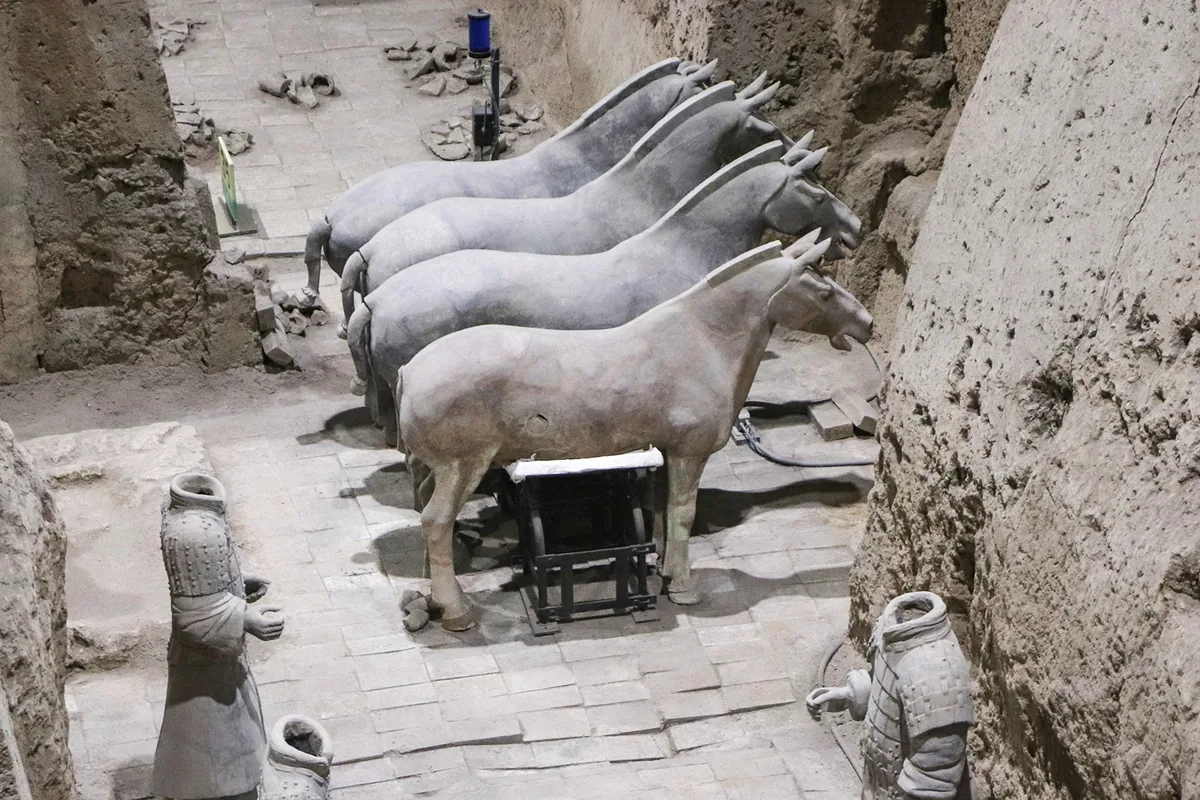
The Bronze Chariots and Horses hall is the quiet masterpiece, and half the visitors skip it. Two half-scale bronze chariots, pulled from a pit beside the tomb in 1980, made from thousands of individual parts with gold and silver fittings, down to articulated reins and individually cast links of harness chain. Nothing else on the site makes the Qin workshops feel so alarmingly competent.
One detail nobody mentions on the way in: every one of these figures was originally painted — lacquer ground, then bright pigment. Exposed to dry air, the lacquer curls and takes the colour with it, fast. That fragility is a large part of why the tomb mound itself has never been opened.
The bit that disappoints people
Lishan Garden. It’s the actual tomb of the First Emperor, UNESCO-listed since 1987, and it is, to the eye, a wooded hill with a path around it. The tomb chamber is unexcavated and will likely stay that way for decades. Add the shuttle ride, the walk and a modest exhibition hall and you’ve spent 60 to 90 minutes on something that looks like a park. It’s genuinely interesting if you’ve read about the mercury rivers and the sealed chambers described by Han historians; it’s a long, hot, anticlimactic detour if you haven’t. Skip it without guilt if the day is 38°C or your feet are done. For context first, UNESCO’s Mausoleum of the First Qin Emperor listing is a five-minute read that makes the hill worth the walk.
The exit route is the other honest gripe — a long retail corridor you can’t bypass, ending at a stall where a man presented as the farmer who struck the first fragments while digging a well in 1974 signs books. Several different men have filled that chair over the years. Buy the book if you enjoy the theatre; don’t buy it thinking you’ve met history.
When to show up
| Arrival time | What you’re walking into |
|---|---|
| 08:30 (opening) | Roughly an hour of Pit 1 before the first coach wave lands. The best window there is. |
| 09:30–11:30 | Peak density. Pit 1 becomes a slow shuffle and the headsets are relentless. |
| 11:30–13:00 | A real lull — tour groups are at lunch. Decent second-best. |
| 14:00–15:30 | Second coach wave. Avoid. |
| After 15:30 | Thins out fast and the halls feel calmer. Check last admission before you commit. |
In July and August, opening moves to 08:00 and the site stays open until 19:30, which turns the last two hours into a genuinely pleasant third option.
Season matters more than hour. Avoid the National Day holiday (1–7 October), the May Day break, Chinese New Year and the July–August school holidays if you have any choice at all. Late March to April, late September, and the second half of October are the sweet spots: mild, dry, and the Lintong pomegranates are ripe in autumn.
The scam belt, and how to walk straight past it
The museum itself is straight-dealing. The approach to it is not.
- Fake buses. Unmarked vans quoting 30–50 CNY, with staff in official-looking lanyards telling you the real bus is broken or full. Only board green public buses in marked bays, and only pay the fare box.
- The replica museums. Drivers and touts near the railway station and around Lintong will offer to take you to a "warriors museum" that turns out to be a hall of cement copies. The real place is called the Emperor Qinshihuang’s Mausoleum Site Museum. Say that name and nothing else.
- "The pits are closed today." They aren’t. That line exists purely to redirect you to a jade or "cultural relic" showroom that pays commission.
None of it is dangerous. It’s just expensive and annoying, and it evaporates the moment you keep walking.
Three things people ask me
Do I need a guide? The signage gives you names and dates, not stories. Rent the official audio guide at the entrance or hire one of the licensed English-speaking guides at the gate — either turns a room of statues into a war machine you can read. The guide is the better spend if you’re a history person.
Can I do this on a visa-free stopover? Xi’an works as a base under China’s transit rules — see our explainer on 240-hour visa-free transit, then confirm the current eligible ports and nationalities with the National Immigration Administration before you book anything. Two nights in Xi’an covers the warriors, the city wall and the Muslim Quarter.
Is half a day really enough? Three hours inside covers all four halls at a decent pace. Add travel and you’ve used six. That leaves an afternoon for Huaqing Palace — same metro stop, hot springs, and the site of the 1936 Xi’an Incident — or a bike lap of the city wall back in town.
Before you book the day, book the train
Xi’an works best as a two-night stop stitched into a Beijing–Xi’an–Chengdu or Xi’an–Shanghai run, with the warriors slotted into the middle morning. The part that trips people up isn’t the museum — it’s getting a seat on the train you actually want, in the season everyone else wants it too.
Tell us your dates and route and we’ll come back with a free quote on your China train tickets, booked against your passport so you can walk straight to the platform gate. If you’d rather sort beds first, our Xi’an hotel bookings put you inside the walls, ten minutes from the Line 1 interchange and the noodle shops that make a 07:00 start survivable.
Photo by TonyNojmanSK on Pexels. Source; Pexels License.