
For a first trip focused on Beijing’s imperial sights, compare Wangfujing and Qianmen. For courtyard stays and hutong walks, compare Gulou, Nanluoguxiang, and Houhai. For dining, nightlife, and a more modern commercial district, consider Sanlitun.
Do not choose from the district name alone. A listing can use a familiar neighborhood label while its actual entrance is far from the station or sight you plan to visit. Check the exact address, walking route, luggage access, and late-arrival transport before paying.
China’s 2024 accommodation measures say qualification requirements should not be used as barriers restricting operators from receiving foreign guests. Hotels still have a legal duty to register and report a foreign guest’s accommodation, so confirm the exact property’s check-in process and bring the original valid travel or identity document used for the stay.
Hotel prices change with the dates, room terms, events, and cancellation policy. This guide therefore compares location and trade-offs rather than presenting a static 2026 price promise.
Key takeaways
- Wangfujing and Qianmen are practical central bases for travelers prioritizing the Forbidden City and Tiananmen area.
- Gulou, Nanluoguxiang, and Houhai suit travelers who value hutong atmosphere and are comfortable checking lane and station access carefully.
- Sanlitun fits dining, nightlife, shopping, and some business trips, but it is east of the historic core.
- Confirm the exact property, not only the brand or neighborhood label, and keep its written check-in response.
- Use current official sources for Palace Museum tickets and visa-free transit conditions before travel.
Where to stay in Beijing: five areas to compare

Beijing’s central sights cover more than one neighborhood, and each district label includes properties with very different entrances and transit access. Use the table as a shortlist, then verify the exact address on a current map.
| Area | Good for | Atmosphere | Access check before booking |
|---|---|---|---|
| Wangfujing | Imperial sights, shopping, first visits | Busy commercial center | Check the exact walking route to the Palace Museum entrance and the nearest station |
| Qianmen and Dashilan | Historic streets and the Tiananmen area | Tourist-facing historic core | Check current security access, station exits, and the property’s actual entrance |
| Gulou and Nanluoguxiang | Courtyard stays and hutong walks | Narrow historic lanes | Confirm luggage drop-off, stairs or lifts, heating or cooling, and station distance |
| Shichahai (including Houhai) | Lakeside walks and evening atmosphere | Lively main lanes with quieter side streets | Check night access, noise reviews, and the walk from the nearest station |
| Sanlitun | Dining, nightlife, shopping, and some business trips | Modern commercial district | Allow for travel to the historic core and verify the route from your arrival point |
A neighborhood name is not a travel-time guarantee. Pin the property entrance and test the route to your first morning attraction before booking.
Wangfujing and Qianmen: practical central bases
Wangfujing sits east of the Palace Museum and combines a major shopping street with a broad range of hotels. Qianmen and Dashilan sit south of the Tiananmen area and provide a different historic-street setting.
Both can work for an imperial-sights itinerary, but the exact property matters. Check the route from the hotel entrance rather than relying on a neighborhood label or a straight-line distance.
The official Palace Museum booking page currently says that it does not sell same-day tickets, reservations open seven days before the visit, and the museum normally closes on Mondays except statutory holidays. It also identifies the Meridian Gate as the visitor entrance. Recheck the official page for your date.
If the Palace Museum is your first priority, compare the route to its actual entrance, the station exit, and any Tiananmen-area access controls. For the rest of the city, use the existing Beijing travel guides after the hotel location is fixed.
Hutongs and Houhai: courtyard stays and lane access
Gulou, Nanluoguxiang, Houhai, and Shichahai appeal to travelers who want courtyard architecture, hutong lanes, and lakeside walks rather than a large commercial-hotel setting.
Properties in converted courtyards vary widely. Before booking, check room size, soundproofing, heating or air-conditioning, stairs or lift access, and whether a vehicle can reach the entrance with luggage. Use recent property-specific reviews rather than assuming every courtyard stay offers the same facilities.
The Shichahai area, including Houhai, contains busy visitor lanes as well as quieter residential streets. Confirm the exact location, night access, and walk from the station. A scenic district can still be inconvenient if the entrance is deep inside a lane or your arrival is late.
Choose this part of Beijing for atmosphere with a known access trade-off. If a smooth passport check-in is a concern, read the verified guide on hotel check-in and accommodation registration in China and confirm the exact property in writing.
Sanlitun: dining, nightlife, and modern hotels
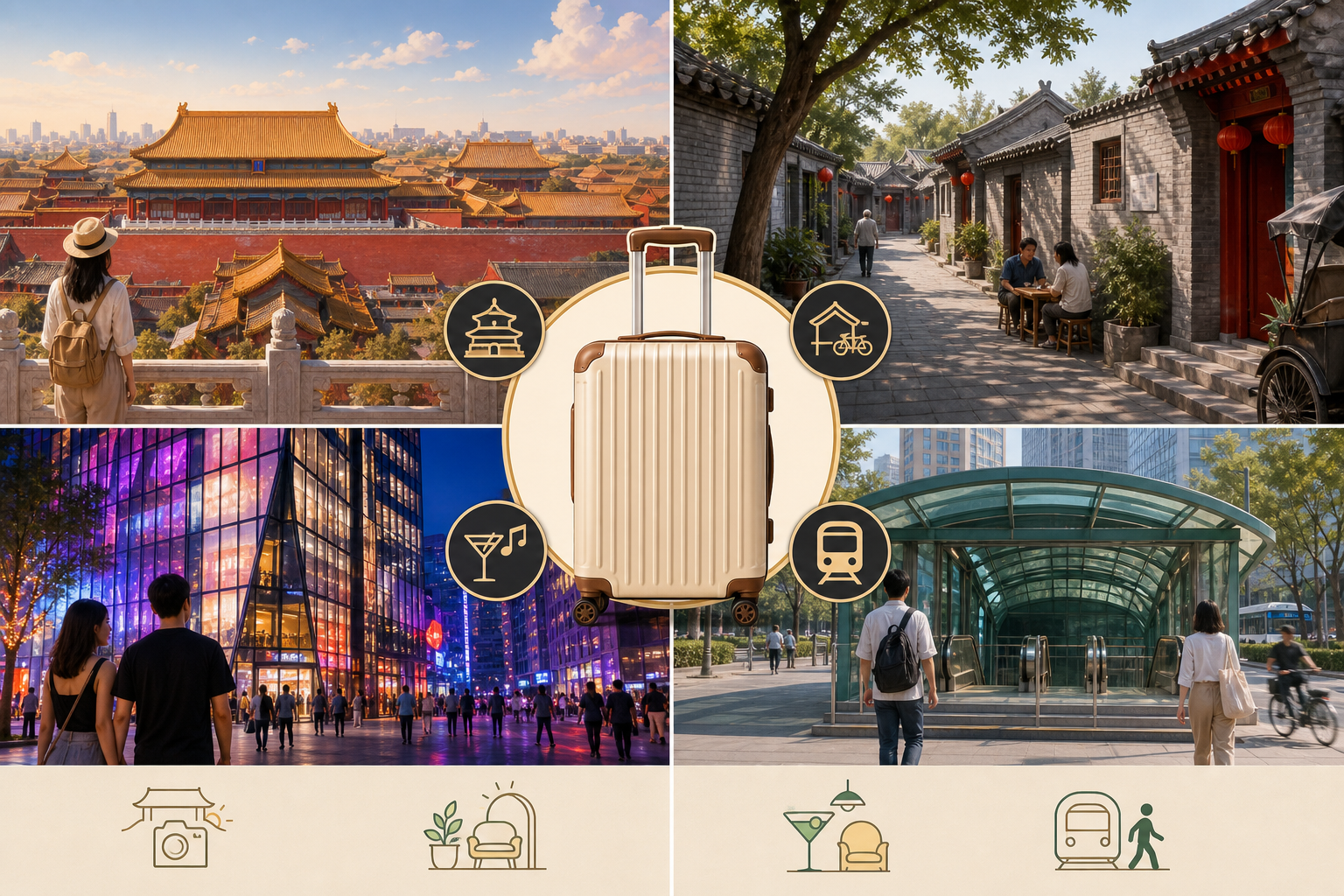
Sanlitun is a modern commercial area in Chaoyang with shopping, restaurants, bars, and hotels. It can suit travelers whose evenings, meetings, or dining plans are concentrated east of the historic core.
It is not the same experience as staying beside the imperial sights. Check the route to every priority attraction and allow for transfers, walking from station exits, and late-evening service changes.
For an airport arrival, verify the route from the airport to the exact hotel rather than assuming that every Chaoyang address has the same connection. For a short sightseeing trip, compare that extra travel with the convenience of Wangfujing or Qianmen.
Getting around, payment, and hotel check-in
Before booking, pin the property entrance and check the current route from your airport or railway arrival point and to the station you expect to use most. Station exits and last-train times matter more than a broad neighborhood label.
A Beijing government payment guide describes mobile payment, bank cards, and RMB cash as available options and states that merchants must accept RMB cash. Prepare more than one payment method and check the current instructions of the provider you plan to use.
Article 39 of the Exit and Entry Administration Law says a hotel handles a foreign guest’s accommodation registration and reports the required information. For a non-hotel stay, the foreign guest or host must register with the local public security authority within 24 hours. Use the current local procedure rather than assuming that every city offers the same online channel.
Keep the booking confirmation, property address, phone number, and original valid travel or identity document accessible at check-in.
Frequently asked questions
Where should first-time visitors stay in Beijing?
Wangfujing or Qianmen can be practical if the Palace Museum and Tiananmen area are priorities. Gulou, Nanluoguxiang, and Houhai suit a hutong-focused stay, while Sanlitun is better aligned with dining, nightlife, shopping, or nearby business plans. Always compare exact addresses.
Can a Beijing hotel refuse me because it lacks foreign-related qualifications?
The 2024 government measures say qualification requirements should not be used as barriers restricting accommodation operators from receiving foreign guests. Normal availability, booking terms, valid-document checks, and the hotel’s registration duty still apply, so confirm the exact property before arrival.
How much does a Beijing hotel cost?
There is no reliable static range for every trip. Compare live prices for your exact dates and review the cancellation terms, taxes, breakfast, deposits, and payment method before booking.
Who handles accommodation registration?
A hotel handles the registration and reporting required by Article 39. For a private home, apartment, or other non-hotel stay, the foreign guest or host must register within 24 hours using the current local procedure.
Which area should I consider for nightlife?
Sanlitun is a well-known dining, shopping, and nightlife district. Check current venues, the route back to the hotel, and transport operating times for the night you plan to go out.
Does 240-hour visa-free transit give every visitor ten days in Beijing?
No. As of this July 2026 review, the National Immigration Administration lists 55 eligible countries and requires a valid international travel document plus a confirmed onward journey to a third country or region through an eligible port. Permitted areas and other conditions apply. Verify the current official rules for your nationality and itinerary.
Before you go: Beijing hotel checklist
- Check the exact address. Confirm the property entrance, station exit, luggage route, and late-arrival plan.
- Match the area to the trip. Choose central imperial sights, hutong atmosphere, or Sanlitun evenings based on the activities you will actually do.
- Confirm check-in. Keep the property’s written response and bring the original valid travel or identity document used for the stay.
- Prepare payment backups. Mobile payment can be convenient, but keep another method and RMB cash available.
- Reserve major sights officially. If visiting the Palace Museum, check its current booking page and entry instructions.
- Verify transit eligibility. Use the NIA source for the current 240-hour visa-free transit rules and do not infer eligibility from a hotel listing.
Continue with the existing Beijing travel guides for city planning, and use the verified hotel check-in guide for accommodation registration details.
Official references: Government summary of accommodation measures (2024) · Seven-department accommodation measures (2024) · Exit and Entry Administration Law · NIA 240-hour visa-free transit notice · Palace Museum booking rules · Beijing payment services guide.
Featured image: “Beijing City (4214640799).jpg” by Kentaro Iemoto from Tokyo, Japan, via Wikimedia Commons, CC BY-SA 2.0; resized for web.