
The Taiwan high speed rail is a single 350 km line down the island’s west coast, running Shinkansen-based trains at up to 300 km/h from Taipei to Kaohsiung in about 1 hour 45 minutes. Mainland China’s network is a different animal entirely: roughly 48,000 km of track, trains hitting 350 km/h, and a new 400 km/h train class arriving in 2026.
If you searched for Taiwan HSR, you may be planning a wider Asia trip and wondering how the two systems compare. That is the useful question. Taiwan’s line is one of the cleanest rail rides in the world, but it covers one route. Mainland China’s system is where most first-time visitors actually spend their days on a train, hopping between Beijing, Shanghai, Xi’an and beyond.
This guide compares the two honestly on speed, price, comfort and booking. Then it focuses on the part that trips up newcomers: buying and boarding a mainland Chinese bullet train as a foreigner, now that visa-free entry has made China far easier to visit.
Key Takeaways
- Taiwan HSR is one 350 km line, 12 stations, top speed 300 km/h, Taipei to Kaohsiung in about 1h 45m.
- Mainland China runs ~48,000 km of high-speed track, tops out at 350 km/h, and launches a 400 km/h CR450 class in 2026.
- A Taipei–Kaohsiung standard ticket is about NT$1,490 (~US$46); Beijing–Shanghai (1,318 km) second class is about ¥553 (~US$77).
- In mainland China your passport IS your ticket at the gate; book online, no paper ticket needed.
- Taiwan and mainland China are separate systems, currencies and booking apps: one trip does not use the other’s network.
Taiwan high speed rail: one line, done extremely well

Taiwan’s system is easy to describe. It is a single spine running down the populated west coast, from Nangang in Taipei to Zuoying in Kaohsiung, with 12 stations in between including Banqiao, Taoyuan, Hsinchu, Taichung and Tainan.
The trains are 700T sets, built on Japan’s Shinkansen technology, and they run at a top service speed of 300 km/h. The fastest Taipei–Kaohsiung trip is 1 hour 45 minutes. Service is frequent and famously punctual, and the system carried over 82 million passengers in 2025.
One 2026 note for rail fans: Taiwan has ordered 12 new N700ST trainsets. The first is due to arrive in Taiwan around August 2026 for testing, with passenger service expected in the second half of 2027. So on your 2026 trip you will still ride the current 700T fleet.
Marc, a photographer from Lyon, rode Taipei to Tainan for the old-town temples, booked the day before on the official app, and still got a window seat. That is the Taiwan experience in one sentence: simple, reliable, hard to get wrong.
Foreign travelers also get a few Taiwan-only perks worth knowing. Overseas visitors can buy discounted passes such as a 3-day unlimited pass sold through partners like Klook and KKday, which pays off fast if you plan to hit several west-coast cities. You still show a passport when you collect the pass, and you still reserve seats for each leg, but the pricing is genuinely cheaper than buying legs one by one.
Stations are compact and bilingual, signage is clear, and the ride is smooth enough to work on a laptop the whole way. For a short north-to-south loop, Taiwan HSR is close to foolproof.
China vs Taiwan high speed rail: the scale comparison
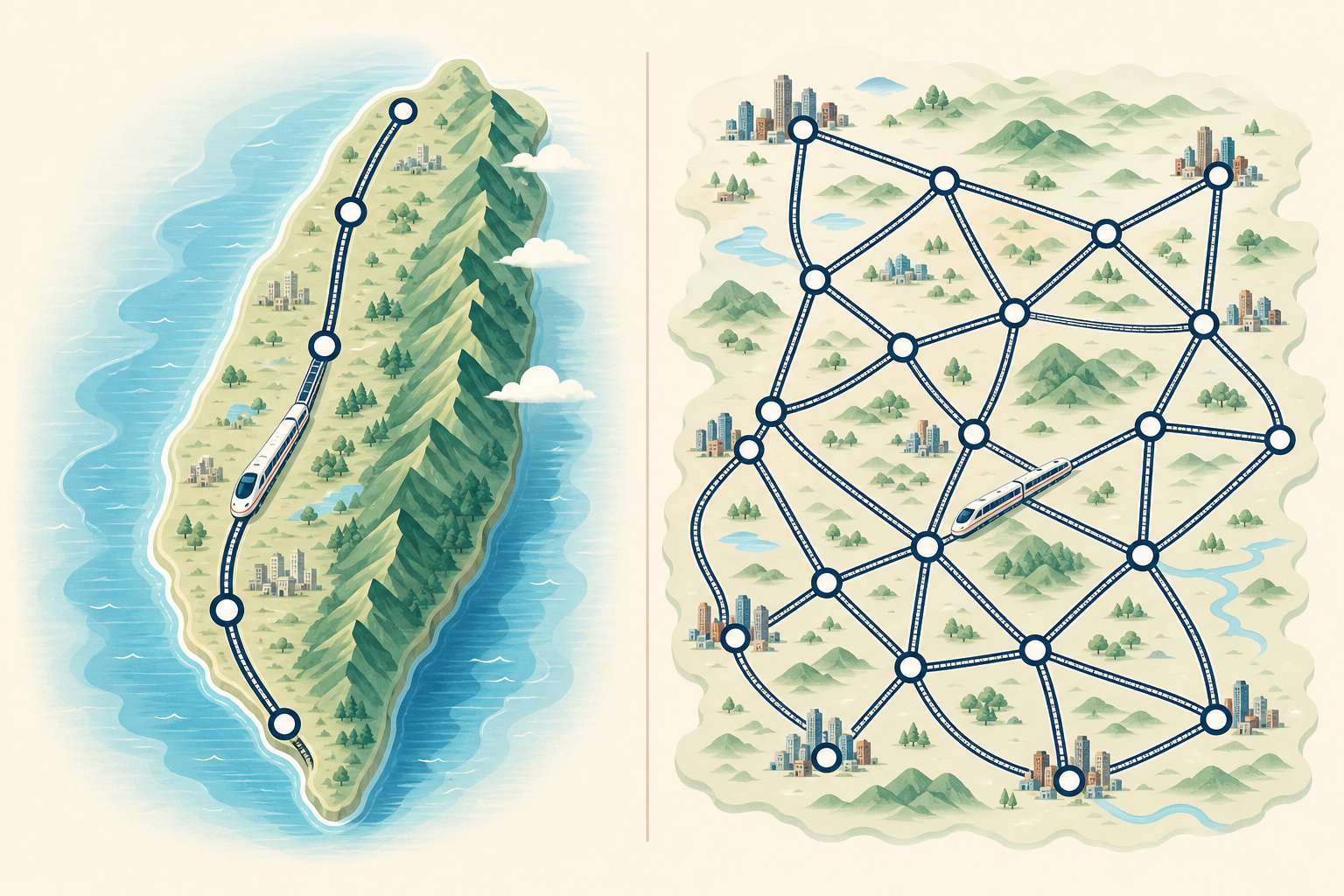
Here is where the two systems diverge sharply. Taiwan is one excellent line. Mainland China is a continent-sized web.
| Feature | Taiwan HSR | Mainland China HSR |
|---|---|---|
| Network length | ~350 km (1 line) | ~48,000 km (many lines) |
| Stations | 12 | 3,000+ served |
| Top service speed | 300 km/h | 350 km/h (400 km/h from 2026) |
| Train technology | Shinkansen-based 700T | Fuxing (CR400 / CR450) |
| Flagship route | Taipei–Kaohsiung, 1h 45m | Beijing–Shanghai, ~4.5h |
| Currency | New Taiwan Dollar (NT$) | Chinese Yuan (¥/RMB) |
| Booking app | THSR official / Klook | 12306 / Trip.com |
The takeaway is not that one is “better.” Taiwan does one job beautifully. Mainland China’s system is what lets you build a real multi-city itinerary, and its newest trains are the fastest scheduled trains on earth. China’s network already carries roughly two-thirds of the world’s high-speed rail traffic.
The 2026 headline on the mainland side is the CR450. It is designed for a 400 km/h commercial speed, up from today’s 350 km/h, and China State Railway Group expects it to finish operational testing in 2026. When it enters service, it will trim time off long corridors like Beijing–Guangzhou. Taiwan has no plan to chase those speeds; its geography does not need them.
Scale changes how you travel, too. In Taiwan you pick a station on one line. In mainland China you might chain Shanghai to Hangzhou to Huangshan to Beijing across several lines in a week, and the trains connect the way flights used to. If a multi-city China route is your plan, our trains and metro travel hub breaks down how the pieces fit together.
Speed, price and comfort head to head
On price, both systems are strong value, but mainland China wins per kilometer.
A standard Taipei–Kaohsiung ticket is about NT$1,490 (roughly US$46) for a 350 km ride. In mainland China, Beijing–Shanghai is 1,318 km — nearly four times the distance — and second class runs about ¥553 (roughly US$77). That is a huge amount of ground covered for the money, and it usually beats flying once you count airport time.
Comfort is comparable and both beat most Western trains. Taiwan’s 700T has business and standard cars in a calm, quiet cabin. China’s Fuxing trains have second class, first class and business class, with power outlets at every seat, generous legroom, and Wi-Fi on many services. Business class on a Fuxing is a wide, near-flat seat that costs a fraction of a flight’s business fare.
Priya, visiting from Manchester on a visa-free stopover, took Beijing to Xi’an in second class for the Terracotta Army. She paid under US$80, arrived rested in a little over four hours, and skipped an airport entirely.
One practical difference: luggage. Neither system weighs your bags or charges per bag like an airline, and both have overhead racks plus end-of-car space for large cases. Food is easy too — stations sell snacks and meals, and mainland trains have a trolley service and hot-water dispensers, so instant noodles are a real onboard tradition. If you want quiet, book a seat away from the vestibule doors on either system.
Booking mainland China trains as a foreigner (the part that matters)
This is where newcomers get nervous, so here is the plain version. In mainland China, your passport is effectively your ticket.
You buy online, no paper ticket needed. You can use the official 12306 app or an English-language platform like Trip.com, which accepts foreign passports and international cards. Book from up to 15 days ahead until about 30 minutes before departure. Popular routes and holidays sell out, so book early.
At the station you go through a passport scan and a quick security check, then walk to the automatic gate. Tap or scan the same passport you booked with, and the gate opens. Aim to arrive about 30–45 minutes before departure; large stations are big.
A few things that surprise first-timers:
- Your name on the booking must exactly match your passport.
- China runs cashless — set up mobile payment before you travel. Our Alipay guide for foreigners walks through it.
- Seats are assigned; there is no free-for-all.
For a full step-by-step, see how to book China high-speed train tickets. If you would rather someone handle names, dates and connections for you, our team can book your China train tickets and send seat confirmations.
Can one trip cover both? Understanding the divide
No single ticket, app or rail pass covers both systems. Taiwan and mainland China are entirely separate networks with separate currencies, separate booking platforms and no rail link between them — they are separated by ocean.
Practically, that means you plan two different trips. A Taiwan visit uses the THSR line and New Taiwan Dollars. A mainland China visit uses the national network, Chinese Yuan and either 12306 or Trip.com.
Entry rules differ too, and mainland China is the one that changed most in recent years. Many nationalities now enter visa-free for short stays or use the extended visa-free transit policy. Check current rules on our visa and entry hub before you book, and read up on the visa-free transit policy if you are connecting through.
Frequently asked questions
How fast is the Taiwan high speed rail?
Taiwan HSR trains run at a top service speed of 300 km/h. The fastest Taipei to Kaohsiung trip takes about 1 hour 45 minutes across the 350 km line. Mainland China’s trains are faster, topping out at 350 km/h, with a new 400 km/h class arriving in 2026.
Is Taiwan HSR the same as China’s bullet trains?
No. They are completely separate systems. Taiwan HSR is one 350 km line using Shinkansen-based trains. Mainland China has roughly 48,000 km of track using its own Fuxing trains. Different networks, different currencies, different booking apps, and no rail connection between them.
Do I need to book China train tickets before I arrive?
Yes, especially for popular routes and holidays, which sell out fast. You can book up to 15 days ahead on 12306 or Trip.com using your passport. There is no paper ticket in mainland China — your passport opens the station gate.
Which is cheaper, flying or the train in China?
The train usually wins for trips under about 1,000 km once you count airport time and transfers. Beijing to Shanghai in second class is around ¥553 (about US$77), often less than the flight and with no airport hassle at either end.
Can foreigners buy Taiwan HSR tickets easily?
Yes. Use the official THSR app or a platform like Klook, often with a discount. You can also buy at station machines and counters. Taiwan’s system is small and English-friendly, so same-day travel is usually no problem outside major holidays.
Is there Wi-Fi and power on these trains?
Mainland China’s Fuxing trains have power outlets at every seat and Wi-Fi on many services, so you can work the whole way. Taiwan’s 700T trains offer free Wi-Fi and power in the cabins too. On both systems, download maps and offline content before you board, since coverage can drop in tunnels.
Before you go: your China rail checklist
A short list to get you moving.
- Confirm your entry route on the visa and entry hub — visa-free, transit, or a standard visa.
- Set up Alipay or WeChat Pay before departure; China is cashless.
- Book high-speed tickets early for Beijing, Shanghai, Xi’an and other headline routes.
- Bring the exact passport you booked with — it is your ticket at the gate.
- Arrive 30–45 minutes early at big stations for the passport scan and security.
Taiwan’s single line is a joy, but the real high-speed adventure for most first-timers is mainland China’s network — and it is easier to ride than it looks. Skip the app confusion and let us handle it: get a free quote and book your China train tickets with seats confirmed and names checked against your passport.
Sources: Taiwan High Speed Rail (official), Taiwan High Speed Rail — Wikipedia, High-speed rail in China — Wikipedia
Featured image: “Taiwan High Speed Rail train 854 at Taichung HSR station March 2026.jpg” by 4300streetcar, via Wikimedia Commons, CC BY 4.0.