
The Shanghai French Concession is a leafy, walkable neighborhood of 1920s villas, plane-tree tunnels, and independent cafes in the city’s Xuhui and Huangpu districts. You do not buy a ticket to enter it. You just walk in, coffee in hand, and let the streets do the work.
Locals call it the "Former" French Concession, because the concession itself ended in 1943. What survives is the architecture: Art Deco apartment blocks, brick lane houses, and the triangular Wukang Mansion that anchors a thousand photos a day. This is where old Shanghai still feels like a real place people live in, not a museum.
Most first-time visitors under-plan it. They rush through in an hour on the way to somewhere flashier. That is a mistake. Give it a slow half-day, know which streets to hit, and you will understand why this is the most sought-after patch of ground in mainland China.
Key Takeaways
- The Former French Concession is free to enter; you only pay for coffee, food, and any museums you choose to visit.
- Best photo spot: Wukang Mansion, a 1924 triangular building by architect László Hudec at Wukang Road and Middle Huaihai Road.
- Nearest metro stops: Shanghai Library (Line 10), Changshu Road (Lines 1 and 7), and South Shaanxi Road (Lines 1, 10, 12). Fares run ¥3–9.
- A specialty latte runs ¥35–45 on Anfu Road and Julu Road, the neighborhood’s cafe belt.
- Come in spring (March–May) or autumn (September–November) for the famous plane-tree canopy.
What is the Shanghai French Concession?
France leased this land from the Qing government in 1849 and expanded it over the next 90 years. French planners lined the streets with London plane trees starting around 1902. Locals nicknamed the tree "Faguo Wutong," the French phoenix tree, and its shade still defines the area’s mood.
The concession dissolved in 1943 during the war years, and the name "French" is now purely historical. No part of it is French-administered today. It is central Shanghai, run like the rest of the city.
What makes it special is density of old buildings. Nowhere else in China packs this many intact 1920s and 1930s villas, apartment houses, and shikumen (stone-gate) lane homes into one walkable grid. Developers cleaned up but did not flatten it.
The area sprawls across two districts. The western half sits in Xuhui, home to Wukang Road and the quiet villa streets. The eastern half falls in Huangpu, where you find Xintiandi and Fuxing Park. You will cross between them without noticing; there is no border, just a gradual shift from sleepy to busy.
A quick word on the name. Some maps and older guidebooks still write "French Concession" as if it were an official zone. It is not. Shanghai’s own tourism board lists these as historic streets and conservation areas, and the official Shanghai government travel site is a reliable place to check current opening details for parks and museums.
French Concession Shanghai: what to do and see

You could wander with no plan and still have a great day. But a few anchors are worth aiming for.
Wukang Mansion is the signature landmark. This ship-shaped, 1924 building sits where five roads meet, designed by the Hungarian architect László Hudec, who shaped much of old Shanghai’s skyline. Stand on the far corner of Middle Huaihai Road for the classic angle. It gets crowded on weekends, so arrive by 9:30 a.m.
Wukang Road itself, running north from the mansion, holds the densest run of original architecture. Small boutiques and cafes fill the ground floors. It is a slow, low-rise street built for strolling.
Tianzifang is a warren of narrow shikumen lanes off Taikang Road (Lane 210). Craft shops, tiny galleries, and street-food stalls fill spaces that still feel lived-in. Entry is free; most shops open around 10 a.m. and run to 10 p.m. Go early or on a weekday to avoid the crush.
Xintiandi is the polished cousin. Developers rebuilt these shikumen blocks into an upscale dining and shopping zone. It is cleaner and pricier than Tianzifang, with less grit and more brand-name gloss. Both are worth seeing to feel the contrast.
Fuxing Park is a French-style formal garden, free and open daily until dusk. Come early morning to watch retirees dance, play cards, and practice tai chi under the trees.
Beyond the big names, the pleasure is in the small stuff. Look for the Art Deco doorways on Fuxing Road West, the wrought-iron balconies on Sinan Road, and the former residences of historical figures scattered through the grid, many marked with small bronze plaques. You do not need to enter them to enjoy them.
Street food deserves a mention too. Between the boutique cafes you will still find local breakfast stalls selling jianbing (savory crepes) and shengjianbao (pan-fried pork buns) for a few yuan. Eating one on a bench under the plane trees costs almost nothing and beats any tourist restaurant for atmosphere.
Emma, a first-timer from Manchester, budgeted one hour and stayed four. She started at Wukang Mansion, drifted up Wukang Road, then got happily lost in the side lanes until her phone battery died.
The best French Concession cafes and coffee streets
Shanghai has more coffee shops than any city on earth, and this neighborhood is the epicenter. The scene runs from third-wave roasters to designer brunch spots.
Anfu Road is the heart of it. Independent cafes, small designer labels, and lifestyle shops draw Shanghai’s young creative crowd. It is where locals actually hang out, not a tourist strip.
Julu Road and the lanes around Wuyuan Road hold quieter roasters, good for a break between walks. Expect to pay ¥35–45 for a latte, roughly New York prices, but the quality is genuinely high.
Beyond coffee, the neighborhood has become a serious food destination. Anfu Road and its neighbors hold natural-wine bars, dumpling spots, and Sichuan restaurants that fill up fast on weekend evenings. Book ahead for anywhere with a name; the good places turn tables quickly.
You will need a mobile payment app for almost all of them. Cash is awkward and cards are hit-or-miss. Set up Alipay before you arrive; our guide on how to use Alipay in China as a foreigner walks through linking a foreign card.
Carlos, visiting from Madrid, worried he would need cash for small cafes. He linked his Visa to Alipay at the airport and paid for every flat white by scanning a QR code.
Getting around and nearest metro stops
Walking is the point here. The neighborhood is flat and compact, and the best bits are only reachable on foot. But the metro gets you to the edges fast and cheap.
| Metro Station | Lines | Walk to | Best for |
|---|---|---|---|
| Shanghai Library | Line 10 | Wukang Road area | Villas, Wukang Mansion |
| Changshu Road | Lines 1, 7 | Anfu Road, cafe belt | Coffee, boutiques |
| South Shaanxi Road | Lines 1, 10, 12 | Middle Huaihai Road | Shopping, central FFC |
| Xintiandi | Lines 10, 13 | Xintiandi, Fuxing Park | Dining, shikumen |
| Dapuqiao (Exit 1) | Line 9 | Tianzifang | Craft lanes, street food |
Fares run ¥3–9 by distance. Buy single-ride tickets from station machines, or add the metro to Alipay for a scan-and-go QR code, which is far easier.
One warning: Google Maps does not work reliably in China. Download Amap (Gaode) or use Apple Maps, which pulls Chinese map data locally. For the full picture on moving around the city, see our trains and metro guide.
A practical half-day walking route
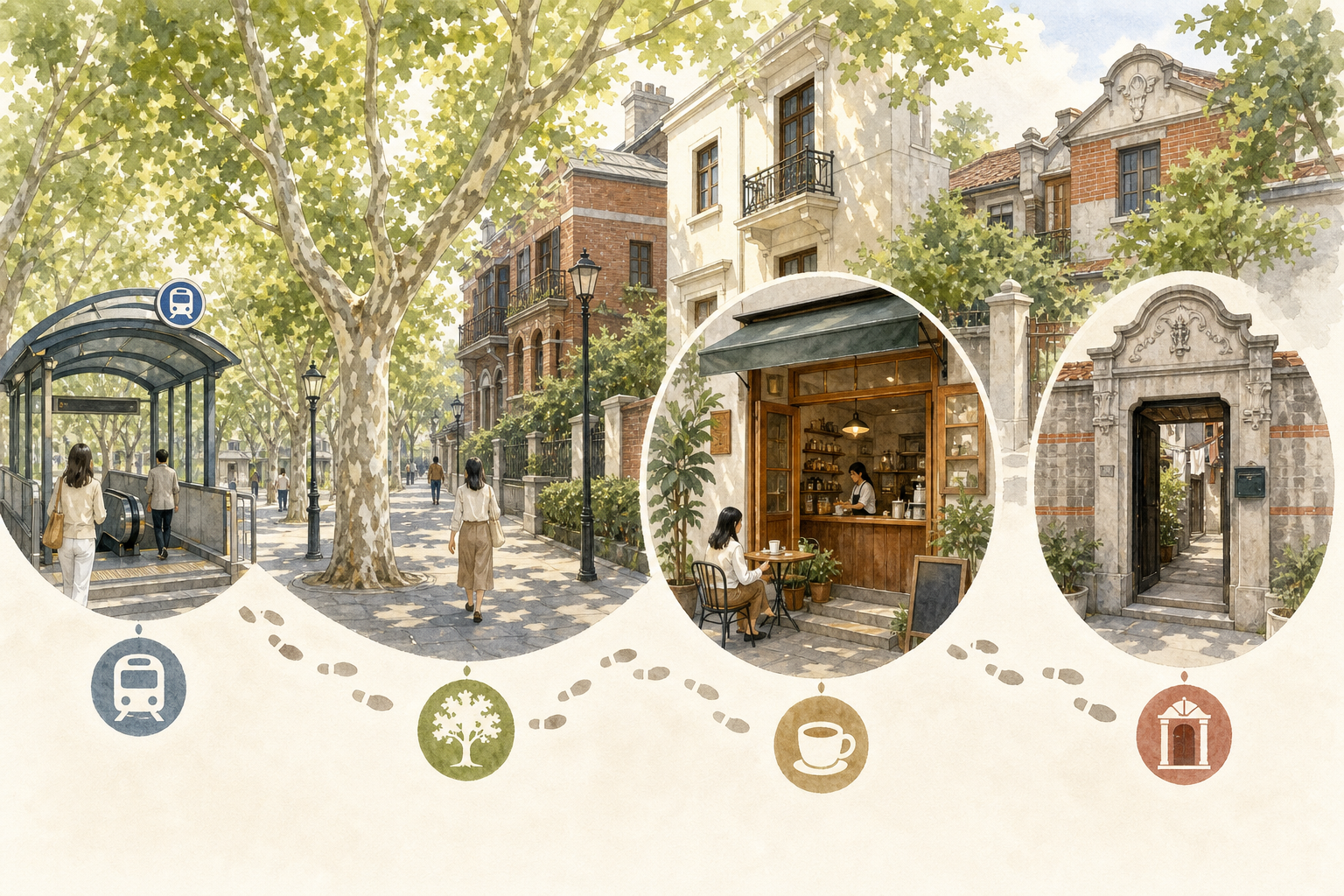
Here is a route that hits the highlights without backtracking. Start mid-morning on a weekday if you can.
- Exit at Shanghai Library (Line 10) and walk to Wukang Mansion for photos.
- Head north up Wukang Road, browsing boutiques and grabbing a coffee.
- Cut east toward Anfu Road for the cafe scene and people-watching.
- Continue to Fuxing Park for a quiet green break.
- Finish at Tianzifang (via Dapuqiao, Line 9) or Xintiandi for dinner and shopping.
The whole loop runs three to four hours at a relaxed pace, longer if you stop often. Wear comfortable shoes; the sidewalks are uneven brick in places.
If you want a proper bed nearby, the concession and neighboring Jing’an have excellent boutique stays. Our Shanghai hotels page can help you pick a base within walking distance.
Frequently asked questions
Is the Shanghai French Concession free to visit?
Yes. The neighborhood is open public streets with no entry fee. You only pay for food, coffee, shopping, and optional paid attractions like certain historic residences. Walking the streets, photographing Wukang Mansion, and entering Tianzifang and Fuxing Park all cost nothing.
How much time should I spend in the French Concession?
Plan at least half a day, three to four hours. That covers the main streets, a couple of cafes, and one of Tianzifang or Xintiandi. Architecture fans and slow travelers easily fill a full day, especially if they linger over coffee and duck into side lanes.
What is the nearest metro station to Wukang Mansion?
Shanghai Library station on Line 10 is closest, a short walk away. Changshu Road (Lines 1 and 7) also works and drops you near the Anfu Road cafe belt. Single metro rides cost ¥3–9 depending on distance.
When is the best time to visit the French Concession?
Spring (March to May) and autumn (September to November) are ideal. The plane trees are full and the weather suits long walks. Weekday mornings, roughly 9:00 to 11:30 a.m., are quietest for photos before the weekend crowds and tour groups arrive.
Can I visit Shanghai without a visa in 2026?
Many travelers can, under the 240-hour visa-free transit policy, if they are flying onward to a third country. Citizens of 55 countries qualify, including the US, UK, Canada, Australia, and most of the EU. See our visa-free transit guide and verify current rules with the National Immigration Administration before you fly.
Do I need cash for the French Concession?
Not really. Almost every cafe, shop, and metro station accepts Alipay or WeChat Pay via QR code, and you can link a foreign card. Carry a small amount of cash as backup, but most visitors go a full day scanning codes without touching a banknote.
Before you go: your action list
A little prep turns a good day into a smooth one. Handle these before you land.
- Set up Alipay or WeChat Pay and link a foreign card for coffee, metro, and shops.
- Download Amap or use Apple Maps, since Google Maps is unreliable in China.
- Confirm your visa-free transit eligibility if you are transiting; check the National Immigration Administration rules.
- Visit in spring or autumn for the plane-tree canopy, and start walks on a weekday morning.
- Book a hotel in or near the concession so you can walk out the door into it.
Getting to Shanghai and moving between Chinese cities is easier than most first-timers expect, especially by high-speed rail. Get a free train ticket quote from RelaxInChina and let us handle the booking, the platform Chinese, and the confusing bits, so you can spend your time under the plane trees instead of in a ticket queue.
Featured image: “Street View of Hengshan Rd..JPG” by Livelikerw, via Wikimedia Commons, CC BY-SA 3.0.