
No. Swiss citizens do not need a visa for China in 2026 for most short trips. If you hold an ordinary Swiss passport, you can enter mainland China visa-free and stay up to 30 days for tourism, business, visiting family or friends, exchange, or transit.
China put Switzerland on its visa-free list and has now extended that policy through 24:00 on December 31, 2026. So a Swiss couple flying Zurich to Shanghai for a two-week trip walks straight up to immigration with just a passport. No embassy visit, no application form, no fee.
That single change turns a trip that used to take weeks of paperwork into a plane ticket and a packed bag. But "no visa" is not the same as "no rules." The 30-day clock, the allowed reasons for visiting, and a new digital arrival card all matter at the border.
This guide walks a first-time visitor through exactly what applies to a Swiss passport, what to prepare, and the traps that catch people who assume visa-free means paperwork-free.
Key Takeaways
- Swiss ordinary passport holders can enter mainland China visa-free for up to 30 days, extended through December 31, 2026.
- The 30 days are counted from the day after entry, and you can enter multiple times during the policy period.
- Allowed purposes: business, tourism, family/friend visits, exchange, and transit — not work, study, or journalism.
- Everyone must now complete the China Digital Arrival Card (CDAC) online, ideally within 24 hours before landing. It is free.
- Longer stays, working, or studying still require a regular visa from a Chinese visa center before you fly.
The short answer: Switzerland’s China visa situation in 2026

Switzerland is one of roughly 50 countries whose ordinary-passport holders enjoy China’s unilateral 30-day visa exemption. China introduced it as a trial and has repeatedly pushed the end date back — the current extension runs to the end of 2026.
The policy is spelled out in official notices from the Chinese Embassy in Switzerland and China’s National Immigration Administration. It covers ordinary passports only. Swiss holders of service passports, or anyone traveling for a reason outside the allowed list, still needs a visa in advance.
Take Lukas, a marketing manager from Bern flying to Shenzhen for a five-day trade fair and supplier meetings. Business is a covered purpose, and five days is well under 30, so he enters visa-free with just his passport.
Compare that to his colleague who is relocating to Guangzhou for an 11-month posting. That is work, not a short business trip, so she must apply for the correct work visa (a Z visa) and residence permit before leaving Switzerland.
The line is the purpose and the length, not your nationality. Get both right and a Swiss passport is one of the easiest ways into China right now.
How the 30-day visa-free stay actually works
The most misunderstood part is how the 30 days are counted. The clock does not start the moment you land — it starts the next day. So if you enter on June 1, day one is June 2, and your 30th day is July 1. You should leave on or before that date.
You may also enter more than once during the policy window. Each separate stay simply cannot exceed 30 days. A traveler doing China, then Vietnam, then back into China is fine, as long as each Chinese stay stays under the limit.
| Rule | What it means for a Swiss traveler |
|---|---|
| Maximum stay | 30 days per entry |
| When counting starts | The day after you enter, not arrival day |
| Number of entries | Multiple entries allowed during the policy period |
| Passport type | Ordinary Swiss passport only (not service passports) |
| Allowed purposes | Business, tourism, family/friends, exchange, transit |
| Not allowed | Work, study, news reporting, or similar |
| Policy valid until | 24:00, December 31, 2026 |
| Cost | Free — no visa fee |
One caution: this exemption is separate from China’s 240-hour (10-day) visa-free transit rule. Swiss travelers rarely need transit rules because the 30-day exemption is longer and more flexible. Use the 30-day exemption for any normal holiday or business trip.
If you genuinely need more than 30 days in one go, do not try to stretch it. Overstaying leads to fines, detention, or a future entry ban. Apply for a tourist (L) visa instead, which can allow a longer stay.
What you still need to prepare before you fly
Visa-free does not mean prepare-nothing. Border officers can still ask you to show why you qualify, so carry a few basics.
First, your passport should stay valid for your whole trip; six months of remaining validity is the safe standard many airlines expect. Second, be ready to show a return or onward ticket and a hotel booking. Officers may ask for proof that matches your stated purpose.
Anja, a photography student from Lausanne, flew to Chengdu for a two-week holiday. At immigration she was asked her reason for visiting and her departure date. She showed her return flight on her phone and was waved through in under a minute.
The newer requirement most people miss is the China Digital Arrival Card (CDAC). Since late 2025, nearly all travelers — including visa-free ones — must complete this online form. It replaced the old paper card and folded in the health declaration.
You can fill it out within roughly the three days before arrival on the National Immigration Administration’s official site, and submitting within 24 hours of your flight is the common advice. Do it in advance to skip queues. It is completely free — ignore any website that charges for it.
A quick planning checklist for Swiss visitors
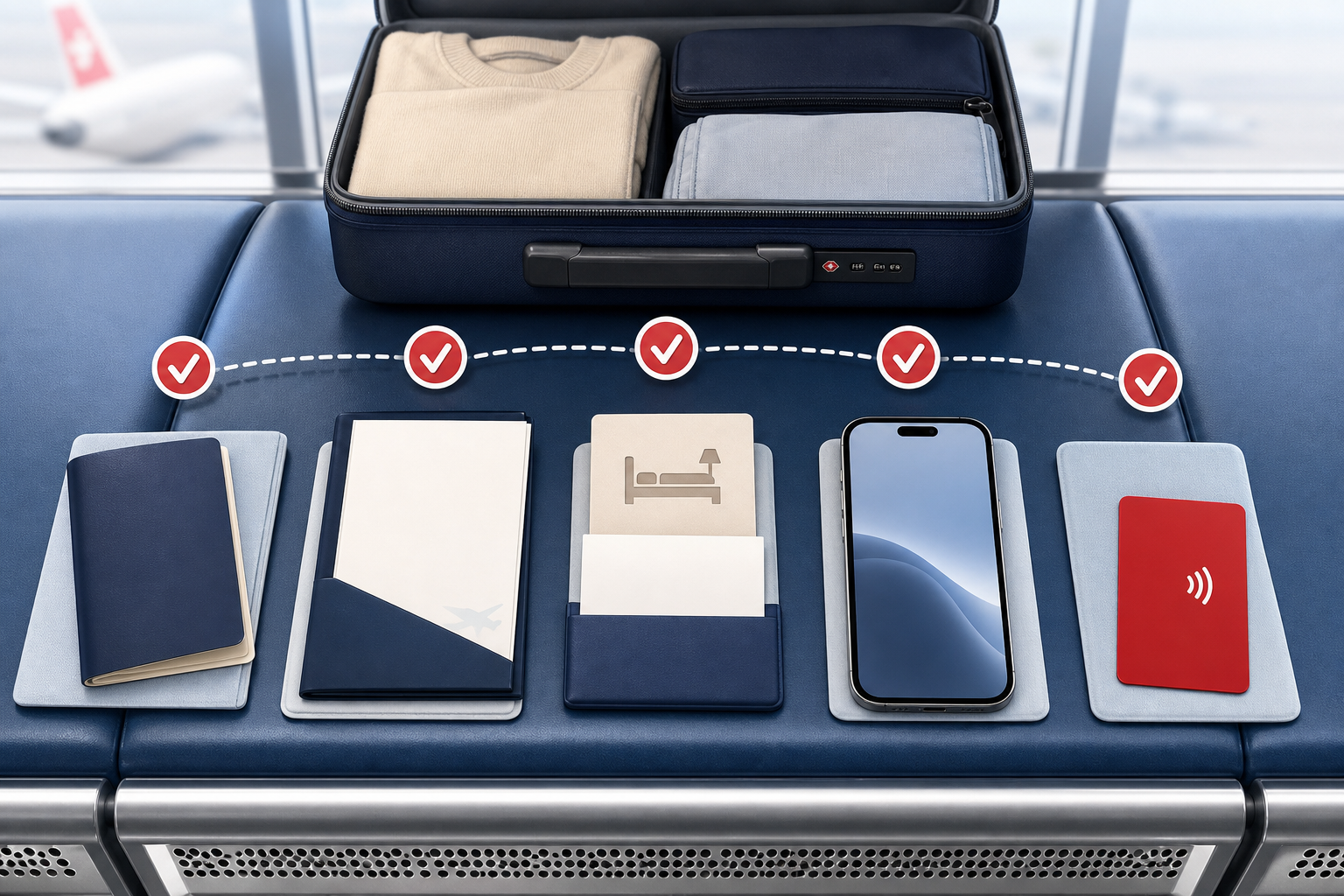
Here is what an efficient Swiss trip looks like from booking to boarding.
| Step | Detail |
|---|---|
| Check passport | Valid for whole trip; 6 months’ validity is safest |
| Confirm purpose | Tourism, business, family, exchange, or transit only |
| Book return/onward flight | Keep it accessible on your phone |
| Reserve accommodation | A hotel booking covers your first nights and address registration |
| Fill the CDAC | Online, free, within ~24 hours before arrival |
| Set up payments | Link a card to Alipay or WeChat Pay before you land |
| Plan intercity travel | Reserve high-speed train tickets early |
Two practical notes for first-timers. Cash is rarely used, so set up mobile payments in advance — our Alipay guide for foreigners walks through linking a Swiss card so you can pay for taxis, noodles, and metro tickets on day one.
Also register your address within 24 hours of arrival. Hotels do this for you automatically at check-in. If you stay with friends or in a private rental, you register yourself at the local police station.
Getting around once you are in
With entry sorted, the fun part is moving between cities. China’s high-speed rail is the standout: Beijing to Shanghai runs in about 4.5 hours at up to 350 km/h, far easier than flying for many routes.
Marc, a retiree from Geneva, planned a Beijing–Xi’an–Shanghai loop entirely by train. He booked reserved seats in advance, walked through station security with his passport, and never touched a domestic flight. He was surprised how much cheaper and calmer it felt than airport hopping.
Foreign passports work at the ticket gates, but the booking process has quirks worth knowing before you go. The name on your ticket must match your passport exactly, and at the gate you scan the passport itself rather than a printed ticket. Our guide to booking China high-speed train tickets covers both steps in detail.
One more tip: arrive at big stations 40 to 60 minutes early. Security lines and the walk to distant platforms take longer than in Swiss stations, and trains leave exactly on time — miss it by a minute and the gate closes. For everything else about entering the country, browse our visa and entry hub.
Frequently asked questions
Do Swiss citizens need a visa for China in 2026?
No. Ordinary Swiss passport holders can enter mainland China visa-free for up to 30 days per trip through December 31, 2026, for tourism, business, family visits, exchange, or transit. Only longer stays or purposes like work and study require a visa applied for in advance.
How long can a Swiss citizen stay in China without a visa?
Up to 30 days per entry. The count starts the day after you arrive, not on your arrival day. You can enter multiple times during the policy period, but each individual stay must not exceed 30 days. For a longer single stay, apply for a tourist (L) visa.
Does the visa-free rule apply to Swiss service or diplomatic passports?
No. The 30-day visa exemption covers ordinary Swiss passports only. Holders of service passports, and anyone visiting for work, study, or journalism, must apply for the appropriate Chinese visa before traveling, regardless of trip length.
What is the China Digital Arrival Card and do Swiss travelers need it?
The CDAC is a free online arrival form that replaced the paper card in late 2025. Nearly all arrivals, including visa-free Swiss travelers, must complete it, ideally within 24 hours before landing, on the National Immigration Administration’s official website. Beware of copycat sites that charge a fee.
Can I extend my 30-day visa-free stay once I am in China?
The 30-day exemption is generally not extendable. If you need more time, leave and re-enter (each stay under 30 days), or apply for a proper visa before you travel. Overstaying risks fines, detention, and future entry bans, so plan your exit date carefully.
Do I need travel insurance or proof of funds?
Neither is a strict visa-free requirement, but travel insurance covering medical care is strongly recommended. If you fall ill, see our overview of medical care in China. Carry a return ticket and hotel booking as proof of your plans in case border officers ask.
Before you go: your action list
Run through this the week before you fly, and China becomes one of the easiest big trips you can take on a Swiss passport.
- Confirm your ordinary passport is valid for the whole trip (six months’ validity is safest).
- Double-check your reason for visiting is on the allowed list.
- Book a return or onward flight and keep it on your phone.
- Complete the free China Digital Arrival Card within 24 hours before you land.
- Set up Alipay or WeChat Pay before departure so you can pay from day one.
- Reserve intercity trains early — the best seats sell out on popular routes.
Ready to lock in your route between cities? China’s bullet trains are the smart way to see Beijing, Xi’an, Shanghai, and beyond — and English booking can be confusing on official apps. Get a free quote and book your China train tickets with us so your seats are reserved before you even land in Shanghai.
Sources: Chinese Embassy in Switzerland — notice extending the visa exemption policy for Swiss citizens; Chinese Embassy in the USA — FAQs on Visa-Free Entry into China (updated 2026); National Immigration Administration — official Arrival Card filling portal. Visa rules change; always confirm on the official Chinese embassy or NIA site before booking.
Featured image: “Swiss Flag.jpg” by Hp.Baumeler, via Wikimedia Commons, CC BY-SA 4.0.