
This Chengdu travel guide gives you the plan a first-time visitor actually needs: see the giant pandas early, eat real Sichuan food, and use the fast trains to reach the big sights nearby. Chengdu is the capital of Sichuan province in southwest China, and it is one of the easiest big cities to enjoy without speaking Mandarin.
Most people come for two things: the pandas and the food. You can do both well in three days. The city is flat, the metro is clean and cheap, and Alipay handles almost every payment, so you rarely need cash.
Here is the part few guides say plainly. The panda base is best at opening time, not midday, because pandas nap in the afternoon heat. Get that one detail right and the rest of your trip falls into place. Chengdu also sits inside China’s 240-hour visa-free transit zone, so many travelers can fly in for up to 10 days with no visa at all.
Key Takeaways
- The Chengdu Research Base of Giant Panda Breeding costs CNY 55 for adults; book online up to 14 days ahead and arrive by 8:00 a.m. for active pandas.
- Metro Line 3 reaches Panda Avenue station, then a short shuttle or taxi gets you to the base gate.
- Sichuan province is in the 240-hour visa-free transit program, letting eligible passport holders stay up to 10 days with no visa.
- Leshan’s Giant Buddha is a doable day trip: about 1 hour each way by high-speed train from Chengdu East.
- Spring (March–May) and autumn (September–November) bring the best weather, around 20–24°C, and the most active pandas.
Seeing the giant pandas the smart way

The Chengdu Research Base of Giant Panda Breeding is the main reason most people visit, and it lives up to it. This is a real breeding and research center, not a zoo, spread across leafy hills about 10 km north of downtown.
An adult ticket is CNY 55, booked online in advance. Children aged 6 and under (or under 1.3 m) and visitors 60 and over enter free with original ID. You can reserve up to 14 days ahead, and popular dates sell out, so book early.
Timing is everything. Giant pandas are most active in the cool morning, roughly 7:30–9:30 a.m., then they eat and sleep through the afternoon. The base opens at 7:30 a.m. from March to October (8:00 a.m. in winter), so aim to be at the gate at opening.
Anna, a solo traveler from Berlin, arrived at 8:00 a.m. on a Tuesday and had the Baby Panda Villa nearly to herself; by 11:00 a.m. the same spot was three people deep. Note the Baby Panda Villa closes on Mondays for management.
To get there, take Metro Line 3 to Panda Avenue station, then a short taxi or the shuttle to the gate. An on-site sightseeing bus runs the long loop for about CNY 30 if you would rather not walk the whole park.
Book your panda ticket through Trip.com or the base’s official WeChat mini-program. Trip.com is the easiest route if you do not have a Chinese bank card, and it ties the ticket to your passport. Bring your physical passport, because staff check it at entry.
What to eat in Chengdu: real Sichuan food
Chengdu is a UNESCO City of Gastronomy, and the food alone is worth the flight. Sichuan cooking is built on two sensations: là (chili heat) and má (the tingling numbness of Sichuan peppercorns). Together they make the famous málà flavor.
Hotpot is the local ritual. You sit around a bubbling pot of beef-tallow broth stacked with chili and peppercorns, then cook thin meat, tofu, and vegetables yourself. Ask for a yuanyang (split) pot with a mild half if you are new to the heat.
Do not miss mapo tofu at its birthplace. Chen Mapo Tofu, founded in the Qing dynasty, holds a Michelin star and still serves the original silky-numbing version. Other must-try dishes include kung pao chicken, dan dan noodles, and zhong dumplings in sweet-spicy sauce.
| Dish | What it is | Heat level | Where to try |
|---|---|---|---|
| Hotpot (火锅) | DIY simmered meats and veg in chili-tallow broth | High (ask for split pot) | Any busy local chain |
| Mapo tofu (麻婆豆腐) | Silken tofu, minced beef, peppercorns | Medium-high | Chen Mapo Tofu |
| Dan dan noodles (担担面) | Noodles with chili oil and pork | Medium | Street stalls, Yulin area |
| Kung pao chicken (宫保鸡丁) | Diced chicken, peanuts, dried chili | Medium | Most restaurants |
| Sweet water noodles (甜水面) | Chewy noodles, sweet-spicy sauce | Low-medium | Kuanzhai Alley |
For hunting these dishes, two areas stand out. Jinli and Kuanzhai Alley are the polished, tourist-friendly lanes for snacks and photos. Yulin, south of the center, is home to cangying guanzi ("fly restaurants") — tiny, no-frills spots that locals swear by.
Marcus, visiting from Toronto, told his server "bu yao la" (no spice) out of caution and got a bland bowl; on day two he asked for "wei la" (mild) and finally tasted why Chengdu is famous. A little spice is the point.
Things to do in Chengdu beyond pandas
The pandas and the food are the headline, but Chengdu rewards a slower pace. The city’s calm teahouse culture is a highlight in its own right, and you can fill two or three days without ever feeling rushed.
Start at People’s Park and the century-old Heming Teahouse. Order a covered cup of jasmine tea, watch locals play mahjong, and try the famous (and oddly relaxing) ear-cleaning service. It is the clearest window into everyday Chengdu life.
Wenshu Monastery is the city’s best-preserved Buddhist temple, with a quiet vegetarian dining hall. Nearby, Jinli and Kuanzhai Alley recreate old Chengdu with lantern-lit lanes, tea, and street snacks — touristy but genuinely pretty at dusk.
If you have time, Chengdu is a natural base for exploring more of Sichuan. Our wider Sichuan and China city guides can help you extend the trip toward Chongqing or the mountains.
Best day trips from Chengdu by train
Chengdu’s high-speed rail makes the region’s biggest sights easy. From Chengdu East Railway Station you can reach several world-class destinations and be back for a late dinner.
| Day trip | Train time (one way) | What you’ll see | Overnight needed? |
|---|---|---|---|
| Leshan Giant Buddha | ~1 hour | The world’s largest stone Buddha (UNESCO) | No |
| Dujiangyan | ~30 min | Ancient irrigation system + Mount Qingcheng | No |
| Mount Emei | ~1.5 hours | Sacred Buddhist peak, dawn Golden Summit | Yes (for sunrise) |
The Leshan Giant Buddha is the standout. Carved into a red cliff over 1,300 years ago, it stands 71 meters tall — you feel small standing at its feet. Trains from Chengdu East run frequently and take about an hour; from Leshan station it is a short taxi to the scenic area.
Dujiangyan pairs a 2,000-year-old engineering marvel with the leafy Taoist Mount Qingcheng, and the train back to Chengdu is only 30 minutes. Mount Emei is grander but really wants an overnight so you can catch sunrise on the Golden Summit.
Booking trains is simple once you know the steps. See our walkthrough on how to book China high-speed train tickets, or skip the hassle and request a free train-ticket quote and we will handle the reservations for you.
Getting around and paying: the practical stuff
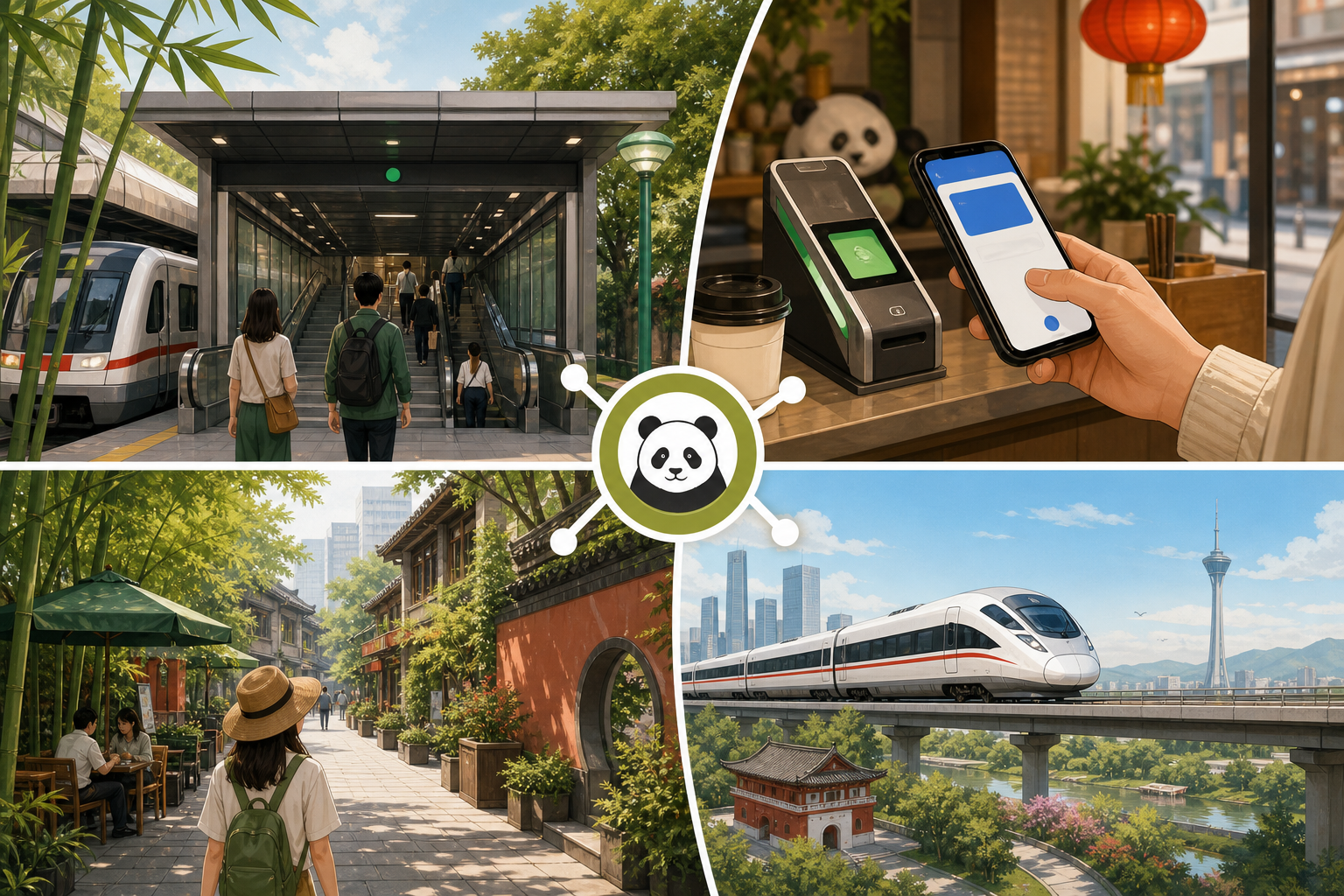
Chengdu has two airports. Tianfu International (TFU) is the newer main hub, reached by Metro Line 18; Shuangliu (CTU) is closer to the center on Line 10. The new Line 19 links both airports in about 30 minutes, which is handy if your connection lands at the "wrong" one.
The metro is your best friend here — modern, air-conditioned, and cheap, with signs and announcements in English. Add the "Transport" QR code inside Alipay before you travel, scan at the gate, and skip ticket machines entirely.
For payments, set up Alipay or WeChat Pay before arrival by linking an international card. Cash is rarely needed, and most taxis, shops, and restaurants scan your phone. Our guide to using Alipay in China as a foreigner covers the setup step by step.
DiDi (China’s ride-hailing app) works inside Alipay and is cheaper than flagging taxis, with an in-app translation feature for your driver. For everything else — eSIMs, VPNs, and staying online — check our connectivity guide before you fly.
When to visit and how long to stay
Spring (March–May) and autumn (September–November) are the sweet spots, with mild temperatures around 20–24°C, less rain, and the most active pandas. April and October are especially comfortable.
Summer (June–August) is hot and rainy, so pack a light rain jacket and non-slip shoes. Winter is cool and often grey but rarely freezing, and crowds thin out — a fair trade if you do not mind fewer blue skies.
For length of stay, three full days is the sweet spot: one for pandas and old-town teahouses, one for food and city walks, and one for a Leshan or Dujiangyan day trip. Add a fourth day if you want to overnight on Mount Emei.
Frequently asked questions
How much are Chengdu panda base tickets in 2026?
An adult ticket to the Chengdu Research Base of Giant Panda Breeding is CNY 55, booked online in advance. Children 6 and under (or under 1.3 m) and visitors 60 and older enter free with original ID. You can reserve up to 14 days ahead.
What is the best time of day to see the pandas?
Arrive at opening, around 7:30–8:00 a.m. Pandas are most active in the cool morning, then nap through the afternoon heat. By late morning the crowds swell and the animals settle down, so the early hours give you the best views and photos.
Do I need a visa to visit Chengdu?
Sichuan is part of China’s 240-hour visa-free transit program, so eligible passport holders can stay up to 10 days without a visa if they are transiting to a third country. Check the current rules and your nationality first via our visa and entry hub.
Is Chengdu food too spicy for beginners?
Not if you order carefully. Ask for "wei la" (mild) rather than no spice, or request a split hotpot with a non-spicy broth. Plenty of Sichuan dishes are savory rather than fiery, so you can ease in without missing the flavor.
How do I pay for things in Chengdu?
Set up Alipay or WeChat Pay before you arrive and link an international card. Almost everything — metro, taxis, restaurants, shops — accepts phone payment. Cash is rarely needed, and few small vendors take foreign credit cards directly.
How many days do I need in Chengdu?
Three full days suit most visitors: pandas and teahouses, food and city sights, and one high-speed-train day trip to Leshan or Dujiangyan. Add a night if you want to climb Mount Emei for sunrise on the Golden Summit.
Before you go: your Chengdu checklist
You have the plan — now lock in the details before you fly.
- Book your panda base ticket online (up to 14 days ahead) and set an early alarm for opening day.
- Install Alipay or WeChat Pay and add the Alipay Transport QR code for the metro.
- Confirm your visa-free eligibility and passport validity through the National Immigration Administration and our visa and entry hub.
- Reserve day-trip train seats to Leshan or Dujiangyan a few days out, especially on weekends.
- Note which airport you fly into (TFU or CTU) and the metro line that serves it.
Ready to see the pandas? Sort the trickiest part first. Our team books your high-speed train seats to Leshan, Emei, or beyond so you skip the Chinese-only apps and confusing queues. Request your free train-ticket quote and start planning your Chengdu trip today.
Official references: Chengdu Research Base of Giant Panda Breeding · China’s 240-hour visa-free transit policy (gov.cn) · National Immigration Administration
Featured image: “Chengdu Research Base of Giant Panda Breeding, 201907, 01.jpg” by Jimmyshjj, via Wikimedia Commons, CC BY-SA 4.0.