
Foreign travelers can book hotels in China. A 2024 seven-department notice says local authorities and online platforms should not use qualification requirements as barriers restricting accommodation operators from receiving foreign guests. It also says platforms and accommodation providers should not improperly publish blanket "no foreign guests" statements.
Hotels still have a legal registration duty. Under Article 39 of China’s Exit and Entry Administration Law, a hotel must register a foreign guest’s accommodation and report the information to the local public security authority. At check-in, be ready to present the valid travel or identity document used for your trip and your reservation details.
Operational problems can still occur when a front desk is unfamiliar with the reporting process. Confirm directly with the exact property before arrival, keep its written response, and use official or booking-platform support if the front desk cannot complete check-in.
Key takeaways
- Qualification requirements should not be used as barriers restricting accommodation operators from receiving foreign guests.
- For a hotel stay, the hotel handles accommodation registration and reports the required information.
- For a non-hotel stay, the foreign guest or host must register within 24 hours of arrival.
- Online registration for non-hotel stays is a 2026 pilot in seven provincial-level jurisdictions, not yet a nationwide service.
- For official guidance or help with a registration problem, use the National Immigration Administration’s 12367 service.
What the current accommodation rules say
A July 2024 government summary says local authorities and online booking platforms should not restrict accommodation operators from receiving foreign guests based on qualification requirements. The underlying seven-department accommodation notice also says platforms and accommodation providers should address improper blanket refusals.
Those official documents do not support a blanket "special police permit" explanation or an unsourced percentage of eligible hotels. The practical question is whether the exact property can complete lawful identification, check-in, and accommodation reporting. Confirm with the property rather than inferring from its brand, price, or star rating.
How to choose and confirm a hotel

Before paying, contact the exact property and ask whether its front desk can check in a guest using your passport or other travel document on your arrival date. Ask through the booking platform or email so you can keep the response with the reservation.
Do not treat a hotel brand, room price, star rating, or booking-platform label as a legal guarantee. Check the individual property, particularly for a late-night arrival, a small independent property, or a booking outside a major city.
Keep the property’s address and phone number available offline. If its answer is unclear, choose another property that confirms the check-in process instead of relying on an assumption.
How foreigner hotel registration in China works
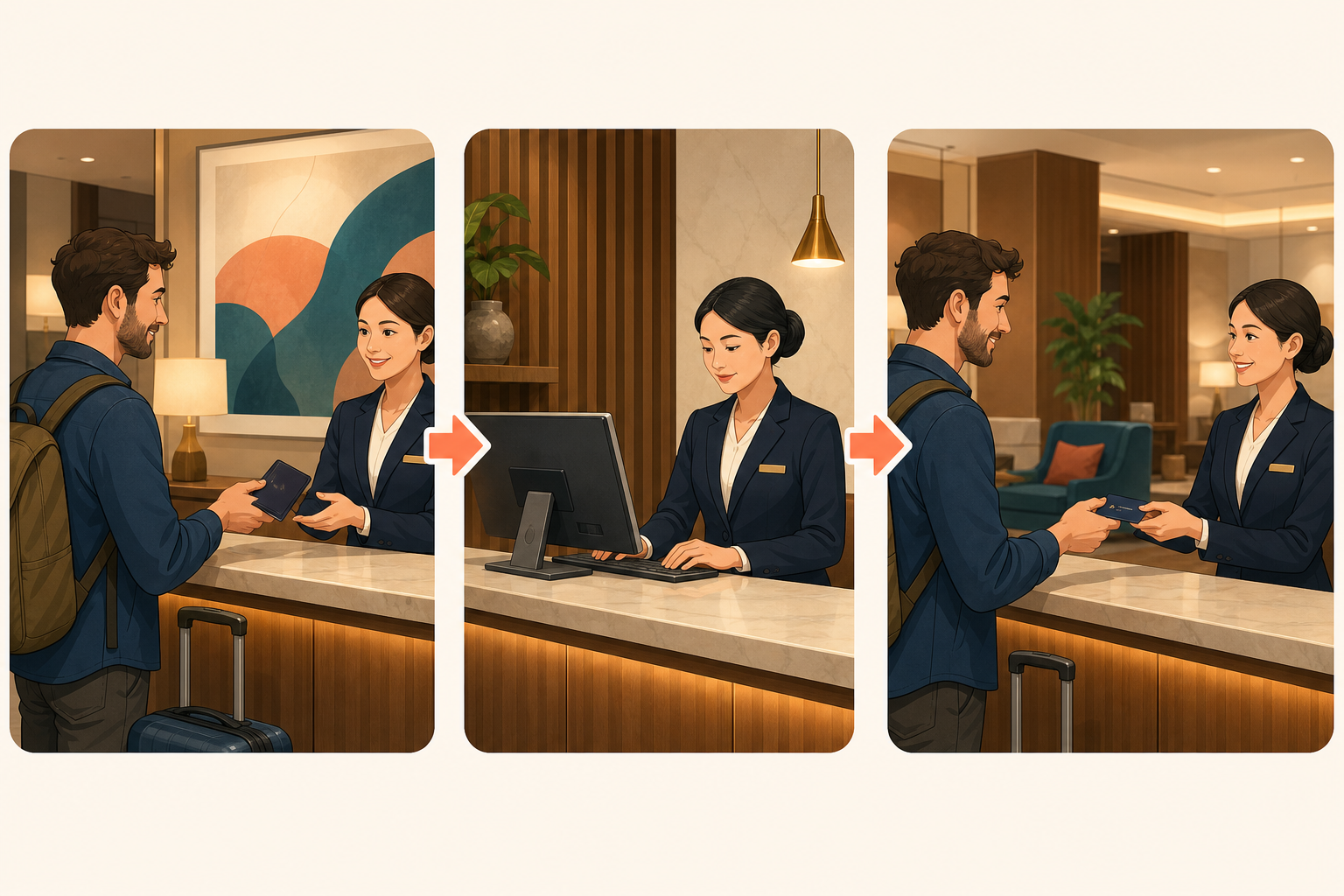
Article 39 of the Exit and Entry Administration Law says that when a foreigner stays in a hotel, the hotel handles the accommodation registration and submits the required information to the local public security authority. This is the hotel’s legal reporting duty.
Bring the original valid travel or identity document you are using for the stay and keep the reservation details accessible at check-in.
These items make check-in easier:
- The original passport or other valid travel or identity document used for your stay.
- Your booking confirmation, the property’s contact details, and the address in Chinese if available.
- Any entry or stay document relevant to your trip, if the property asks to verify it.
Registration for non-hotel stays
For a private home, apartment, or other accommodation outside a hotel, Article 39 requires the foreign guest or the person providing the accommodation to register with the local public security authority within 24 hours of arrival.
Under Article 76 of the same law, failing to complete the registration can result in a warning and a fine of up to CNY 2,000.
Since March 20, 2026, an official online-registration pilot has operated in Hebei, Liaoning, Zhejiang, Hubei, Guangxi, Chongqing, and Sichuan. A foreign guest or host can use the NIA government-services website, the NIA 12367 app, or the official WeChat and Alipay mini programs.
The online service is not yet nationwide. In July 2026, the National Immigration Administration said it planned to expand the service gradually. Outside the pilot areas, or when online registration is unavailable, use the local public security registration channel or ask 12367 for the current procedure.
| Where you stay | Who handles registration | Timing |
|---|---|---|
| Hotel | The hotel | Handled as part of hotel check-in and reporting |
| Private rental | The foreign guest or host | Within 24 hours of arrival |
| Friend’s or family’s home | The foreign guest or host | Within 24 hours of arrival |
What to do if check-in is refused
Ask the front desk for the specific reason and keep the booking confirmation and any written messages. A room can be unavailable for ordinary reasons, but a blanket refusal based only on a claimed lack of foreign-related qualifications conflicts with the 2024 government measures.
If you need accommodation immediately, secure a suitable alternative first. Then contact the booking platform for support or use the National Immigration Administration’s 12367 service for official guidance. Keep screenshots, receipts, and the property’s name and address if you need to explain what happened.
For payment preparation, use the existing Money & Payment guides rather than assuming that every property accepts the same cards or mobile-payment methods.
Frequently asked questions
Can a hotel refuse me because it lacks foreign-related qualifications?
The 2024 government measures say local authorities and online booking platforms should not restrict accommodation operators from receiving foreign guests based on qualification requirements. Normal availability, booking terms, valid-document checks, and the hotel’s registration duties still apply, so confirm the exact property before arrival.
What happens to my passport information at check-in?
Article 39 requires the hotel to register a foreign guest’s accommodation and submit the required information to the local public security authority. Ask the property or 12367 if you need details about the information collected in a particular location.
Do I need to register a private-home or private-rental stay?
Yes. The foreign guest or host must register within 24 hours of arrival. Online registration is currently a pilot in seven provincial-level jurisdictions; elsewhere, use the local public security channel or ask 12367 for the current procedure.
How can I confirm a hotel before arrival?
Message the exact property with your arrival date and ask whether its front desk can complete check-in using your passport or other travel document. Keep the written answer with your booking.
What should I do if check-in is refused?
Ask for the precise reason, arrange suitable alternative accommodation if necessary, and contact the booking platform or 12367. Preserve the booking, messages, receipts, and property details.
Do I need a printed booking confirmation?
Requirements can vary by property. Keep the reservation accessible and bring the original valid travel or identity document used for the stay.
Before you go: hotel checklist
- Confirm the exact property and arrival date, and keep its written check-in response.
- Bring the original valid passport or other travel or identity document used for the stay.
- Keep the booking confirmation, property phone number, and address available offline.
- For a non-hotel stay, complete registration within 24 hours; do not assume the online pilot is available nationwide.
- Save the booking platform’s support channel and the NIA 12367 contact before a late arrival.
For city-specific accommodation planning, continue with where to stay in Beijing or where to stay in Shanghai. For cards, cash, and mobile-payment preparation, use the Money & Payment hub.
Official references: Government summary of accommodation measures (2024) · Seven-department accommodation measures (2024) · Exit and Entry Administration Law · NIA online-registration pilot notice (2026) · NIA pilot status update (July 2026)
Featured image: “Sichuan Jinjiang Hotel 20241007153243.jpg” by TurnOnTheNight, via Wikimedia Commons, CC BY-SA 4.0.