
Choose Chaozhou for an old-town stay with time for streets, tea and the Han River, rather than trying to visit every Chaoshan city in one day. Two nights give you an arrival evening, a full day and a quieter departure morning. Chaozhou, Shantou and Jieyang belong to the wider regional conversation, but they are separate bases with separate transfers.
This guide focuses on Chaozhou Old Town (潮州古城). The Guangdong guide provides the broader provincial context. The route below is editorial advice informed by sources checked on 27 October 2026, not a personally tested tour or a promise of attraction availability.
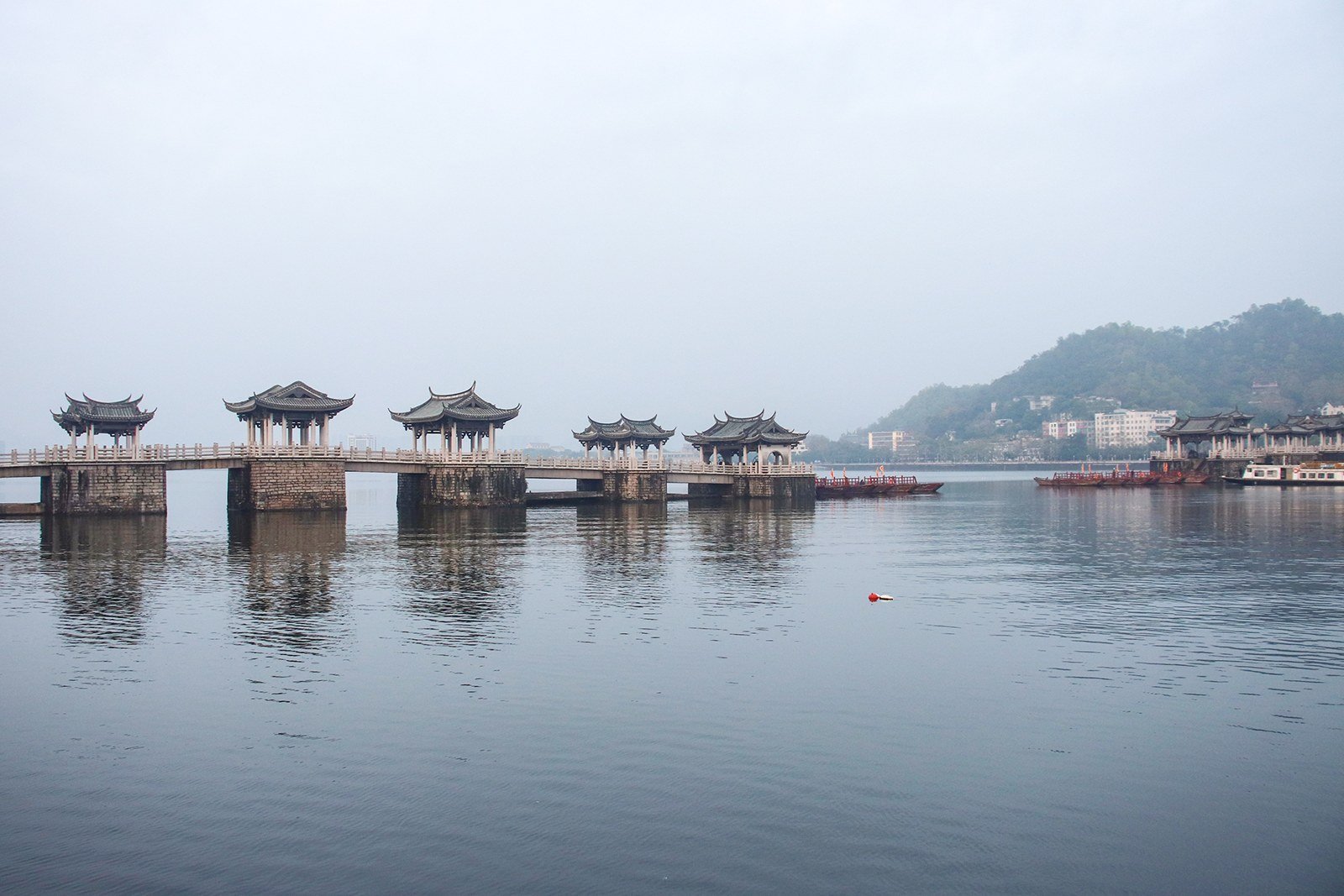
Guangji Bridge,6 February 2023. Archival view, not a map of current entry gates or ticket boundaries. Photo: Windmemories. Source · CC BY-SA 4.0. Resized and JPEG encoded; no additional crop.
Do not confuse Chaoshan Station with the old town
When searching trains, distinguish Chaoshan Station (潮汕站) from Chaozhou Station (潮州站) and from a hotel pin in the historic city. Choose a service by the complete route to your accommodation, not by the closest-looking English place name.
Use China Railway 12306 for the actual date and available stations. For an arrival by air, identify the booked airport and the onward road transfer separately. A listing labelled “Chaoshan” does not establish that you are arriving beside Paifang Street.
Before boarding, save the hotel’s Chinese address and a road-accessible drop-off point. Ask whether the property is in a pedestrian lane, whether there are stairs and how to reach it with luggage. Use an agreed taxi or ride-hailing pickup rather than a vague instruction to meet “outside the old town.”
Choose a base within reach of the streets you want
For a visit centred on the historic core, compare accommodation around the old town’s accessible edges. Being close enough to walk in for dinner can be more useful than staying beside an onward transport hub. A room directly over a popular street may be lively, so ask about noise instead of assuming an old building means a quiet stay.
The provincial foreign-affairs office’s introduction to Chaozhou Old Town places Paifang Street, Kaiyuan Temple, Guangji Bridge and Guangji Gate Tower within the same historic-city setting. They provide a sensible orientation framework; they do not share one admission ticket or one closing time.
First evening: take a short walk and eat locally
Keep the arrival walk simple: one stretch of the old town, a place for dinner and a route back to your room. Paifang Street (牌坊街) is a useful landmark, while side lanes offer a different pace. Do not enter a house or working courtyard just because its doorway is attractive.
Tea is worth making time for as an actual activity. Ask what a tasting or seated service includes and whether the charge is per person, per pot or for a package. If you are buying tea, establish the quantity and price before accepting a demonstration as a purchase commitment.
For food, order a few dishes at a time and ask about ingredients you need to avoid. A broad “Chaoshan food” label does not tell you which items contain shellfish, peanuts or offal. The Chinese dishes guide offers general ordering context; let the actual menu determine dinner.
Full day: connect the lanes and the river
Start with the old town while you are fresh. Use Kaiyuan Temple (潮州开元寺) as one anchor, respecting worship and photography instructions, then explore a manageable part of the nearby street network. Do not confuse it with the temple of the same name in Quanzhou.
Reserve a separate part of the day for Guangji Bridge (广济桥) and the river. Viewing the bridge from the bank, entering the bridge attraction and crossing the river are different plans. Establish the day’s usable entrance, ticket conditions and return route before heading to the gate.
This matters because access changes. An official 10 September 2026 notice temporarily moved entry away from the western side; an official Chaozhou government press-office update on 2 October reported the western entry in use again. The older closure notice should not be treated as a permanent instruction. Check the bridge’s current notice for your date, especially before arranging a one-way walk to the opposite bank.
The city’s river-route introduction connects the bridge with the riverside and Han Yu’s memorial temple. Use that geographical relationship to choose an outing, not to assume every stop in the older published route remains open on the same timetable.
If a bridge session or evening display is essential, verify it independently. This guide does not give an unverified light-show time or use a photograph to promise what will happen on your evening.
Departure morning: keep one final neighbourhood
Have breakfast and return to a nearby lane or shop you wanted more time for. Avoid adding another Chaoshan city before an afternoon train unless the complete transfer has been checked. Your station and luggage collection remain part of the day’s schedule.
A second city makes more sense as the next base when you have the nights for it. You do not need a three-city checklist to get value from a Chaozhou stay.
Where transit-visa permission fits
Chaozhou is within Guangdong’s permitted stay area under the current 240-hour transit policy. Eligibility still depends on your passport, designated entry port and onward journey. A domestic train into Chaozhou is not itself a visa-free entry procedure. Check those conditions before constructing a Guangdong–Fujian route.
Save your return pickup, hotel address and issued train details offline. With those settled, the useful part of Chaozhou is the time between landmarks: a tea break, a street you walk twice and a meal you have room to enjoy.