
At 7:15 on a Tuesday morning, the loudest thing in the Temple of Heaven is a retired man playing "Auld Lang Syne" on a saxophone into a stand of cypress trees older than most of the countries his audience flew in from. Forty metres away, six women in windbreakers keep a weighted shuttlecock in the air with their heels and nobody drops it. Near the corridor, a man writes calligraphy on the paving stones with a sponge brush and a bucket of water. The characters evaporate almost as fast as he can make them.
The blue-tiled hall you came for is still forty-five minutes from opening.
This is the part most visitors never see. They arrive at eleven, photograph one building, and are gone by half past twelve, which is a bit like visiting a cathedral and only looking at the roof.
The short version: buy the 34 CNY combined ticket, book it a day or two ahead with your passport details, and be inside before 8am. The halls shut on Mondays outside the summer window.
Sorting the ticket before you land
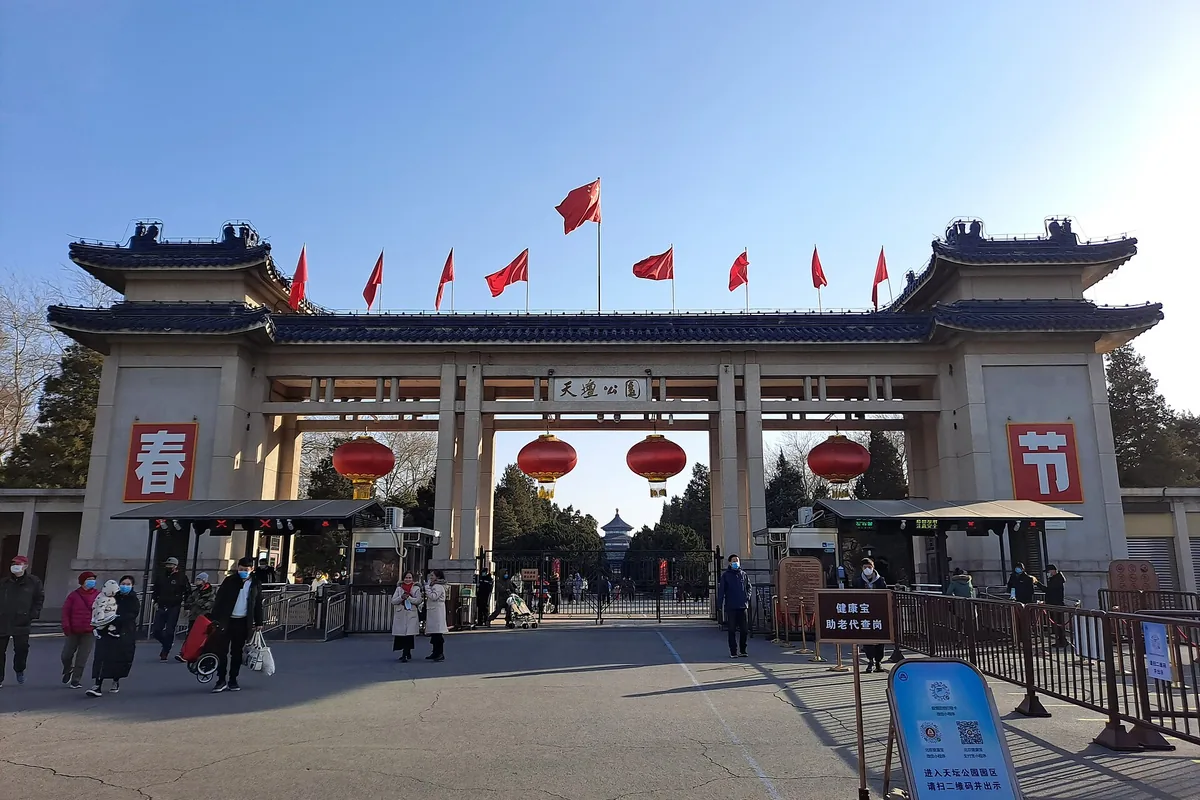
Start here, because this is where mornings get wasted.
The park runs on real-name booking. You choose a date and a time slot, attach it to an ID document, and scan a QR code at the gate. Your passport counts as the ID. Booking opens one to seven days ahead through the official Tiantan Park WeChat account or the city’s Visiting Beijing Parks account, and the fiddly part is the form: change the ID type dropdown from the default to Passport, then enter your passport number exactly as printed and your name as it appears in the machine-readable strip. One wrong character and the QR code will not match the document you hand over.
You will not be stranded if you skip this. Contrary to a lot of blog folklore, the park keeps a staffed ticket office and service counters — including an English-language ticketing window — and the staff can place the order for you on the spot. Same-day tickets are sold at the entrance, provided the park has not hit its daily capacity.
That proviso is doing real work, though. On an October Saturday the capacity will go, and queueing to find out costs you the only ninety minutes worth having. Book ahead anyway. Weekdays are relaxed and the night before is usually fine. Weekends, national holidays, and the first week of October are a different animal — set a reminder and book the moment the window opens.
You will need a working Chinese payment method to complete the purchase, which for most visitors means a foreign card linked inside Alipay or WeChat Pay. If you have not done that yet, sort it before you land — our guide to using Alipay as a foreigner walks through the card linking, and the same setup pays for everything else you will do that week.
Prices and hours, both of which swing with the season
Two ticket types exist and the cheap one is a trap. Park-only entry gets you through the gate and no further; every building you actually came for sits behind a second barrier. The combined ticket (联票, liánpiào) covers the park plus the three sights behind that barrier: the Hall of Prayer for Good Harvests, the Imperial Vault of Heaven with its Echo Wall, and the Circular Mound Altar. The gap is nineteen yuan. Pay it.
| High season (Apr 1 – Oct 31) | Low season (Nov 1 – Mar 31) | |
|---|---|---|
| Park entry only | 15 CNY | 10 CNY |
| Combined ticket | 34 CNY | 28 CNY |
| Park gates open | 6:00 (last entry 21:00) | 6:30 (last entry 21:00) |
| Halls and altars | 8:00 – 18:00 (last entry 17:30) | 8:00 – 17:00 (last entry 16:30) |
Note the gap at each end. The park opens at six but the buildings do not open until eight, and the buildings shut hours before the gates do. That gap is not a flaw in the schedule. It is the schedule that the neighbourhood actually uses, and it is the best thing about the place.
One rule with a seasonal escape hatch: the paid halls close on Mondays, public holidays excepted. But Beijing’s municipal parks lift the Monday closure for the school summer — roughly 15 July to 31 August — and through that stretch the halls open every day. Outside it, a Monday means paying 15 CNY, walking the grounds, and seeing the Hall of Prayer only from the outside. Some people do that deliberately and are perfectly happy. Nobody enjoys discovering it by accident. The summer dates are announced each year rather than fixed in stone, so check the park’s WeChat account before you build a Monday around it.
Which gate you pick decides what kind of morning you get
The East Gate is the obvious one. Tiantandongmen station on subway Line 5 puts you almost at the entrance, it is signposted in English, and it is where every taxi driver assumes you are going. It is also where roughly everyone else enters.
Entering east drops you near the Long Corridor, which is the heart of the dawn scene and the reason to come early. Fine choice, and the one most people should make.
But there is a better piece of theatre available. The complex is built on a south-to-north axis, and it was designed to be walked in that direction. The emperor came in from the south, fasted, then processed up the line: the open-air Circular Mound Altar, then the Imperial Vault of Heaven, then 360 metres along the raised Danbi Bridge, rising as he went, until the Hall of Prayer for Good Harvests appeared ahead of him. Enter at the South Gate and you get that sequence in the order the architects intended, with the big hall as the payoff rather than the opening shot. It costs you a taxi instead of a subway ride. It is worth it once.
Whichever gate you choose, understand the scale first. The grounds run to 273 hectares — close to four times the footprint of the Forbidden City — and there is a lot of pine wood between the highlights. Wear real shoes. People routinely underestimate this park because the map makes it look compact and the buildings look close together. They are not.
What is actually here, and what is oversold
The Hall of Prayer for Good Harvests is the one on every cover. Three stacked circular roofs in cobalt tile, no steel, no nails, sitting on a triple marble terrace. Lightning burned the original down in 1889; the replacement you are looking at was finished in 1896. It genuinely delivers — but manage one expectation: you do not go inside. You join a queue, reach a doorway, look in at the painted interior over a barrier for maybe forty seconds, and move on. The exterior is the experience.
The Circular Mound Altar is a bare open-air platform of concentric stone rings, no building at all, and it is the sleeper hit. Stand on the round centre slab and your own voice comes back at you off the balustrades, hollow and slightly wrong. In summer, marble at noon plus zero shade equals genuine misery, which is another argument for arriving early.
The Echo Wall is the honest disappointment, and it deserves a paragraph. The pitch is that the circular wall carries a whisper all the way around to a listener on the far side. The physics are real. The conditions required are not. It works when two people stand at the wall in near silence, and there has not been near silence there since about 1985. What you get instead is forty people simultaneously shouting into the masonry, sections roped off to stop hands wearing away the surface, and a queue for the privilege. Give it five minutes because it is on your way, expect nothing, and you will not feel cheated.
The quiet reward is the Divine Music Administration in the western quarter, the office that trained the musicians for the ceremonies. It is a long walk from the main axis and it is often close to empty. It also tends to appear on the park’s price list as its own 10 CNY admission rather than riding on the combined ticket, and the bundling has shifted over the years, so check what you are actually buying at the point of booking.
Then there is the bit outside the wall. The Hongqiao Pearl Market sits across Tiantan East Road, a couple of minutes from the East Gate subway exit, and pulls in tourists on momentum. It is a real market and some people do fine there, but it runs on aggressive haggling, and the pavements near the tourist gates are prime ground for the tea-ceremony and art-student routines. If a friendly English-speaking student approaches you outside the gate wanting to practise, you already know how this ends.
Timing it properly
Go at 6:30am. Everything else is a compromise.
You will have ninety minutes in the park before the halls open, and those ninety minutes are the real Temple of Heaven: not a monument, but a working neighbourhood park that happens to contain a UNESCO World Heritage Site. Ballroom dancers under the corridor roof. Card games with committee-level spectating. Someone practising Peking opera into the trees because the cypresses give the voice something back. Then the halls open at eight and you are already at the front.
Season matters more than the calendar suggests. Late September into October gives you hard blue Beijing sky against the cobalt tiles, which is the whole visual point of the building. Winter is cheap, cold, and beautifully empty. July and August are hot, humid, and the marble radiates. Whenever you come, plan around the Monday closure — summer aside — and the first week of October, when the entire country travels at once — the same warning applies to every big-ticket sight in China.
Two to three hours covers it properly. Half a day if you walk the full axis and the western side. It pairs naturally with the Forbidden City but not on the same day — that is nine or ten kilometres of walking and you will end up hating both.
Three things people ask
Is the Temple of Heaven worth it if I only have two days in Beijing?
Yes, but only if you go early. At 11am it is a nice building with a crowd in front of it, and against the Forbidden City or the Great Wall it will lose. At 7am it is the most human place in the city, and nothing else on your list does that.
Can I get in without WeChat?
Yes. The park keeps staffed windows and a service counter that will process a same-day ticket against your passport, capacity permitting, and a hotel concierge can book on your details instead. WeChat is the smoother road, not the only one — just do not rely on the counter on a holiday weekend.
Do I need to book a guide?
No. The site signage carries English and the layout explains itself once you know the south-to-north axis. Spend the money on a better dinner.
Before you go
Get the booking done before you land, not from a hotel lobby at 10pm the night before while the last weekend slots evaporate. If you are still assembling the trip, most people slot Beijing in via the 240-hour visa-free transit and connect onward by rail, and staying near the Qianmen or Chongwenmen side puts you close enough for a 6:30am start without a taxi.
And if Beijing is one stop rather than the whole trip, the trains are the easy part — tell us where you want to go and we will send you a free quote and book your high-speed tickets, so the only thing you have to be on time for is the saxophonist.
Sources and official information: