
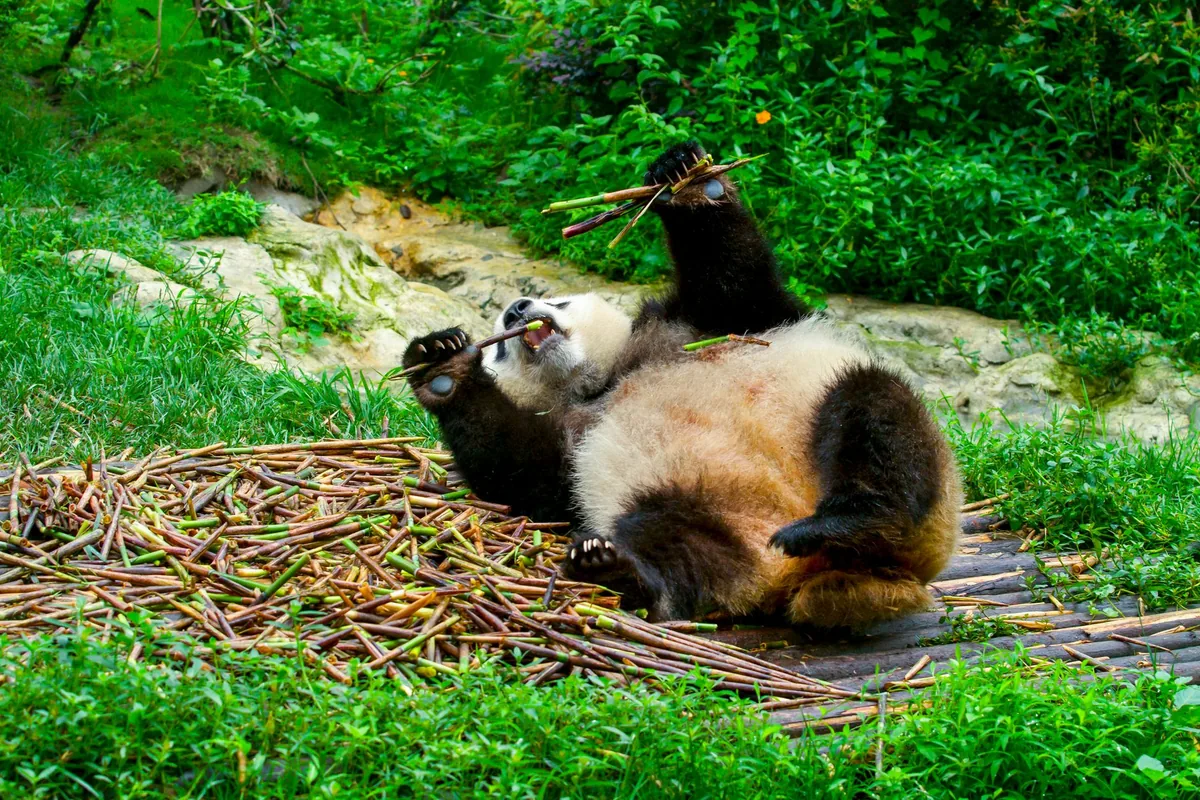
At 7:52 in the morning the loudest thing at the Chengdu panda base is not people. It is bamboo. A dry, splintering crack, then another, coming from behind a screen of green about six metres away, where a very large animal is working through breakfast with the single-minded rudeness of someone who has never once had to share. Nobody around you is talking. Everyone has their phone up. A keeper walks past with a plastic crate of steamed corn bread and the whole enclosure shifts.
Ninety minutes later that same animal will be asleep in a tree with one leg dangling down, and the path will be four people deep, and someone’s tour group flag will be in your photo.
That gap — between 7:52 and 9:30 — is basically the entire strategy for this place. Everything below is about getting you inside the gate on the right side of it.
The short version: book online with your passport number 2–3 days ahead, be at a gate for the first entry slot — West is calmer than South — and give yourself three hours minimum.
Getting out there before the coaches do
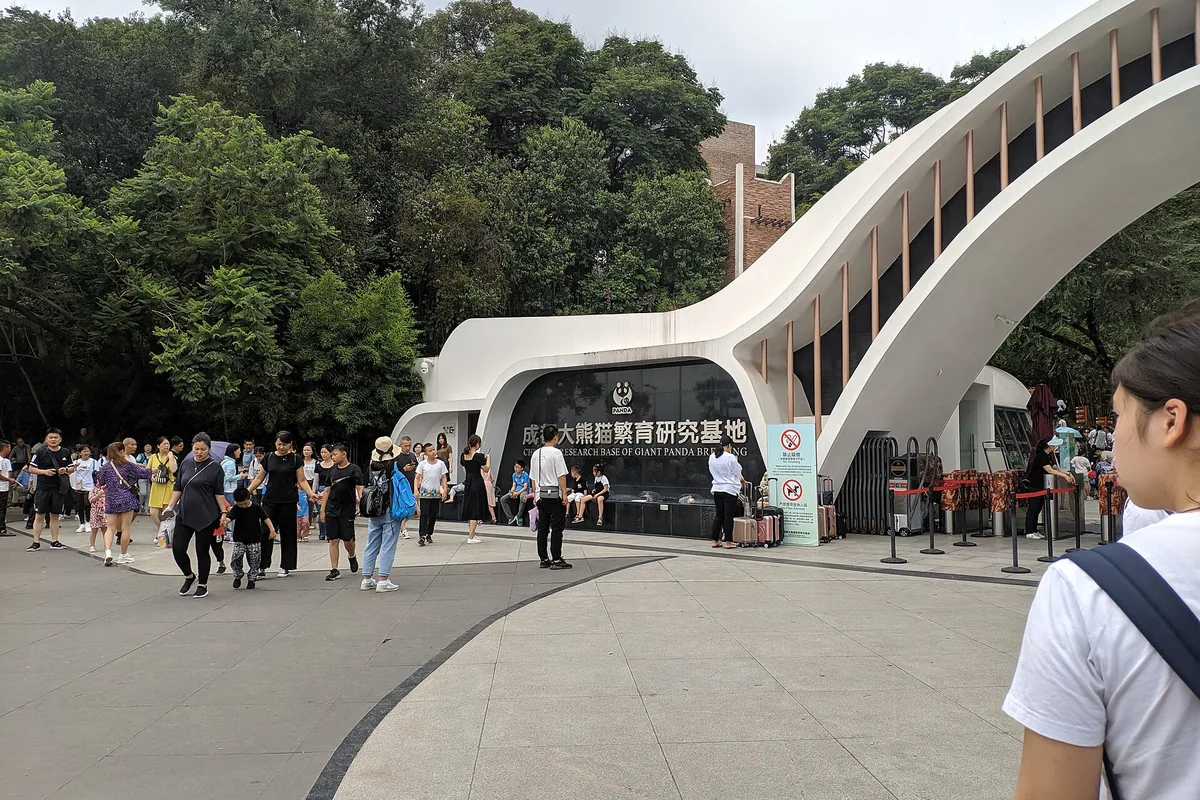
The base sits about 10 km north-east of the city centre, in what used to be farmland. It is not walkable from anywhere you’d plausibly be staying, and the taxi queue at 7am is a lottery.
Metro Line 3 is the answer, and it is genuinely easy. Two stations serve two different gates — the one bit most guides skip:
| Your gate | Metro stop (Line 3) | Then | Time |
|---|---|---|---|
| South Gate (main, busiest) | Panda Avenue, Exit A | Shuttle bus 408 | ~10 min |
| West Gate (quieter) | Junqu General Hospital, Exit B | Shuttle bus 409 | ~10 min |
Metro fares start at ¥2 and the shuttle hop is small change, so the trip from central Chengdu costs about as much as a coffee and takes roughly 45–55 minutes door to door. Don’t assume a taxi beats it — before 8am it usually doesn’t. The base’s own reference fares put a taxi from Chunxi Road or Chengdu East at about ¥40, ¥100 from Shuangliu airport, ¥200 from Tianfu. The official site publishes the full transport breakdown, including slower bus routes and a second metro option via Zoo Station.
Here is the counterintuitive bit. Almost every tour bus, every hotel shuttle and every first-timer piles into the South Gate. The West Gate opens onto the newer half of the park and is noticeably calmer at opening. If you’re travelling as a couple and want the first hour to feel civilised, West Gate is the better door.
If you’re arriving in Chengdu the same morning, don’t. Chengdu East Railway Station is well connected — high-speed trains from Chongqing run a little over an hour, Xi’an in the three-to-four hour range depending on the service — but the base rewards people who slept nearby the night before. Our train ticket booking service can get you in the evening before, and there are plenty of hotels near the Line 3 corridor that put you 20 minutes from the gate.
What the first two hours are actually like
Pandas eat hard in the early morning, then sleep through most of the day, and no amount of standing hopefully at a railing at 1pm will change that. Morning feeding generally falls in the first hour or two after opening, though it drifts by enclosure and keeper. The base opens for morning entry at 7:30 from March to October, 8:00 from November to February.
So the shape of a good visit is: through the gate in the first fifteen minutes, walk fast and deep before you stop, and see the busiest enclosures while everyone else is still queuing for the sightseeing bus.
The temptation is to stop at the first enclosure you reach, because there are pandas in it and you have come a long way to see pandas. Resist for ten minutes. The enclosures nearest the South Gate are the ones that saturate first. Walk on, find something 400 metres in, and you’ll have a railing largely to yourself.
The genuinely magical part is the nursery buildings. The Sun and Star nursery houses hold the youngest animals, and if your visit lands in autumn — cubs are typically born between July and September — you may see something the size of a football being carried around by a keeper in gloves. That is the moment people fly here for. It is also seasonal and not guaranteed. Nobody can promise you a cub.
Red pandas are the sleeper hit. Smaller, awake far more of the day, and housed in walk-through areas where the path runs close to them, so the most alert animal of your morning is likely to be the wrong species entirely. The base asks visitors to stay at least three metres from red pandas and any free-roaming animals. Don’t touch, don’t feed, don’t be the person who gets asked to leave.
The half of the park most guides still haven’t updated for
The base has expanded a long way past its old footprint. The original area behind the South Gate is what you’ll see in every photo taken before 2020. The newer section stretching towards the West Gate is greener, hillier, built as naturalistic habitat rather than viewing platforms — more bamboo forest with animals in it than zoo.
Connecting the two is the internal sightseeing bus, and this is where older guides will mislead you. It runs between the South and West Gate terminals through eight stops — Panda Villa, the Sun nursery house, the Panda Reception Hall, Bamboo Tower, the Star nursery house, Panda Creek Valley, Swan Lake — and it runs both directions, so overshooting an enclosure is not the disaster some blogs make out. Summer service is 7:30–17:30, winter 8:00–17:00.
Budget for the price, though. A full-price ticket is ¥30 per person, not the ¥10 still quoted in older write-ups — ¥120 for a family of four, on top of admission. What you’re buying is distance: the walk end to end covers serious ground, much of it uphill. With a small child or tired knees, pay it. Otherwise ride one way and walk back. Avoid the South Gate stop mid-morning, when the queue is at its worst.
Where the visit falls flat
The middle of the day here is disappointing. Visitors book a 10am arrival, find heaps of sleeping fur, and leave convinced pandas are boring animals.
They aren’t. You just arrived at nap o’clock.
The other soft spot is the themed retail and food strip — fine if you want a stuffed toy and a bubble tea, skippable otherwise, and priced like the attraction it sits inside. So are the on-site restaurants, functional at best. Eat a real breakfast before you come, carry water, and save your appetite for hotpot back in the city.
Outside the gates you’ll meet the usual ecosystem: people offering "special panda photos," people offering shortcuts, people selling tickets. Ignore all three. Holding a panda is not a thing here — the base permits no visitor contact with the animals, so anyone offering it is selling you something else. The ticket touts are easier to see through once you know the rule: every visitor needs an online real-name reservation tied to their own ID, checked at the gate. A stranger cannot hand you a valid entry, because a valid entry has someone else’s name on it.
Finally, the crowds are real. The site’s stated daily capacity is 85,000 visitors. On a Saturday in October it can feel like all of them arrived at once. A Tuesday or Wednesday is a different park.
Tickets, passports, and the booking step that trips people up
Adult admission is ¥55, for ages 18 to 59. Students in full-time education pay ¥27. Children under 6 or under 1.3 m go free, as do visitors aged 60 and over — and those free categories need no reservation at all, so a grandparent or a toddler joining late is not a booking problem. An annual pass is ¥168, which is only relevant if you’re an expat, but at three visits it pays for itself.
Everything is now real-name and digital. You reserve online — up to 14 days ahead — against a specific ID document, and at the gate staff scan the original document you booked with. For foreign visitors that means your passport, and it means the passport number you type must match the passport in your pocket, character for character.
The friction point: the official WeChat mini-program is the cheapest route but often baulks at foreign phone numbers and non-Chinese cards. Most international visitors end up booking through a licensed resale platform instead, which costs a little more and works reliably. Do it two or three days out — not the night before, not at the gate. Check the official ticket page first, since rules here change more often than at most attractions.
Have Alipay or WeChat Pay set up before you arrive regardless. The shuttle buses, the internal sightseeing bus and the metro all assume it, and the sightseeing bus service page lists routes and timings if you want to plan around it.
Opening hours by season:
- March–October: morning entry 7:30–12:00, afternoon entry 12:00–17:00, park clears at 18:00
- November–February: morning entry 8:00–12:00, afternoon entry 12:00–16:30, park clears at 17:30
Picking your month
April–May and September–October are the best all-round windows: mild, green, active animals, cubs in the autumn slot. June through August is hot and humid enough that the pandas retreat indoors to air conditioning for large parts of the day, which is exactly as unphotogenic as it sounds.
Winter is the underrated option. Chengdu is grey and damp from December to February, but the pandas are visibly happier in the cold, they stay out longer, and the crowds thin dramatically. Bring a coat and accept flat light.
Avoid the first week of October and the Chinese New Year fortnight entirely. Domestic holiday crowds at a site like this are not a mild inconvenience; they are the whole experience.
Planning a second, quieter panda stop outside the city? Dujiangyan and Wolong are the usual candidates, but check the status of either directly before committing a day — these facilities open, close and rebuild on their own schedule, and the day-trip posts ranking for them are often years stale. For most visitors the better answer is one unhurried morning at the Chengdu base instead of a day in a car chasing a quieter version of it.
Fitting it into a Chengdu trip
Half a day, realistically. Gate at opening, out by 11:30, back in the city for lunch. That leaves the afternoon for People’s Park tea houses or Wuhou Shrine — a far better use of a day than stretching the base into six hours.
Two full days in Chengdu is the sweet spot before you move on. Leshan and the Giant Buddha are about an hour away by high-speed rail, and Chongqing is a comfortable hop of a little over an hour. Our wider attractions guides cover the rest of Sichuan, and if you’re coming through on the 240-hour visa-free transit rules, Chengdu makes an unusually good anchor city for it.
Ready to lock in the trains? Send us your dates and cities for a free quote — Chengdu East is one of the busiest hubs in western China, and the good morning departures sell out. Get your free train ticket quote here.
Three things people still ask
Can I hold a panda?
No. Visitor contact with the animals is not permitted at the Chengdu base, and the published visitor rules go further: keep at least three metres from red pandas and free-roaming animals, no feeding, no flash. Anyone selling a "hold a panda" photo outside the gate is running a scam.
Is the internal sightseeing bus worth it?
It costs ¥30 per person, so for a family it is a real decision rather than a shrug. The park is large and hilly since the expansion, and it runs both directions between the South and West gates. Ride it one way early, walk back at your own pace.
How long should I budget inside?
Three hours is comfortable, four if you want the new area properly. Under two hours and you’ll only see the crowded original section — which is the version of this place that people describe as overrated.
Photo by Alex Bian on Pexels. Source; Pexels License.