
Solo travel in China is less about proving bravery than removing single points of failure. One traveller has one phone, one wallet, one set of booking details and nobody beside them to catch a missed station or failed payment. A good solo plan builds a second way to navigate, pay, communicate and reach accommodation.
This page focuses on independent-trip design. It does not repeat a national safety verdict, promise that an incident will not happen, or assume that every solo traveller has the same needs.
Build redundancy before adding destinations
The highest-value preparation is deliberately unglamorous:
- Keep the hotel name, address and telephone number offline in Chinese.
- Carry a paper copy of the passport photo page and entry details, stored separately from the original.
- Set up more than one lawful payment option and keep a modest emergency fallback appropriate to the trip.
- Save transport bookings and reservation codes outside the app that created them.
- Give a trusted contact the first-night address and broad itinerary.
- Keep essential medication, a charger and a power bank in hand luggage.
The China packing list provides a fuller document and device checklist. Redundancy does not mean carrying valuable duplicates together; separate them so one lost bag does not remove every fallback.
Design the arrival evening first
The first night has the fewest recovery options. Choose accommodation with a reachable front desk, confirm the late-arrival procedure, and avoid a tight final connection after the reception window.
Hotels are responsible for registering foreign guests with public security. If staying in a private residence or other non-hotel accommodation, national immigration guidance says the foreign visitor or host must complete accommodation registration with local public security within 24 hours. Online options and documents vary by location, so use the current local instructions.
The guide to hotels accepting foreign guests explains practical booking and check-in checks. It is still sensible to message the property with the passport nationality and arrival time, then save the reply.
Keep the phone from becoming the whole trip
A phone can hold maps, translation, train tickets, payments and ride-hailing, but it should not be the only place where any of them exists. Download an offline city map, screenshot the next transfer, and write down the hotel address. Know the account-recovery method before the handset is lost rather than after.
Some travel eSIMs provide data without a local voice number. That may be enough for navigation but not for ordinary calls or certain verification flows. If a Chinese number is important to the route, arrange it intentionally rather than assuming every eSIM includes one.
At a station, use the train number, departure time and destination together. Large stations can have multiple entrances and waiting areas; “north” and “south” are not interchangeable. Arrive with enough time to ask staff rather than relying on a last-minute sprint.
Make transport verifiable
For ride-hailing, compare the plate and vehicle in the app, choose a staffed or well-lit pickup point, and share the trip details with a trusted contact when that is useful. Do not enter a vehicle because someone claims the assigned car changed.
The DiDi guide for foreigners covers setup, pickup and payment. App features and availability can change, so keep the accommodation address ready for a marked taxi or staff member as a fallback.
On longer journeys, avoid scheduling the only train or flight that can preserve the next booking. A buffer is more valuable to a solo traveller because there is no second person to contact the hotel while the first deals with a disruption.

Choose a route with the right level of support
Major cities and high-speed rail corridors usually offer more frequent transport, larger accommodation choice and more staffed alternatives. Rural, high-altitude, winter or border-area routes may require permits, longer transfers and stronger language support.
That does not make a remote route unsuitable. It changes the preparation:
- Confirm the operator and return transport, not only the outbound ticket.
- Add daylight and weather buffer.
- Check whether mobile service is dependable along the route.
- Share the plan and a check-in time with someone outside the trip.
- Know when an organised or licensed local operator is required.
For a first solo visit, fewer bases with recoverable day trips often work better than changing hotels every night. This is a planning principle, not a universal itinerary.
Personal safety without broad gender claims
Use the same boundaries that work in other large cities: keep control of drinks and payments, avoid moving to a venue selected by a stranger, leave escalating disputes, and use staffed public spaces when seeking help.
Women, LGBT+ travellers, disabled travellers and people travelling with medication may face different legal, access or social considerations. Current government travel advice and direct questions to accommodation or transport providers are more useful than claims that a group is always safe or always at risk.
If an interaction feels wrong, it is reasonable to leave without proving that a crime was intended. If there is an immediate threat, contact local emergency services.
A first-hour recovery plan
If the phone, wallet or passport goes missing:
- Move to a staffed public location and secure immediate physical safety.
- Use the offline hotel details or a companion contact to restore communication.
- Lock affected payment cards and accounts through official channels.
- Report theft or an urgent incident to police and preserve the report details.
- Contact the relevant embassy or consulate for a lost passport.
- Tell the accommodation or transport provider only what it needs to protect the next booking.
Do not send money to an unsolicited “recovery” service. Account, insurance and document remedies depend on the provider and nationality; none can be guaranteed here.
FAQ
Is China suitable for a first solo trip?
It can be when the traveller’s health, communication needs and route are matched to available support. Major transport hubs offer more backup options than an isolated multi-stop itinerary.
Do I need a Chinese phone number?
Not for every trip. It can help with ordinary calls and some verification flows, while many travel eSIMs are data-only. Check the actual services required by the itinerary.
Can I stay in a private home?
Yes, but national immigration guidance requires accommodation registration with local public security within 24 hours for non-hotel stays. Check the current local process.
What should I share with someone at home?
Share the broad itinerary, first-night address, transport details for remote legs and a realistic check-in plan—without publishing live location widely.
Sources and review date
- National Immigration Administration: accommodation registration
- UK government: China safety and security
- Government of Canada: China travel advice
- Australian government Smartraveller: China
Registration and safety guidance was checked on 30 August 2026. Recheck local processes, regional advice and provider instructions for the exact trip.
Image credits
- Featured image: Traveller with a suitcase in Shanghai. Photo by Colin Dean on Pexels. — Pexels License.
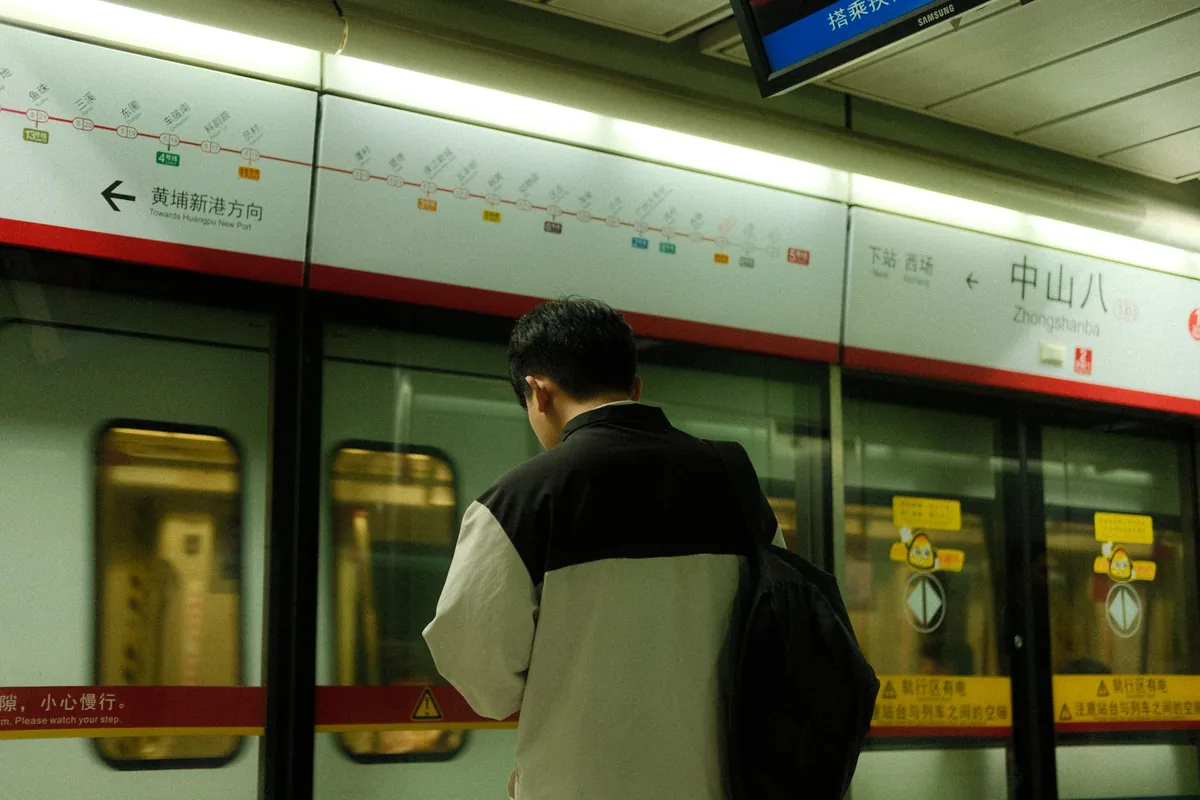
- First inline image: Passenger at Zhongshanba metro station in Chongqing. Photo by Muhamad Guruh Budi Hartono on Pexels. — Pexels License.
- Second inline image: City-walk break in Hangzhou. Photo by JUNLIN ZOU on Pexels. — Pexels License.