
Yes. Indian citizens need a visa for China in 2026, and there is no visa-on-arrival for tourism. Every Indian passport holder must apply for a tourist visa (the L visa) at a Chinese Visa Application Service Centre before they fly.
Here is the part most blogs get wrong: the wave of visa-free news you keep seeing does not include India. China now lets travelers from 55 countries transit for up to 240 hours without a visa, but Indian passports are not on that list. You cannot use it to sightsee in Shanghai on the way to Bangkok.
The good news is that applying is cheaper and simpler than it was two years ago. China has cut visa fees for Indians and waived fingerprints for short-stay visas, and both benefits run through the end of 2026. A student from Pune or a family from Ahmedabad can now get a straightforward tourist visa for less than it cost in 2023.
This guide covers exactly what you need, what it costs, how long it takes, and the transit rule that trips people up.
Key Takeaways
- Indian citizens must get a visa before entering mainland China. There is no visa-on-arrival and no visa-free tourism.
- The tourist (L) visa fee is ₹2,900 for single entry, held at the reduced rate through 31 December 2026.
- Fingerprints are waived for short-stay visas (180 days or under) until 31 December 2026.
- India is not eligible for the 240-hour visa-free transit policy for sightseeing — only pure airside transit to a third country.
- Apply online first through the COVA portal, then submit in person at a CVASC in Delhi, Mumbai, or Kolkata.
Do Indian citizens need a visa for China? The short answer
Yes, and it is not optional. Mainland China requires Indian passport holders to hold a valid visa on arrival at the airport or land border. Show up without one and you will be denied boarding at your departure gate in India.
The visa you want for a holiday is the L visa (tourism). It is the same category used for visiting friends and relatives. A standard L visa gives you 30 days per entry and is usually valid for three months from the date of issue.
Business travelers use the M visa instead, which covers meetings, trade fairs, and site visits. If you are going to sign contracts or attend a conference, apply for the M, not the L.
There is one narrow exception worth naming so you do not chase it by mistake. Indian passengers changing planes in a Chinese airport, staying strictly inside the transit area and continuing to a third country, may transit without a visa. The moment you want to leave the airport and see the city, you need a proper visa.
Why the visa-free headlines do not apply to India

China’s 240-hour (10-day) visa-free transit policy is real and generous. It now covers 55 countries and 65 ports of entry across two dozen provinces. It lets qualifying travelers land, leave the airport, and explore Beijing, Shanghai, Chengdu, or Xi’an for up to ten days.
India is not among the 55 countries. Neither is Malaysia. So the policy that lets a British or Indonesian traveler wander Shanghai visa-free simply does not extend to an Indian passport.
Meet Rohan, a software engineer from Bengaluru flying Delhi–Shanghai–Los Angeles. He can change planes in Shanghai without a visa if he stays airside. But he read a blog about "240-hour visa-free China" and assumed he could spend two days in the city between flights. He cannot. To leave Pudong airport, even for one night, he would need an L visa arranged in advance.
The lesson: for any real time in China, plan on a full tourist visa. Treat the transit rule as a technicality for connecting flights, not a travel hack.
What a China tourist visa costs Indians in 2026
China extended its reduced visa fees for Indian applicants through 31 December 2026. These rates are well below the old standard fees, which is why 2026 is a good year to go.
Two charges stack up: the visa fee (set by the Chinese Embassy) and the CVASC service fee (charged by the visa centre that processes your file). Budget for both.
| Visa type | Entries / validity | Visa fee (2026) |
|---|---|---|
| L visa | Single entry | ₹2,900 |
| L visa | Double entry | ₹4,400 |
| L visa | Multiple entry, 6 months | ₹5,900 |
| L visa | Multiple entry, 12 months+ | ₹8,800 |
| Group visa | Per applicant | ₹1,800 |
On top of the visa fee, the CVASC charges a service fee of roughly ₹1,900–₹2,000 for regular processing, or around ₹2,900 for express. So a single-entry tourist visa lands near ₹4,800–₹5,000 all in for most applicants.
For a first trip, single entry is almost always enough. Only pick multiple entry if you genuinely plan to leave and re-enter China (for example, a side trip to Hong Kong and back).
How to apply for a China visa from India, step by step
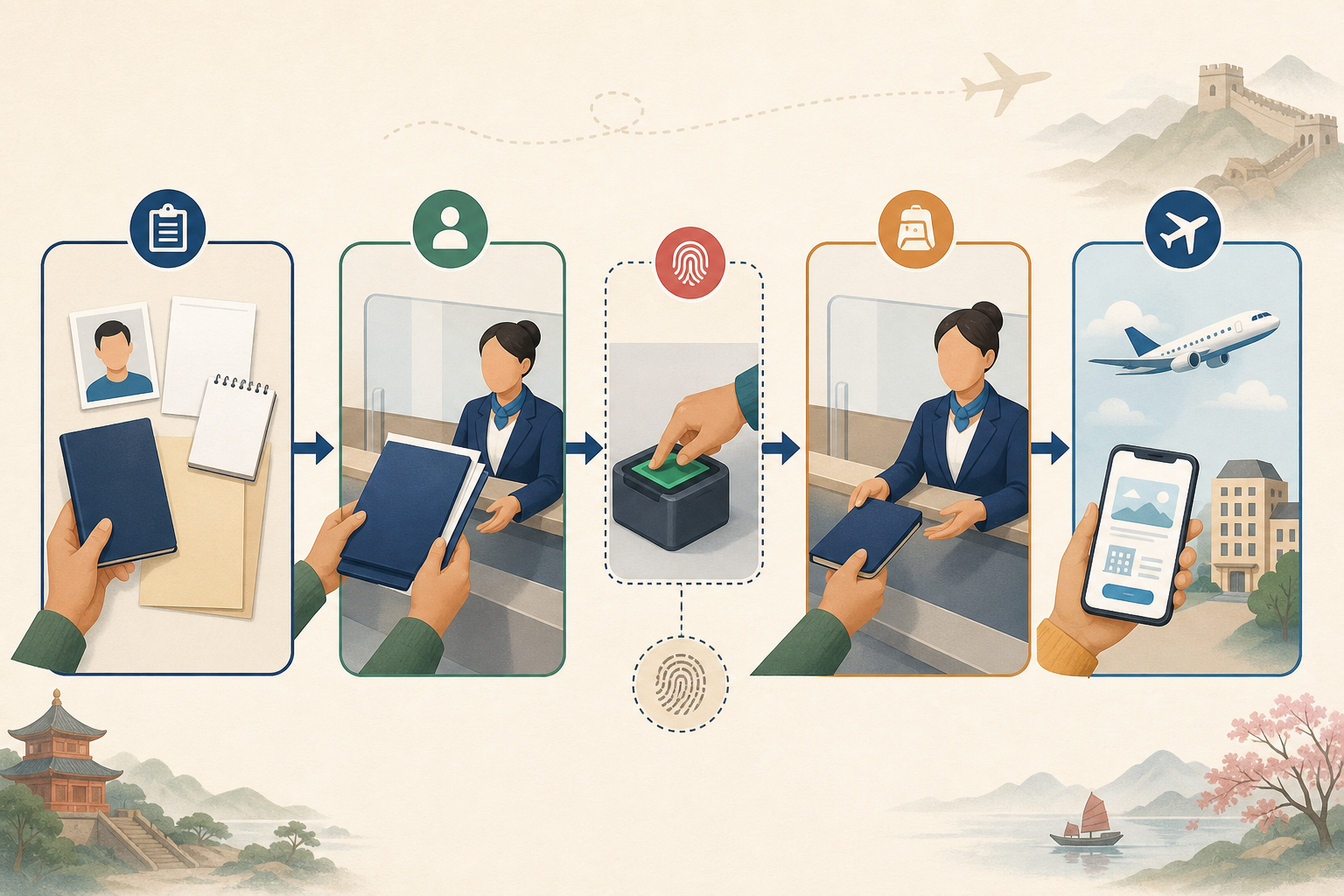
Since December 2025, China uses an online-first system. You build your file on the COVA (China Online Visa Application) portal before you ever visit the centre. This cut most applications down to a single in-person trip.
Step 1 — Fill the form online. Complete the application on the COVA portal, upload your digital photo, and print the confirmation page. Be honest and consistent; mismatched dates between your form and your tickets cause rejections.
Step 2 — Gather your documents. You will need:
- Original passport, valid at least 6 months, with 2 blank pages
- One printed COVA confirmation page
- One recent passport photo, 33mm × 48mm, white background
- Round-trip flight bookings (Delhi–China–Delhi, or similar)
- Confirmed hotel reservations for your whole stay
- A day-by-day itinerary or cover letter
- Bank statements showing steady funds (roughly ₹1,00,000+ is a common benchmark)
- Proof of employment or, for students, a bond-fide letter from your college
Step 3 — Submit in person at a CVASC. Go to the centre in New Delhi, Mumbai, or Kolkata. No appointment is required for submission; walk in during working hours. Fingerprints are waived for short-stay visas through 2026, so most tourists skip the biometric step entirely.
Step 4 — Collect your passport. Regular processing is ready around the 6th working day; express around the 4th. You will get a receipt with your exact collection date.
Meet Ananya, a college student in Kolkata. She booked refundable flights and a cancellable hotel first, uploaded everything to COVA on a Sunday night, walked into the Kolkata CVASC on Tuesday morning, and picked up her passport the following week. Total cost, all fees included: under ₹5,000.
Documents that get Indian applicants rejected
Most refusals are avoidable. The visa officer wants to see a real, funded, round trip with a clear plan to leave China on time.
The three most common problems are thin bank balances, unconfirmed hotels, and one-way flights. A blank return leg reads as intent to overstay. A bank statement with a sudden large deposit the day before applying reads as a borrowed balance.
Book fully refundable flights and free-cancellation hotels for the application, then finalize once your visa is approved. This protects your money if there is a delay.
| Common mistake | What to do instead |
|---|---|
| One-way ticket | Book a round-trip or onward ticket out of China |
| No hotel proof | Add free-cancellation bookings for every night |
| Sudden large deposit | Show 3–6 months of steady bank statements |
| Photo wrong size | Use exactly 33mm × 48mm, white background |
| Form-ticket date mismatch | Match travel dates across every document |
If you are still nervous, sort your onward transport before you apply so your itinerary looks solid. Our guide to booking China high-speed train tickets shows how to lock in intercity travel that strengthens your application.
Planning the trip once your visa is approved
A China visa is only the first step. Two things surprise first-time Indian visitors more than anything: payments and the internet.
Cash is nearly dead in China. You will pay for almost everything through Alipay or WeChat Pay, both of which now link to international Visa and Mastercard. Set this up before you fly — our walkthrough on using Alipay in China as a foreigner covers the exact steps.
The internet is the other adjustment. Google, WhatsApp, Instagram, and Gmail are blocked on local networks, so plan your connectivity, eSIM, and VPN setup before departure rather than scrambling on arrival.
For getting around, China’s high-speed rail is faster and calmer than flying between most cities. Beijing to Shanghai takes about 4.5 hours by train, city centre to city centre. You can compare routes and reserve seats through our train ticket booking service and browse more visa and entry guides while you plan.
Frequently asked questions
Can Indian citizens get a visa on arrival in China?
No. There is no visa-on-arrival for Indian tourists in mainland China. You must apply and receive your visa in India before travel, or you will be refused boarding. The only visa-free path is airside transit to a third country without leaving the airport.
How much does a China tourist visa cost for Indians in 2026?
The single-entry L visa fee is ₹2,900, held at a reduced rate through 31 December 2026. Add the CVASC service fee of about ₹1,900–₹2,000 for regular processing. Most single-entry applicants pay roughly ₹4,800–₹5,000 in total.
Do Indian applicants need to give fingerprints for a China visa?
Not for short stays. China waived fingerprint collection for visas allowing 180 days or less until 31 December 2026, which covers all standard tourist visas. Applicants over 70, children under 14, and recent applicants were already exempt.
How long does it take to get a China visa from India?
Regular processing is usually ready by the 6th working day after submission; express is around the 4th. Because slots and document checks add time, apply at least 3–4 weeks before your trip, and earlier during peak travel seasons.
Is Hong Kong or Macau included in a mainland China visa?
No. Hong Kong and Macau have separate entry rules from mainland China. Indian passport holders should check each destination’s requirements individually; a mainland L visa does not cover them, and re-entering the mainland counts as a fresh entry.
Can Indians use China’s 240-hour visa-free transit for a holiday?
No. India is not among the 55 eligible countries, so the 240-hour visa-free transit policy cannot be used for sightseeing. Indians may only transit airside to a third country. Any city visit requires a full tourist or business visa.
Before you go: your China visa checklist
Run through this list before you book anything non-refundable.
- Confirm your passport has 6+ months validity and 2 blank pages
- Complete the COVA form online and print the confirmation page
- Get a 33mm × 48mm white-background photo taken
- Book refundable round-trip flights and free-cancellation hotels
- Prepare 3–6 months of steady bank statements
- Submit in person at the Delhi, Mumbai, or Kolkata CVASC
- Set up Alipay or WeChat Pay and your eSIM or VPN before you fly
Once your visa is stamped, the rest of the trip is the fun part — and the smoothest way to see China is by rail. Get a free quote and reserve your high-speed China train tickets here, and we will handle the seats, the routes, and the Chinese-language booking so you can focus on the journey.
Sources & official references:
- National Immigration Administration of China — 240-hour visa-free transit policy
- Embassy of the People’s Republic of China in India — Visa services
- Chinese Embassy in India — Notice on Extension of Visa-Fee Reduction
Featured image: “Flag of India.svg” by Government of India, via Wikimedia Commons, Public domain.