
Beijing hutongs are the narrow gray-brick lanes that fill the old center of the city, built around courtyard homes called siheyuan. They are where ordinary Beijingers have lived, cooked, and gossiped for more than 700 years, and walking them is the closest thing to time travel the capital offers.
Most first-time visitors rush from the Forbidden City to the Great Wall and skip these lanes entirely. That is a mistake. A single afternoon in the right hutong shows you a side of China that no big monument can: old men playing cards under a scholar tree, a grandmother steaming buns in her doorway, a cat asleep on a stone lion.
Here is the catch. Some hutongs are polished tourist streets full of milk-tea shops, while others are quiet, lived-in, and free. Knowing the difference is the whole game. This guide sorts the real from the staged, gives you 2026 prices and metro stops, and flags the one scam that catches too many travelers.
Key Takeaways
- Beijing has roughly 1,000 named hutongs left today, down from over 3,000 in the 1950s.
- The word "hutong" comes from a Mongolian term for "water well," dating to the Yuan Dynasty (1271–1368).
- Prince Gong’s Mansion, the top paid hutong sight, costs 40 RMB (Apr–Oct) or 30 RMB (Nov–Mar) in 2026.
- Skip street-corner rickshaws: unlicensed drivers quote 30 RMB, then demand 300. Book through your hotel instead.
- Nanluoguxiang and Shichahai sit on Metro Lines 6 and 8, so you never need a taxi.
What is a hutong, and why do they matter?
A hutong is a small lane between rows of siheyuan, the four-sided courtyard houses of old Beijing. "Si" means four, "he" means to enclose, "yuan" means courtyard. Picture four single-story buildings facing inward around an open square of sky. String hundreds of those together and the gaps between them are the hutongs.
The name itself is Mongolian, not Chinese. When Kublai Khan made Beijing (then Dadu) his capital in the 13th century, planners laid the city out on a neat grid. The lanes were spaced around water wells, and the Mongolian word for well, roughly "hottog," became "hutong."
Social rank shaped the map. Noble families lived in wide lanes near the center, close to good water. Poorer households were pushed to narrow lanes at the edges. You can still read that history in the street widths today, where a grand princely lane might run six meters across and a servant’s alley barely one.
Look for the details as you walk. The stone drums or carved blocks flanking a doorway, called mendun, once signaled a family’s rank. Round drums marked military households, rectangular ones marked scholars. Faded red gates, brass knockers, and the height of a threshold all told visitors who lived inside before they even knocked.
The count has dropped hard. Beijing had over 3,000 hutongs in the 1950s and has around 1,000 now, after decades of demolition for roads and towers. That loss is exactly why the surviving lanes feel precious, and why the best of them are now protected conservation zones.
The best Beijing hutongs to visit in 2026

Not all hutongs offer the same experience. Some are commercial and buzzy, some are sleepy and residential. Here is how the main ones compare, so you can match a lane to your mood.
| Hutong / area | Vibe | Best for | Entry | Nearest metro |
|---|---|---|---|---|
| Nanluoguxiang | Lively, commercial | First-timers, snacks, shopping | Free | Nanluoguxiang (L6/L8) |
| Shichahai / Houhai | Scenic, lakeside | Evening walks, bars, boats | Free | Shichahai (L8) |
| Wudaoying | Artsy, hip cafes | Coffee, boutiques, calm | Free | Yonghegong (L2/L5) |
| Dongsi cluster | Quiet, residential | Real local life, photos | Free | Dongsi (L5/L6) |
| Mao’er Hutong | Historic, refined | Qing architecture fans | Free | Nanluoguxiang (L6/L8) |
| Liulichang | Antiques, art shops | Ink, brushes, books | Free | Hepingmen (L2) |
Nanluoguxiang (South Gong and Drum Lane) is the famous one, an 800-meter pedestrian street over 740 years old. It is fun but crowded, so dive into the side alleys off the main drag for a calmer feel.
Wudaoying is the arty alternative, quieter than Nanluoguxiang with a near-European cafe scene. Emma, a solo traveler from Manchester, spent a rainy morning there over pour-over coffee and said it felt more like Berlin than her idea of Beijing.
For the real thing, walk the Dongsi cluster. There are almost no shops here, just laundry lines, card games, and neighbors who barely notice you. It is one of the best-preserved residential areas in the city, and the numbered lanes (Dongsi Santiao through Batiao) are a photographer’s dream in the low golden light of late afternoon.
Liulichang is the choice for collectors. This Qing-era "culture street" is famous for its "Four Treasures of the Study," meaning ink, brushes, paper, and inkstones. Century-old shops like Rongbaozhai still sell woodblock prints, and even if you buy nothing, the shopfronts are a museum in themselves.
Old Beijing life in the Shichahai hutong
Shichahai is the postcard version of hutong life, and it earns the reputation. Three linked lakes, Qianhai, Houhai, and Xihai, sit ringed by willow trees, old mansions, and around 15 distinct hutongs.
By day it is calm and green. By night, the Houhai lakeshore turns into a strip of bars and live-music spots. Both versions are worth seeing, and the neighborhood is free to wander at any hour.
The star sight here is Prince Gong’s Mansion (Gong Wang Fu), the best-preserved princely residence in Beijing, once home to the corrupt official Heshen. In 2026 it costs 40 RMB from April to October and 30 RMB from November to March. It opens 8:30 AM to 5:00 PM, with last entry at 4:10 PM, so arrive by mid-afternoon.
Nearby, the Drum Tower and Bell Tower anchor the old central axis. A combined ticket is 30 RMB (20 for the Drum Tower, 15 for the Bell Tower alone), open 9:30 AM to 5:30 PM in peak season. Climb the Drum Tower for a rooftop sea of gray tiles.
Taking a hutong tour: rickshaw, bike, or your own two feet
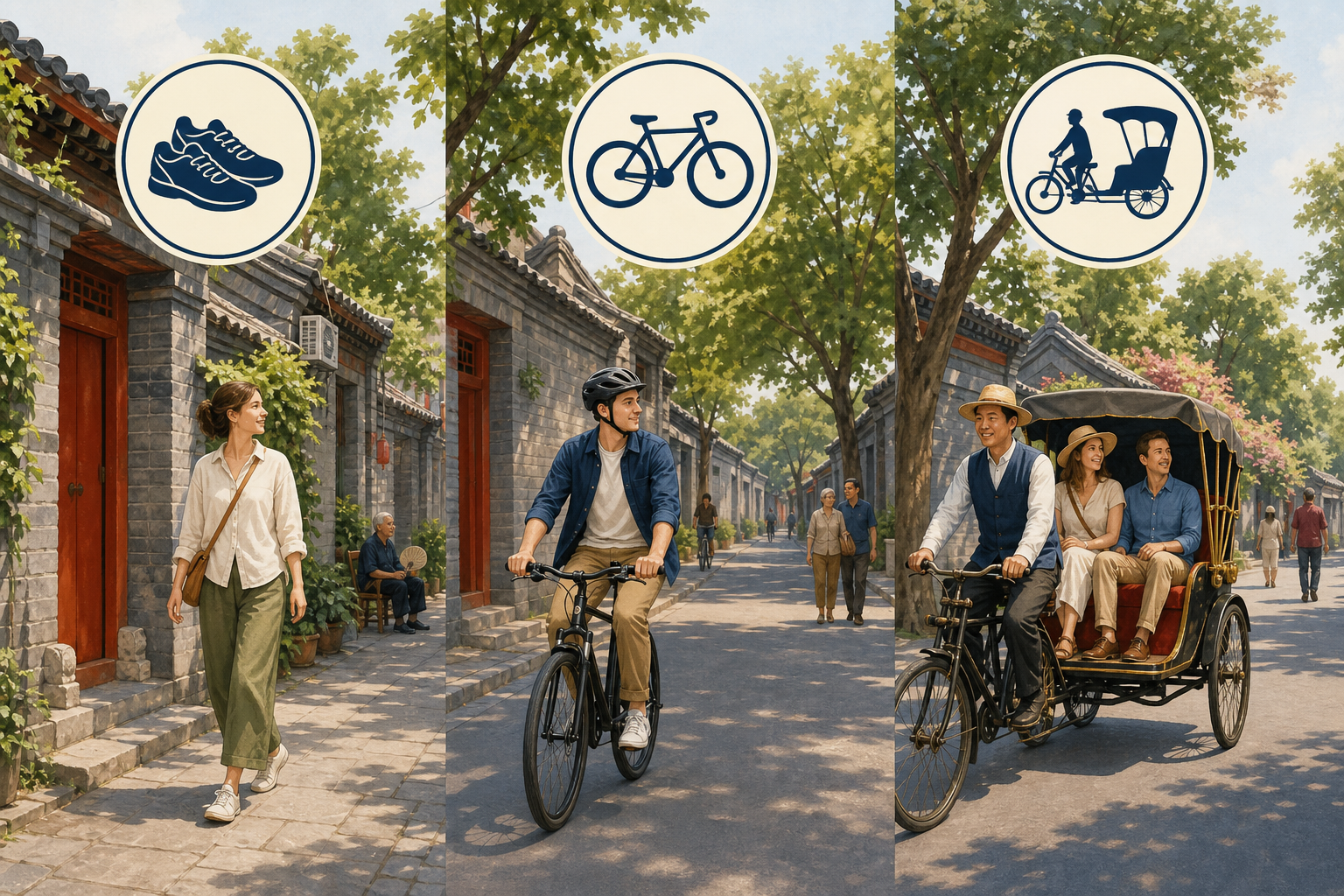
A guided hutong tour helps if you want the stories behind the doorways. Rickshaw rides through Shichahai are the classic option, running roughly 7:00 AM to 5:00 PM, with each loop lasting about 30 minutes. Official Shichahai rickshaw tours run around 120 RMB per person for a short loop up to 180 RMB for a 90-minute version.
Here is the warning that saves you money and stress. Do not flag down a random rickshaw on a street corner. The classic scam: a driver quotes "30," then after the ride insists it was 30 per person, or that 30 was only a deposit and the real fare is 300, or invents a "hutong entrance fee."
James, a retiree from Ohio, agreed to a 50 RMB ride near the Drum Tower and got a 400 RMB demand from an aggressive driver at the end. Always book a licensed tour through your hotel or a trusted operator, and get the total price in writing first.
Cycling is a fine middle ground. Bike-share apps like Meituan and HelloBike cover the city, and the flat lanes are easy to pedal. Just walk your bike on the busiest pedestrian stretches, where crowds make riding slow and rude.
Honestly, though, the best hutong tour is free: your own slow walk. Pick a lane, get a little lost, and follow the sounds of daily life. Duck into a courtyard cafe when your feet tire, and watch the neighborhood move at its own pace. If you would rather have a local guide handle logistics, our team can arrange one alongside your other bookings. A good guide unlocks stories you would walk right past, from which mansion hid a Qing spymaster to why one gate faces the wrong way.
How to get around the hutongs by metro
You never need a taxi for the hutongs, and you should not want one. Cabs get stuck outside the lanes, and the drop-off points are often a long walk from where you actually want to be.
The Beijing Metro drops you right at the door. Take Line 6 or Line 8 to Nanluoguxiang Station for both Nanluoguxiang and Mao’er Hutong. From the same station it is an 8-minute, 600-meter walk south to Prince Gong’s Mansion.
Line 8 also serves Shichahai Station for the lakes, while Line 2 stops at Hepingmen for Liulichang’s antique shops. A single ride costs 3 RMB and up depending on distance.
Pay with your phone. Alipay and WeChat Pay both run the metro QR code, and our guide to using Alipay in China as a foreigner walks you through setup before you land. For the wider network, see our trains and metro hub.
Frequently asked questions
What is a hutong in simple terms?
A hutong is a narrow lane in old Beijing lined with traditional courtyard houses called siheyuan. The word comes from a Mongolian term for "water well." Together, the lanes form the historic residential heart of the city, some over 700 years old.
Are Beijing hutongs free to visit?
Yes. Walking the hutongs themselves is completely free, including famous lanes like Nanluoguxiang, Wudaoying, and the Shichahai area. You only pay for specific attractions inside them, such as Prince Gong’s Mansion (30–40 RMB) or the Drum and Bell Towers (30 RMB combined).
How much time do I need for the hutongs?
Plan at least half a day. The lanes reward slow wandering, not a quick photo stop. A relaxed loop of Shichahai, Prince Gong’s Mansion, and the Drum Tower fills three to four hours. Add lunch in a courtyard restaurant and you have a full, unrushed afternoon.
Are the hutongs safe for tourists?
Very safe. Violent crime is rare and the lanes are busy and well-lit in tourist areas. The main risk is money scams, mostly unlicensed rickshaw drivers who inflate the fare after the ride. Agree on a total price in writing first, or book through your hotel.
When is the best time to visit the hutongs?
Go early (8:30–10:00 AM) or late afternoon to dodge crowds and harsh light, and aim for weekdays over weekends. Spring (April–May) and autumn (September–October) bring the best weather. Winter is quiet and atmospheric but cold, so dress in warm layers.
Do I need a visa to visit Beijing in 2026?
Many travelers can now enter visa-free. China offers a 240-hour (10-day) visa-free transit for eligible nationalities, and other short-stay waivers apply. Check the rules for your passport in our visa and entry hub before booking.
Before you go: your hutong action list
You are ready. Run through this quick list before you set out for the lanes.
- Set up Alipay or WeChat Pay for the metro and street snacks.
- Save Nanluoguxiang and Shichahai stations offline in your map app.
- Book any rickshaw or guided tour through a trusted source, never a street corner.
- Carry small cash as a backup and your passport for ticketed sights.
- Start early and wear comfortable shoes; you will walk more than you expect.
The hutongs are just one stop on a great China trip, and the smartest way to link Beijing with Xi’an, Shanghai, or the Great Wall towns is by high-speed rail. Let us handle the hard part: get a free quote and book your China train tickets here, and travel between cities without the queues. Once you land, our city guides help you plan the rest.
Sources for facts in this guide: Prince Kung’s Palace Museum official site, the Beijing municipal government tourism portal, and UNESCO on Beijing’s Central Axis World Heritage listing.
Featured image: “Hutong, BJ (2917153763).jpg” by Caitriana Nicholson from 北京 ~ Beijing, 中国 ~ China, via Wikimedia Commons, CC BY-SA 2.0.