
Shanghai December weather calls for a warm, adjustable outfit, not an expedition wardrobe. Pack a wind-resistant coat, removable mid-layers, comfortable closed shoes and light rain protection. Then use the forecast for your dates to decide whether to add thermals, gloves or a heavier insulated layer.
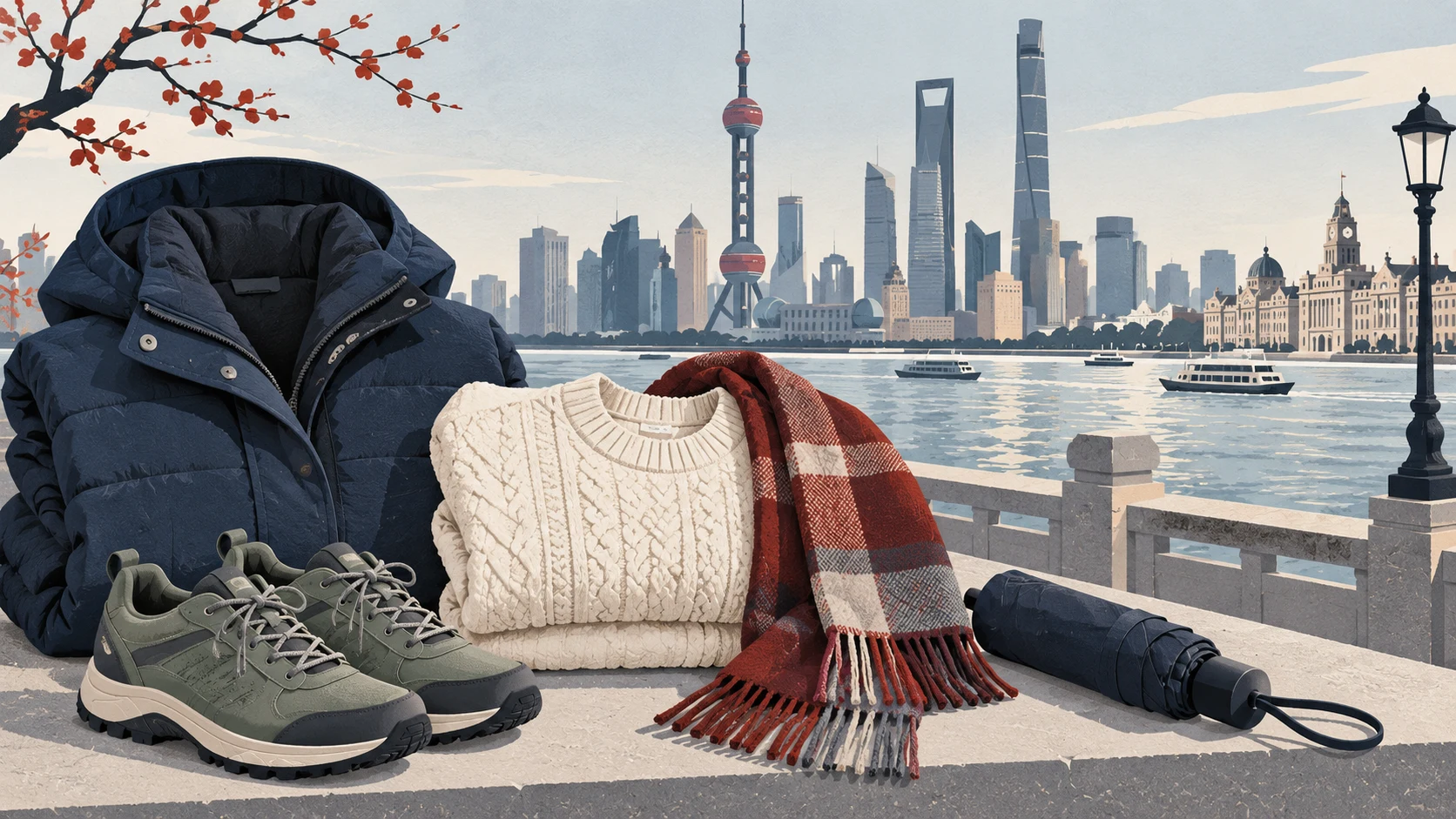
AI-generated editorial illustration, not a photograph or weather forecast.
The awkward part is moving between environments: an exposed waterfront, a crowded metro carriage, a heated shop and a hotel room with its own temperature controls. An outfit that adjusts between those settings is more useful than one chosen from a monthly temperature alone.
Shanghai December weather: averages are a starting point
For a point near central Shanghai, the NASA POWER climatology gives a December mean temperature of 7.04°C, about 45°F, for 1991–2020. This is a gridded long-term monthly average, not a citywide measurement for every neighbourhood and not a prediction for December 2026.
An average also hides day-to-day variation. Shanghai's 2025 statistical yearbook, using meteorological bureau data, records December 2024 with a mean of 7.9°C, a monthly extreme high of 20.3°C and an extreme low of 1.0°C. Those extremes describe that particular month. They are not the expected daily high and low for your visit.
Use the numbers for the decision they can support: December needs warm clothing with room to adjust. They cannot tell you whether your Bund walk next Thursday will be dry or whether a particular hotel room will feel warm.
For the actual trip, look at the forecast's morning and evening temperatures, wind, precipitation and any official warnings. A midday high alone is a poor guide if your main activity happens after dark.
What to wear in Shanghai in December
Start with three layers that fit comfortably together. The base layer should work indoors on its own. The middle layer supplies most of the adjustable warmth. The outer layer should reduce wind exposure and accommodate both without restricting your arms.
For a city sightseeing day, that might mean a long-sleeve top, a sweater or fleece, and a lined coat. If you tend to feel cold, a thermal base or packable insulated jacket gives more flexibility. This is clothing advice, not a claim that every visitor needs the same thickness of down jacket.
Try the complete outfit before packing. Sit, walk and raise your arms with the coat zipped. A heavy coat that only fits over a thin shirt can be less adaptable than a lighter coat with space for a warm middle layer.
Choose trousers you can walk in for several hours. Thermal leggings are optional for colder forecasts or long periods standing outdoors. For a dinner or business meeting, bring an indoor outfit that fits beneath the same outer layer instead of packing an entirely separate winter wardrobe.
The most useful small additions are a scarf, a compact hat and gloves. Keep them accessible in your day bag; accessories buried in a hotel suitcase do nothing during an unexpected cold evening.
Match your clothes to the activity, not just the temperature
The same forecast can produce different packing decisions depending on how the day is spent. The following is an editorial planning matrix, not a measured wind-chill table.
| Planned activity | Main clothing problem | Useful adjustment |
|---|---|---|
| Bund waterfront walk | Exposure and time outside | Wind-resistant outer layer; scarf and gloves within reach |
| Museum followed by shops | Repeated indoor–outdoor changes | Removable middle layer; a bag that can hold it |
| Long theme-park day | Standing and walking outdoors for longer periods | Warmer layering margin, tested shoes and spare dry socks |
| Neighbourhood cafés and short walks | Frequent stops in different indoor temperatures | Moderate layers rather than one cumbersome garment |
| Business meetings plus evening dinner | Indoor dress requirements and the return trip | Meeting outfit beneath a warm coat; comfortable transfer footwear |
Do not interpret the theme-park row as a prediction of queues or weather. It simply recognises that standing outdoors for a long time differs from walking ten minutes between cafés. Check Shanghai Disneyland's own information for the operating calendar and conditions affecting your date.
For a mostly indoor trip, leave room in your bag for a removed sweater. For an outdoor-heavy trip, leave room in your schedule for a warm break. Both are small changes that improve the whole day.
A compact Shanghai winter packing list
For a short stay, pack around repeated outfits and your laundry arrangements. The quantities below are a suggested starting set for a roughly four-to-seven-day city visit, not a requirement or a suitcase-weight guarantee.
| Item | Starting quantity | How to adjust |
|---|---|---|
| Warm coat that blocks wind | 1 | Wear it while travelling if luggage space is tight |
| Sweater or fleece | 2 | Choose layers that also work with your indoor clothes |
| Long-sleeve or thermal tops | 2–3 | Add rotation if laundry is unavailable |
| Comfortable trousers | 2 | Add an indoor business outfit only if needed |
| Walking shoes | 1 tested pair | Bring a second pair if wet-weather drying is a concern |
| Socks and underwear | Enough between washes | Add a dry sock pair for an outdoor day bag |
| Hat, scarf and gloves | 1 set | Adjust warmth to the forecast and your own comfort |
| Compact umbrella or rain shell | 1 | Choose the option you can actually carry on walks |
A bag with space for a coat or sweater is useful when moving indoors. A small sealed pouch can protect tickets, a paper hotel address and electronics from rain. Neither replaces a waterproofing guarantee from the bag manufacturer.
Keep medication, essential documents and the layer you need on arrival in your carry-on. If checked luggage is delayed, you should not have to buy an entire outfit before leaving the airport. The wider China packing checklist covers documents, electronics and other non-weather preparation.
Shoes, rain and the snow question
For most city itineraries, comfortable closed shoes with useful grip matter more than specialist snow boots. If rain appears in the forecast, choose a water-resistant upper or a second pair that lets the first dry. Do not take brand-new footwear simply because it looks more winter appropriate.
Shanghai's official seasonal overview describes snowfall as rare. That supports a practical distinction: snow is possible, but a normal December packing list should not be built around a guaranteed snowy city break.
If a cold spell or disruptive weather warning is issued for your dates, follow the current advice and revise outdoor plans. Do not rely on the long-term average to dismiss a warning.
An umbrella and a warm layer address different problems. A coat that is warm when dry may be unsuitable for prolonged rain, while a thin rain shell may need a sweater beneath it. Check the materials and fit of the items you already own before buying replacements.
Plan outdoor time and one indoor fallback
Put the outdoor activity you most want to do into a flexible daylight block. Keep an indoor option nearby rather than treating bad weather as a reason to cross the city repeatedly.
For example, a central-city day might pair a shorter Bund visit with an indoor stop around the same broad part of Shanghai. A neighbourhood walking day can become a shorter walk and a longer café break. These are route-design ideas, not promises that a venue will have availability.
If you choose a museum, confirm the specific branch, reservation requirement and opening date before travelling. The Shanghai Museum guide is a starting point, but “Shanghai Museum” is not enough information to identify your destination and entry arrangement.
The Shanghai winter itinerary covers wider sightseeing choices. Keep this article as the clothing and weather decision page rather than trying to squeeze a full itinerary into a packing guide.
Avoid fixing every outdoor activity to an exact hour weeks in advance. Choose one important reservation and let the less time-sensitive walking sections move around it.
Ask the hotel about heating before you book
Indoor comfort is a property-level question. Ask whether the particular room has working heating, whether you can control it, and whether a winter mode or other operating arrangement limits adjustment. A listing that says “air conditioning” does not, by itself, answer every one of those questions.
Recent winter reviews can suggest what to ask, but they are not a guarantee about the room assigned to you. Confirm directly if temperature control is important, especially for an apartment or smaller guesthouse.
Also consider the route from transit to the property. Carrying luggage a long way in rain is a different arrival experience from a short, sheltered walk. The Shanghai accommodation guide can help compare neighbourhoods; verify the actual building entrance separately.
On arrival, check the heating while staff are available. A clear question at check-in is easier than trying to resolve an unfamiliar controller late at night.
A forecast check that turns into packing decisions
Review your packing in three passes:
- When booking: use climate information to choose the general season and confirm accommodation heating. Do not treat a distant daily forecast as settled.
- Shortly before departure: examine temperatures across your actual activities, rain, wind and warnings. Adjust outerwear and footwear, not the entire wardrobe.
- Each morning: compare the day's forecast with the plan. Carry the accessories needed for the return journey as well as the warmest part of the afternoon.
If the day includes a late dinner, check the evening conditions. If the itinerary includes a full outdoor day, add flexibility for breaks. If heavy rain makes your original walk unattractive, use the prepared indoor option rather than trying to salvage every stop.
This is more actionable than asking whether December is “cold” in the abstract. The useful question is whether your clothes and schedule match the hours you will actually spend outdoors.
Frequently asked questions
How cold is Shanghai in December?
The NASA POWER 1991–2020 climatology for a point near central Shanghai gives a monthly mean near 7°C. Your actual day may be warmer or colder. Check daily highs, lows and wind for your dates instead of treating that mean as an outfit instruction.
Does Shanghai get snow in December?
Snow is possible but rare in the city's official seasonal description. Prepare for cool weather and possible rain; add snow-specific precautions only when the current forecast or warning calls for them.
Do I need a down jacket in Shanghai?
Not automatically. A wind-resistant coat and removable warm layers can work for many city visits. An insulated jacket is useful if you feel cold easily, have a colder forecast or plan long periods outside.
Can I visit the Bund at night in December?
You can plan an evening waterfront visit, but check current access notices and the forecast. Carry warm accessories and keep the walk adjustable. A long exposed walk is optional; it does not need to become the coldest part of your trip.
What should I wear for Shanghai Disneyland in December?
Plan for more outdoor time than on a museum-and-café day. Wear tested walking shoes and adjustable warm layers, carry rain protection if needed, and check the resort's current operating information. The forecast determines the final outfit.
Make the final choice from your itinerary
Shanghai December weather is manageable when your packing has a range. Bring layers that work together, footwear suited to the forecast, and a small set of accessories for exposed walks. Confirm hotel heating and keep one realistic indoor alternative. You do not need to pack for every imaginable winter; you need to pack for the trip you are taking.
Research checked 6 October 2026. This is a source-based planning guide, not a field-tested clothing review. Climate statistics are historical; forecast and venue conditions must be checked for the travel date.