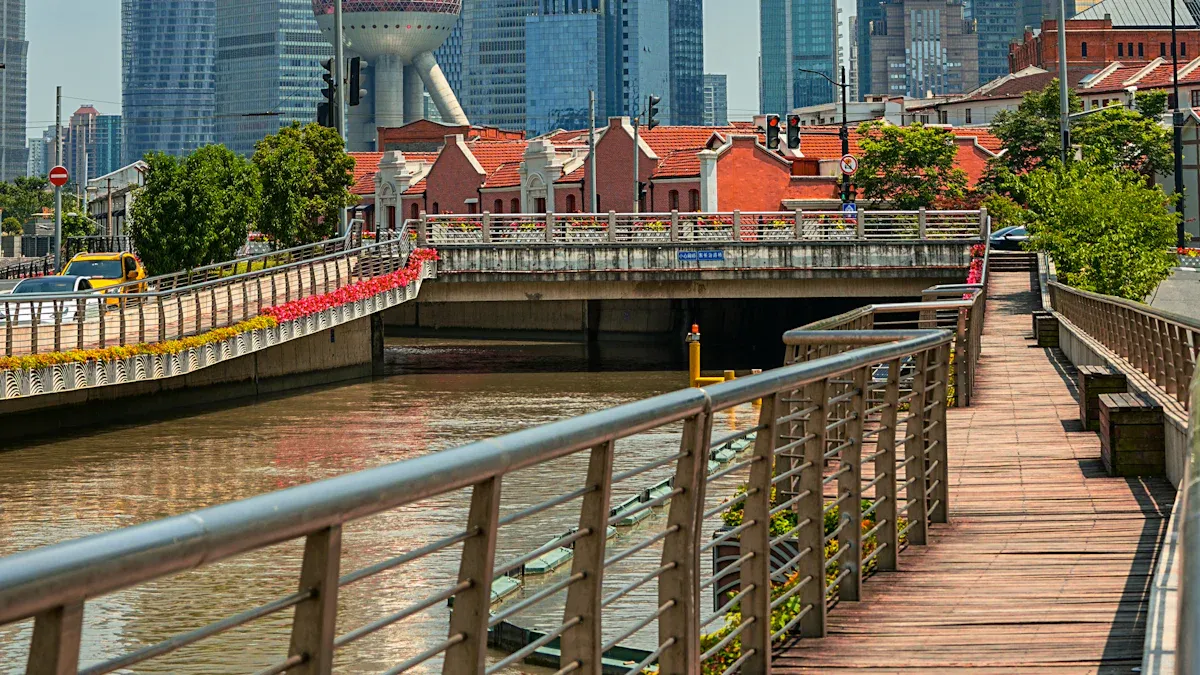
The Bund is Shanghai’s famous waterfront and old area. Its buildings show how the city has changed and mixed cultures. Local people enjoy life along the walkway. Here, history meets new energy. Visitors see many building styles. These styles come from different places and have special meanings:
| Architectural Style | Origin | Significance |
|---|---|---|
| Gothic | British architects | Shows colonial power and money history |
| Baroque | Foreign investors | Means mixing cultures and growing business |
| Neoclassical | International institutions | Shows Shanghai becoming a world money center |
Many people visit the Bund every year.
- In 2025, Shanghai had over 9.36 million visitors.
- More people stayed overnight, which means the Bund is more popular.
People see both old and new Shanghai here. The Bund gives a special look at the city’s spirit and growth.
Key Takeaways
- The Bund has many types of buildings. This shows Shanghai’s long history and how it has grown. Visitors can walk along the promenade and feel the busy energy. People do tai chi, shop, and eat there. The best time to go is in the late afternoon or evening. You can see great views and feel the lively mood. People work hard to keep the old buildings safe. This makes the Bund like a museum that is still alive. Many people visit the Bund every year. This shows it is important for Shanghai’s people and business.
Origins of the Bund
Early Days and Etymology
The word “bund” comes from Persian. It means “embankment.” Traders and merchants brought this word to Asia. In the 1800s, people in Shanghai started using “bund” for the city’s waterfront. This place became important after the Treaty of Nanking. Foreign countries got the right to trade and build by the river. The bund soon turned into a busy spot for business and travel. Now, “Bund Shanghai” stands for the city’s famous riverfront and its big part in world trade.
The name “bund” shows how languages and cultures mixed in Shanghai. It also reminds people that Shanghai has always been a meeting place for East and West.
Bund Shanghai and International Settlement
In the late 1800s, the bund changed fast. Foreign countries made settlements along the river. These places were called the International Settlement. The new settlers brought their own ways and building styles. They built banks, clubs, and offices that looked like ones in Europe. The International Settlement shaped Bund Shanghai in many ways:
- British settlers used the bund to show their culture and values.
- The area had parks and clubs for fun, so foreigners felt at home.
- The saying “I Believe in Shanghai” showed hope to make the city modern.
- The bund became a place where people from many countries met and did business.
The International Settlement also changed life for local people. Many Chinese lost access to the waterfront. The new buildings and rules made the area feel different from other parts of Shanghai. The bund became a sign of both progress and division.
Architectural Beginnings
The first buildings on the bund showed many styles. Architects from Europe and America designed lots of them. They used ideas from their home countries and from old buildings. The bund soon became famous for its european style building clusters. These clusters made the area look grand and modern.
| Architectural Style | Description |
|---|---|
| Eclecticism | Mixed styles, common in early bund buildings. |
| Romanesque Revival | Thick walls and rounded arches. |
| Gothic Revival | Pointed arches and detailed stonework. |
| Renaissance Revival | Inspired by ancient Rome and Greece. |
| Baroque Revival | Dramatic shapes and strong contrasts. |
| Neo-Classical | Symmetry and columns, like old temples. |
| Beaux-Arts | Classical look with modern touches. |
| Art Deco | Bold lines and bright colors, popular in the 1920s. |
Some of the most famous old buildings on the bund are:
- Great Northern Telegraph Building (No.7 Bund), built in 1908 by Atkinson & Dallas, Renaissance style.
- China Merchants Steam Navigation Company Building (No.9 Bund), built in 1901 by Morrison, Roman-inspired.
- HSBC Building (No.12 Bund), built in 1923 by Palmer & Turner, Beaux-Arts style.
- Russo-Chinese Bank Building (No.15 Bund), built in 1902 by Heinrich Becker, Beaux-Arts style.
- Chartered Bank Building (No.18 Bund), finished in 1923, Neoclassical style.
- Palace Hotel (No.19 Bund), finished in 1906, Renaissance style.
- North China Daily News Building (No.17 Bund), built in 1924 by Lester, Johnson & Morriss, Modernism and Neo-classicism.
The bund grew as a waterfront area for many reasons:
- There were many docks and warehouses for ships and trade.
- The city built a public plaza and walkway for people to enjoy the river.
- State-owned companies worked together to help the project.
- The bund changed old factory land into a lively city space.
- New mixed-use buildings brought more business and life to the area.
Today, people can visit the bund and see these old buildings up close. The mix of styles and stories makes the bund a living museum of Shanghai’s past.
20th Century Bund
Economic Growth and Expansion
The Bund changed quickly in the early 1900s. Shanghai became a big place for trade and money. Many banks and companies opened offices by the river. People from many countries came to work and do business. The Bund showed how the city was growing. Ships moved on the Huangpu River, bringing goods and people. The area got busy with workers, traders, and visitors. At night, lights from old buildings shined on the water. The Bund became a sign of Shanghai’s modern spirit.
War, Revolution, and Change
In the 1930s and 1940s, war and revolution changed Shanghai. Foreign powers lost control of the Bund. Local leaders took over the area. Many businesses closed or moved away. The Bund lost some of its old energy. People had hard times, but the river still brought hope. After the revolution, the government used the Bund for new things. Some buildings became offices for state companies. The city started to rebuild and get better. The Bund stayed a place for people to gather and remember the past.
Preservation Efforts
In the late 1900s, leaders saw the Bund’s old buildings were special. They wanted to protect the history and beauty of the area. Many groups worked together to save the Bund:
- Shanghai Municipal Government
- Authorized heritage institutions
- Academic institutions
- Design institutions
- Construction companies
These groups made plans to fix old buildings and keep the Bund safe. They learned the best ways to repair and use the historic buildings. The Bund became a big part of Shanghai’s tour experience. Visitors could walk by the river and see the Huangpu. Preservation efforts helped the Bund stay lively and important for locals and tourists.
Modern Bund Shanghai
Revitalization and Restoration
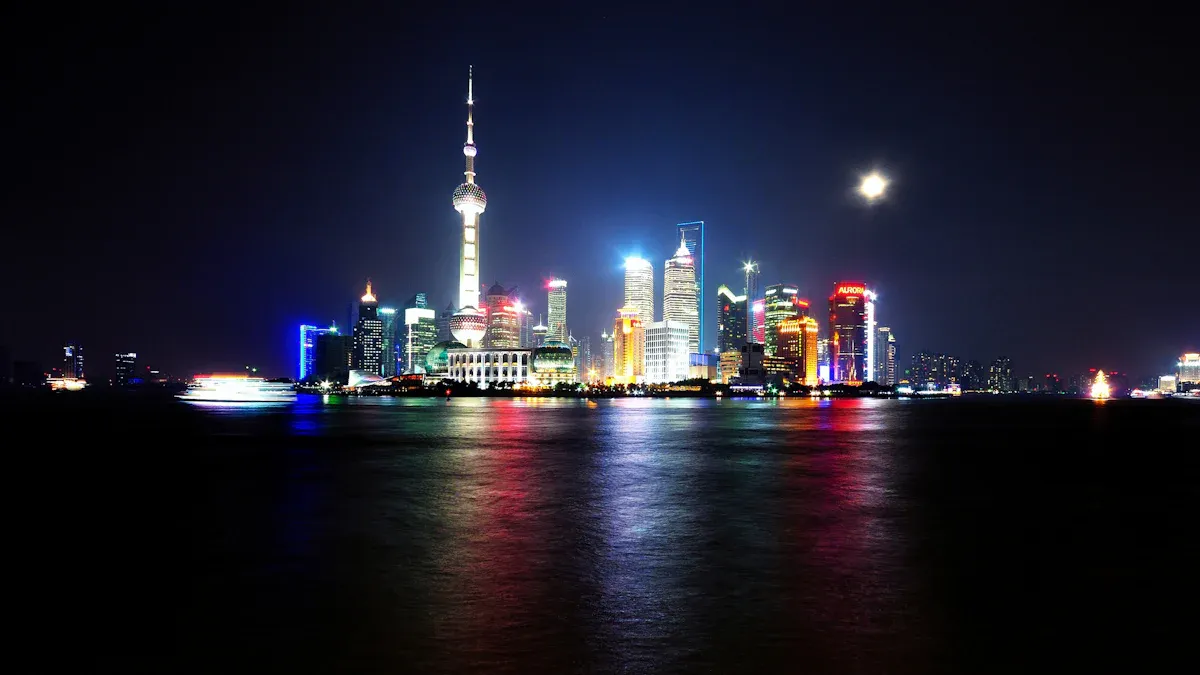
Since the 1990s, Shanghai has worked to improve the bund. Old buildings were fixed up and now have shops, restaurants, and clubs. The Rockbund project is a big example. It focuses on the Waitanyuan area. Buildings from 1900 to 1933 became a busy place for culture and business. These changes keep history alive and help the city today.
Cultural and Social Life
The bund is not just for seeing old buildings. It is a place where people meet. Locals and visitors gather at Chen Yi Square. In the morning, people exercise and practice martial arts or Tai Chi. On Saturday nights, concerts bring music and excitement. The promenade by the huangpu river gives a nice view. People walk, talk, and enjoy the city there. Events and activities help everyone feel part of the community.
- Chen Yi Square has morning exercises and concerts at night.
- The promenade is good for social events and meeting people.
- Tourists and locals use the area to relax and have fun.
Iconic Landmarks on the Huangpu
The bund is about 1,100 meters long along the huangpu river. More than 20 old buildings stand by the river. Each building shows a style from a different country. Since 1843, this area helped shanghai grow in trade and finance. The buildings show ideas from Britain, America, Japan, Italy, and Germany. Some famous landmarks are:
| Landmark | Description |
|---|---|
| Fairmont Peace Hotel | An Art Deco hotel that shows the rich colonial times. |
| Customs House | A clock tower like London’s Big Ben, showing world trade. |
| Jiang Hai Customs Building | Built in the 1920s, now used by Shanghai Customs, showing old architecture. |
| HSBC Building | The biggest building on the bund, showing money power. |
| Asia Building | Once the tallest, it was the office for the British Asia Petroleum Company. |
| The Bund Lover’s Wall | A romantic place by the river, showing the area’s culture. |
These landmarks let visitors see shanghai’s history and today’s life.
Visiting the Bund Today
Attractions and Activities
The Bund is a top place to visit in Shanghai. People can have fun here all year. It is a great spot for both travelers and locals. You can walk by the river or join a tour. There are many famous places to see. The Bund has old buildings, new shops, and places to eat. Many people take a Huangpu River cruise to see the city in a special way. The Bund Sight Seeing Tunnel is a fun trip under the river. In the morning, locals do tai chi or go jogging. People who love taking pictures come at night. The old buildings light up and look amazing.
Top-rated attractions and activities:
- Walk along the Bund
- East Wind Hotel
- Shanghai Pudong Development Bank
- North & South Building of Peace Hotel
- Huangpu River Cruise
- Bund Sight Seeing Tunnel
- Huangpu Park
- Morning Exercise
- Shopping
- Photography
- Places to Eat
- Getting to the Bund
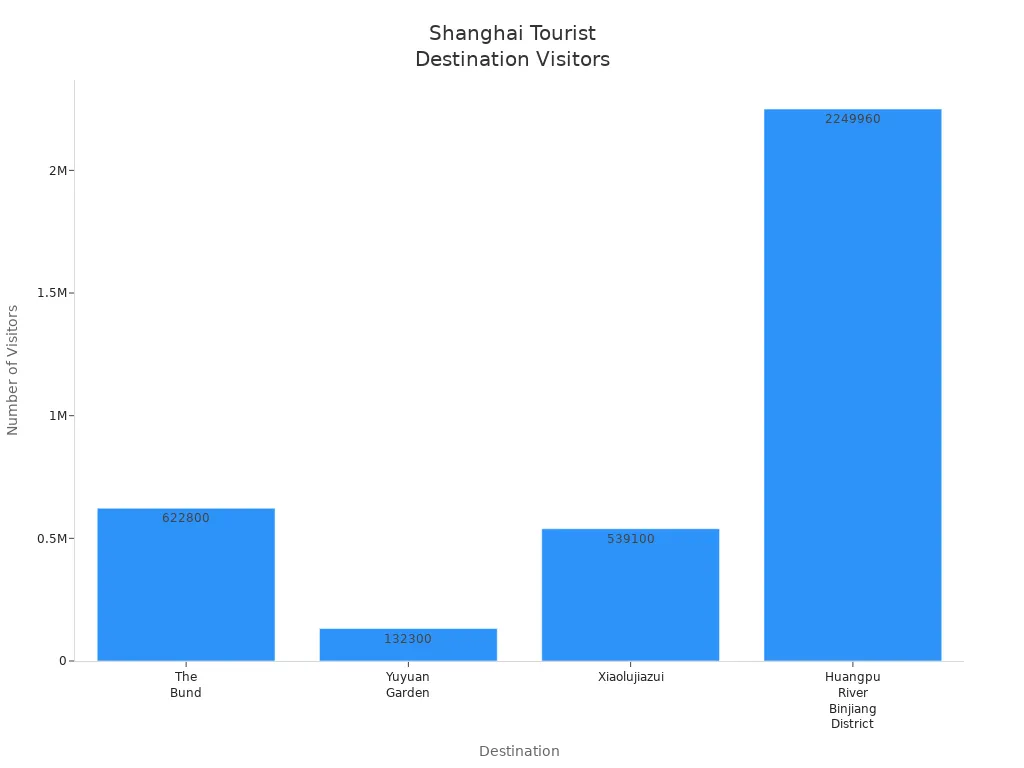
Shanghai gets millions of tourists every year. The Bund has more visitors than other famous places in the city. The table below shows how popular the Bund is compared to other spots.
| Destination | Visitors |
|---|---|
| The Bund | 622,800 |
| Yuyuan Garden | 132,300 |
| Xiaolujiazui | 539,100 |
| Huangpu River Binjiang District | 2,249,960 |
Walking the Huangpu Promenade
The promenade is 1.5 kilometers long by the Huangpu River. You can see 52 old buildings from the 1800s and 1900s. The HSBC Building is the most famous one. The Customs House has a clock tower that rings every hour. The Peace Hotel shows Art Deco style and history. Bund 18 has fancy shops and places to eat. Sassoon House has a nice rooftop terrace. At 7:00 PM, there is a light show. The skyline has tall buildings like Shanghai Tower and Oriental Pearl Tower. It looks beautiful at night.
Notable sights along the promenade:
- HSBC Building
- Customs House
- Peace Hotel
- Bund 18
- Sassoon House
- Light show at 7:00 PM
- Views of Shanghai Tower and Oriental Pearl Tower
The promenade is flat and easy for wheelchairs. People with disabilities can visit without trouble. Locals use the walkway for exercise and meeting friends. Mornings are quiet and pretty. At night, the lights are bright and the area is busy.
Tips for Visitors
The best time to visit the Bund is late afternoon or early evening, from 4 to 8 PM. Sunset brings nice colors and starts the light show. Weekdays are less crowded and more peaceful. Weekends and holidays are busier. Spring and autumn are good for walking because the weather is nice. Early mornings are calm and the river view is clear.
Tip: Go on weekdays for a quieter visit. Spring (March–May) and autumn (September–November) have the best weather.
Tourists should follow local customs. A small bow or nod is polite when greeting people. Hugs or kisses in public are not common. If you visit someone’s home, bring a small gift wrapped in red or gold. Give the gift with both hands. Do not give red or white flowers or an odd number of gifts.
The Bund is easy to get to by subway, taxi, or bus. You can shop, eat, and see sights all in one place. Locals come for morning exercise, tai chi, and to meet friends. The Bund is always full of life for everyone.
The Bund used to be a busy trading port. Now, it is a lively place in Shanghai. People see old and new buildings together. Some buildings are Neoclassical, and some are Art Deco.
| Architectural Style | Description |
|---|---|
| Neoclassical | This style is from the colonial times. Many buildings on the Bund have it. |
| Beaux-Arts | These buildings look grand and have lots of details. |
| Gothic | They have pointed arches and fancy patterns. |
| Baroque | The shapes are bold and the shadows stand out. |
| Art Deco | These buildings have modern lines and bright colors. |
- The Bund’s story shows how Shanghai grew in culture and business.
- People can walk by the river and see the skyline.
- You can feel the city’s history here.
- The Bund makes visitors want to explore and learn more about its past.
FAQ
What is the best time to visit the Bund?
Most visitors enjoy the Bund in the late afternoon or early evening. The sunset and city lights create a beautiful view. Weekdays feel less crowded. Spring and autumn offer comfortable weather.
Can people visit the Bund at night?
Yes, the Bund stays open all night. Many people come after dark to see the skyline and light show. The area feels safe and lively in the evening.
Are there any free activities on the Bund?
Visitors can walk along the promenade, watch the river, and see historic buildings for free. Locals often exercise or take photos. The Bund offers many sights without any cost.
How do people get to the Bund?
Travelers can reach the Bund by subway, bus, or taxi. The nearest subway station is East Nanjing Road. Signs help visitors find the riverfront easily.